
Overhead Press vs Lateral Raises Muscles Worked, By EMG Data
Lateral raises torch your shoulders, but overhead presses build more visible mass—here's the EMG breakdown of exactly which muscles each move recruits, and why the difference matters for your program.
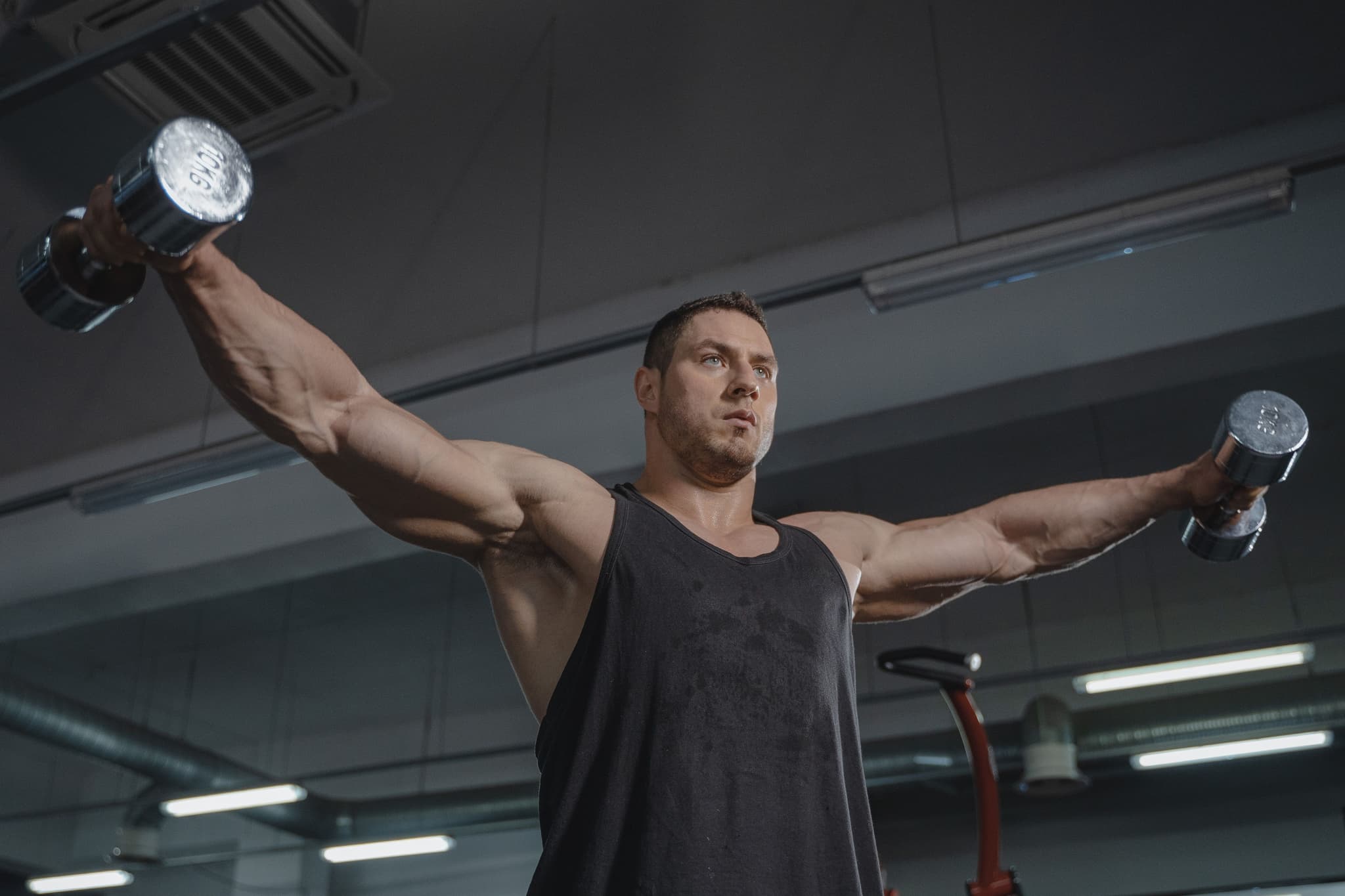
If your shoulders feel torched after lateral raises but your overhead press builds more visible mass, the EMG data explains why. The question of which muscles each exercise works—and how overhead press vs lateral raises muscles worked differs in practice—gets waved off too often with "both hit the shoulders," an answer that gives you nothing to program from.
The electrode readings tell a sharper story.
Medial deltoid activation lands close between the two lifts, with the lateral raise at 30.3% MVIC and the overhead press at 27.9% MVIC, a gap of about 2.4 percentage points. That's close enough that either exercise builds that muscle just fine. Posterior deltoid activation splits the two lifts further apart: the lateral raise hits 24% MVIC for the posterior deltoid, while the overhead press reaches 11.4% MVIC, more than double. That gap should decide which exercise gets priority depending on your goal.
Below: the muscle-by-muscle numbers, why EMG studies don't always agree with each other, and how to program both lifts once you know what the data actually says.
Overhead Press vs Lateral Raises Muscles Worked: The Quick Answer
When comparing overhead press vs lateral raises muscles worked, the key difference is this: the overhead press recruits more total muscle mass through a compound push pattern, while the lateral raise isolates the middle deltoid with surgical precision.
EMG research directly comparing these exercises found that both the lateral raise and shoulder press produce significantly higher medial deltoid activation than isolation movements like the bench press or dumbbell fly (Campos et al., 2020, Journal of Human Kinetics).
Exercise | Primary Muscles | Secondary Muscles | Best For |
Overhead Press | Anterior deltoid, medial deltoid | Triceps, upper traps, serratus anterior, core stabilizers | Building total shoulder mass and pressing strength |
Lateral Raise | Medial deltoid | Anterior deltoid, upper traps | Widening shoulder appearance, isolating the middle delt |
The press is a systemic exercise. It loads your front delt hard, calls in your triceps to lock out the weight overhead, and forces your core and upper back to stabilize a bar traveling in a straight vertical line.
The lateral raise strips almost everything else away. Your arm moves through a single plane, your elbow stays fixed, and the resistance curve places most of the tension on the middle deltoid fibers responsible for that rounded, capped-shoulder look.
Neither exercise replaces the other. They target overlapping muscle groups from different angles, which is exactly why the comparison matters for anyone building a shoulder workout.
Muscle-by-Muscle Breakdown: What Each Exercise Actually Trains
Shoulder exercises rarely train "the shoulder" as one unit. Both the overhead press and lateral raise split their work across five or six muscle groups, and the numbers show exactly where that work goes.
Anterior Deltoid: 33.3% MVIC
The overhead press produced significantly higher anterior deltoid activation at 33.3% MVIC, compared to the lateral raise at 21.2% MVIC. The pressing motion drives the arm straight overhead, and the front head of the deltoid does most of the work through that path. Lateral raises add some anterior deltoid activity, but nowhere near as much, unless the arms drift forward and the movement turns into a front raise.
Medial Deltoid: 30.3% MVIC
The lateral raise produced 30.3% MVIC in the medial deltoid, compared to the overhead press at 27.9% MVIC. That's closer than most lifters expect. The lateral raise gets there with far less external load, since it isolates the joint action instead of splitting work with the triceps and traps. Pound-for-pound moved, the raise squeezes more out of the middle head.
Posterior Deltoid: 24% MVIC
The lateral raise produced significantly higher posterior deltoid activation at 24% MVIC compared to the overhead press at 11.4% MVIC. Elbow and shoulder rotation matter more than grip here. EMG research shows posterior deltoid activation increases when the lateral raise is performed with internal rotation, compared to neutral or external rotation variants. That rotation angle is something the vertical press path simply can't replicate.
Upper Trapezius and Serratus Anterior: The Stabilizer Story
Upper trapezius activation runs high in both lifts because the scapula has to elevate and rotate to support arm movement overhead in the press and out to the sides in the raise. The serratus anterior works alongside it, stabilizing the scapula against the load. That stabilizing role tends to matter more during the press, where the axial load on the shoulder joint runs heavier.
Upper Chest (Pec Major): Where Grip and Bar Path Matter
The clavicular head of the pec major picks up some activation during the overhead press, largely dictated by grip width and bar path. A closer grip with the bar traveling slightly forward of the ears tends to increase pec involvement. Lateral raises produce almost no pec activity regardless of technique, since the movement plane doesn't load the chest at all.
Rotator Cuff: The Unsung Stabilizers in Both Lifts
Supraspinatus and infraspinatus activity stays moderate but fairly consistent across both shoulder exercises. These muscles aren't prime movers in either lift. They keep the humeral head seated in the socket while the deltoid does the visible work, which is why cuff fatigue often shows up before deltoid fatigue on high-volume shoulder days.
Exercise | Primary Muscles | Secondary Muscles | Best For |
Overhead Press | Anterior Deltoid (33.3% MVIC), Upper Trapezius | Medial Deltoid (27.9% MVIC), Pec Major, Rotator Cuff | Heavy pressing strength, front shoulder development |
Lateral Raise | Medial Deltoid (30.3% MVIC), Posterior Deltoid (24% MVIC) | Anterior Deltoid (21.2% MVIC), Rotator Cuff | Shoulder width, rear delt balance, isolation work |
Line these numbers up side by side, and the case for training overlap between these two lifts looks thinner than most people assume.
Do Overhead Press and Lateral Raises Work the Same Muscles?
No. The overhead press and lateral raise don't work the same muscles to the same degree, but the size of that gap depends on how a study is set up. Two labs can test the same two exercises and land on different conclusions because load, grip, and electrode placement all shift the readout.
Load Percentage Changes the Picture
A press done at 60% of your one-rep max recruits differently than one done at 85%. Heavier loads on the overhead press push anterior and medial deltoid activation closer together, which is part of why some studies report more overlap between the two lifts than others. Lighter loads on lateral raises tend to isolate the medial delt more cleanly since stabilizer demand drops.
Bar Path: Front Press vs Behind-the-Neck Press
Where the bar travels changes which fibers do the work. In a study of competitive bodybuilders, medial deltoid activity ran higher during the behind-the-neck barbell press than the front version, and posterior deltoid showed the same pattern.
Pectoralis major, by contrast, showed greater activity in the front press than the behind-the-neck version.
Anterior deltoid activity was also higher in the behind-the-neck press than the front press during the lowering phase. Grip width and bar path decide which fibers carry the load, so a single number for "overhead press" activation doesn't hold across variations.
Isolated Movement vs Compound Recruitment
The lateral raise is a single-joint movement with almost no compound assistance, so EMG readings there stay more consistent from study to study. The overhead press recruits the anterior, medial, and posterior deltoid along with the upper trapezius, pectoralis major, and triceps brachii, so small changes in stance, grip width, or scapular position introduce more variability in the readout.
Treat any published activation percentage as a range tied to a specific load and bar path, not a fixed number you can apply to every version of the lift.
Overhead Press vs Lateral Raises for Shoulder Width and Strength: Which Builds Better Shoulders
You don't need another "it depends" answer here. The data points in two different directions, depending on what you're chasing. Pick your goal and follow the numbers.
For Strength and Pressing Power: Overhead Press Wins
If you care about raw pressing strength, overhead vertical push capacity, or building a shoulder that transfers to bench and athletic movement, the overhead press is the clear choice. It loads the anterior deltoid, triceps, and upper pecs together under heavier weight than a lateral raise ever will. The overhead press recruits stabilizer muscles that lateral raises don't engage, producing higher total muscle activation across multiple muscle groups because of the load demand.
For Shoulder Width: Lateral Raise Wins on Efficiency
If your goal is the wide, capped look, the lateral raise gets there faster per set. The medial deltoid is the muscle most responsible for shoulder width, and the overhead press trains it less directly than a dedicated raise does. A thesis from the University of Wisconsin-La Crosse tested EMG activity across ten shoulder exercises using experienced lifters at 70% of 1RM. The study found that anterior deltoid activation differed significantly between the dumbbell shoulder press and other exercises, while medial deltoid activation showed no significant difference across all ten movements tested. What lateral raises do offer is a break from the anterior deltoid and triceps fatigue that limits how many productive reps you get on a press.
Overhead Press vs Lateral Raises: Workout Order for Shoulder Development
Doing both makes sense. Press first while your anterior deltoid and triceps are fresh, since that's where the heavy loading happens. Save lateral raises for after, when you can isolate the medial delt without pressing strength holding you back.
Rep ranges and load selection shift these numbers further, and that's next.
Don't Forget the Arms: Triceps and Upper-Arm Activation Compared
The keyword search brings people here for shoulders, but your arms are doing more work than you'd think, at least in one of these two lifts.
Why Overhead Press Trains the Triceps as a Secondary Mover
The overhead press is a compound movement that works multiple joints and muscle groups. The shoulder joint drives the lift, but the elbow has to extend fully to lock the weight out overhead, and that's the triceps' job. This arm activation during the overhead press is substantial enough to matter for your training plan.
EMG data compiled in a Sensors (MDPI) review puts triceps brachii activation during the overhead press in the 50-65% MVIC range, depending on grip width and load. The triceps take on real work during lockout, not just a token assist. That's why coaches often program triceps-specific work lighter on days that include heavy overhead pressing. The muscle already took a hit.
This also answers what muscles the overhead press works besides the shoulders. The triceps get real work, and so do core stabilizers and upper traps, all riding along on a single push pattern.
Why Lateral Raises Barely Touch the Arms
The lateral raise is built differently. The elbow stays fixed at a slight bend for the entire rep, so the triceps and biceps do almost nothing beyond holding that joint angle steady.
An EMG study on lateral raise variations published in Sensors (MDPI) measured triceps brachii activity using surface electromyography and found it consistently low compared to the deltoid muscles doing the actual lifting. Triceps activation during lateral raises sits in the single digits to low teens as a percentage of MVIC. That's the tradeoff of an isolation exercise. Programming both lifts covers more ground for upper-body training than doubling down on either one alone.
How to Program Overhead Press and Lateral Raises Based on the EMG Data
Numbers only help if you turn them into sets and loads. Here's how to apply what the EMG readings actually mean on the gym floor.
Overhead Press: Load and Frequency for Strength Carryover
Anterior deltoid activation climbs with load, so the overhead press earns its spot as a heavier, lower-rep movement. Program it at 70-85% of your one-rep max for 4-6 reps, 3-4 sets, twice a week if shoulder strength is a priority. Recovery matters here too. The anterior delt and triceps both take real fatigue from a heavy press session, so stacking max-effort days back-to-back will blunt your numbers. Give at least 48 hours between heavy sessions.
Lateral Raises: Rep Ranges That Match Isolation-Muscle Fatigue
The medial deltoid responds to time under tension more than raw load, which is why lateral raises work best in the 12-20 rep range at lighter loads (30-50% of what you'd use on a compound lift). Three sets, 2-3 times weekly, is enough to drive growth without overloading the rotator cuff.
Overhead Press vs Lateral Raises: Quick Reference
Exercise | Primary Muscles | Secondary Muscles | Best For |
Overhead Press | Anterior deltoid, triceps | Upper chest, core | Strength, pressing power |
Lateral Raise | Medial deltoid | Anterior deltoid, rotator cuff | Shoulder width, isolation |
Putting Both in One Shoulder Workout
Overhead press: 4 sets × 5–6 reps @ 75–80% 1RM
Lateral raise: 3 sets × 15 reps @ moderate load
Order: press first, raises second. Fatigue in the medial delt won't tank your press numbers the way pre-fatigued anterior delts would.
SHRED's app tracks these thresholds automatically, adjusting your load percentage and volume as your press strength and raise endurance shift week to week. That takes the guesswork out of when to add weight versus when to add reps.
Overhead Press vs Lateral Raises: Frequently Asked Questions
Can lateral raises replace the overhead press?
No. Lateral raises isolate the middle deltoid but don't build pressing strength. The overhead press engages different movement patterns: shoulder flexion recruits the clavicular head of the pec major, and elbow extension activates the triceps—muscles lateral raises never work. If you need vertical pushing power, you need to press.
Should you do overhead press or lateral raises first in a workout?
Press first. It's a compound lift that demands fresh triceps and a rested nervous system. Lateral raises only move one joint, so fatigue matters less there. Save them for after you've pressed.
Is the overhead press a compound or isolation exercise?
Compound. It moves the shoulder and elbow joints simultaneously. The shoulder flexes and rotates internally through the anterior deltoid and clavicular pec, the elbow extends through triceps contraction, and once the arm passes 60 degrees of flexion, the serratus anterior and trapezius move the scapula. Research on shoulder exercises confirms that athletes need a variety of movements—both compound presses and isolation raises—to train the deltoid effectively, which is why these two lifts serve different jobs in a program.
Still deciding how to split these two lifts across your week? The programming breakdown above covers sets, load, and order in more detail.
The Bottom Line
EMG data shows how overhead press vs lateral raises muscles worked differ in practice. Research comparing these shoulder exercises found that both recruit the anterior and medial deltoid more than bench press or dumbbell fly, but each targets the deltoid differently.
The medial deltoid shows significantly higher activity during the lateral raise and shoulder press compared to the bench press and dumbbell fly. Studies on overhead pressing show it recruits the anterior deltoid, triceps, and stabilizing muscles in a compound chain that builds pressing strength you can use on a bench or an athletic field. The lateral raise isolates the middle deltoid instead.
A lateral raise excites the medial deltoid more than a frontal raise at a similar relative load. Abduction on the lateral plane proves more effective than frontal abduction for that muscle. That's the width that makes shoulders look built from the front.
Neither exercise substitutes for the other. The press builds capacity. The raise builds shape.
If you want both without guessing at ratios or sets, SHRED's app programs shoulder routines around these activation patterns, pairing press volume with raise isolation in the sequence the research supports. Open the app, follow the plan, and train off data instead of guesswork.
Related Articles
Dumbbell Arm Exercises for Beginners: Why Free Weights Beat Cables
Cables feel safer, but they hide the mistakes that matter most. See why dumbbell arm exercises beginners should master first build real strength, better balance, and honest form fast.
Step-Ups for Hamstrings: Box Height, Stance & Form Guide
Are step-ups actually a hamstring exercise, or just quads in disguise? Here's how box height, stance, and hip hinge decide the answer.
7 Progressive Overload Mistakes Beginners Make (and Fixes)
Stalled lifts? You might be making one of these 7 progressive overload mistakes beginners make without realizing it. Get the symptoms, causes, and exact fixes before it costs you months.