
Cable Curls vs Barbell Curls vs Dumbbell Curls: Full Breakdown
Biceps have two heads and three angles of attack, and your equipment choice changes everything. This breakdown uses EMG data to settle cable curls vs barbell curls vs dumbbell curls once and for all.
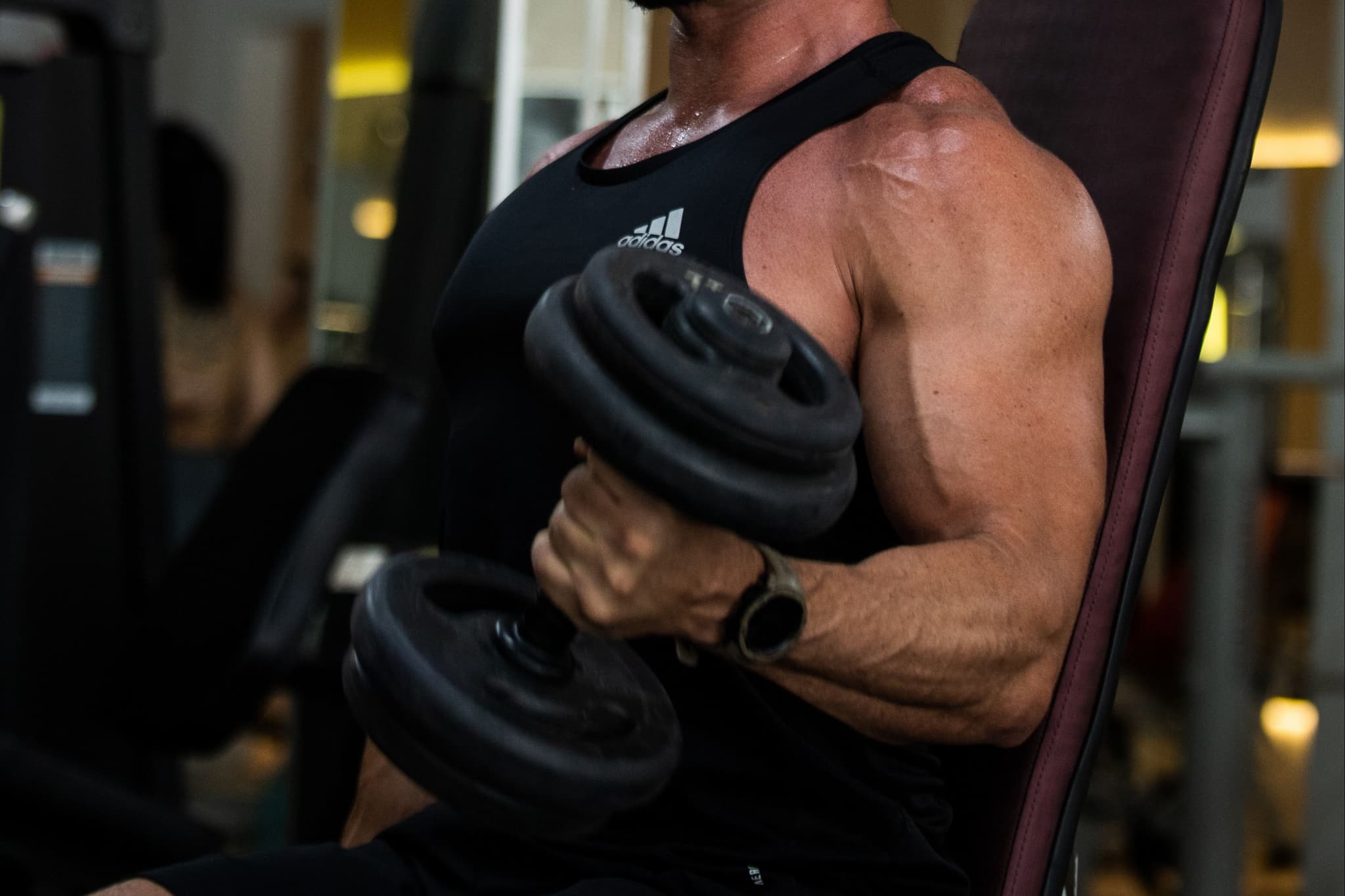
Your biceps have two heads, three angles of attack, and zero loyalty to whatever equipment you grabbed first at the gym. That's the problem with most cable curls vs barbell curls vs dumbbell curls comparisons out there. They pick a favorite, then mention the other two in passing.
This one doesn't work that way. You're getting a real breakdown of what each tool does to your long head and your short head. You'll also see the exact points in the rep where your biceps stop working and start coasting. We'll back it with EMG data instead of gym-bro opinion. By the end, you'll have an actual program that uses all three of these bicep curl variations on purpose.
The cable curls vs barbell curls vs dumbbell curls question won't feel like a debate anymore. You'll know which one to grab based on what you're actually training for that day.
Cable Curls vs Barbell Curls vs Dumbbell Curls: The Quick Answer
Tool | Tension Curve | Load Potential | Joint Stress | Muscle Emphasis |
Cable Curl | Constant, even at lockout | Moderate | Low | Biceps peak + brachialis, steady pump |
Barbell Curl | Heaviest at mid-range, drops at top/bottom | Highest | Moderate to high on wrists | Overall mass builder, biceps brachii |
Dumbbell Curl | Peaks mid-rep, allows rotation | Moderate | Low to moderate | Biceps + brachialis, unilateral balance |
When comparing cable curls vs barbell curls vs dumbbell curls, the choice depends on your goal. Barbell curls let you load the most weight for raw strength. Dumbbells let each arm work independently and allow your wrist to rotate naturally through the movement. Cables keep tension on the biceps from bottom to lockout, something free weights can't do because gravity pulls straight down instead of along the muscle's line of pull.
No single curl variation builds bigger arms by itself. Barbells are the mass builder when you want to move heavy weight. Dumbbells train each arm on its own and give you unilateral balance. Cables maintain constant tension throughout the range of motion, including at the top of the rep—a key difference from free-weight bicep curl variations. Most lifters who train arms seriously use two or three of these in the same program and shift the emphasis depending on whether they're chasing strength or a pump.
The Biomechanics of Cable Curls vs Barbell Curls vs Dumbbell Curls: Long Head vs Short Head vs Range of Motion
Your biceps brachii isn't one muscle doing one job. It's two heads with different attachment points, and each one grows for a different reason.
The long head runs along the outside of your arm and crosses the shoulder joint. The short head sits on the inside, closer to your chest, and stays largely out of shoulder mechanics.
The biceps brachii is a stronger elbow flexor when the forearm is supinated, and a stronger forearm supinator when the elbow is flexed. Cadaver research on the distal biceps tendon backs up why grip matters: the long head's moment arm was significantly higher in supination, while the short head had a significantly higher moment arm in neutral and pronation.
Comparison Table: Cable vs Barbell vs Dumbbell Curls
Factor | Cable Curl | Barbell Curl | Dumbbell Curl |
Tension Profile | Constant throughout range | Heavy at bottom, lighter at top | Variable; heaviest mid-range |
Load Potential | Moderate | Highest | Moderate to high |
Joint Stress | Low (fixed path) | Moderate to high | Moderate (stabilization required) |
Long Head Emphasis | High (arm position away from body) | Moderate | High (with proper spacing) |
Short Head Emphasis | Moderate | High (close grip) | Moderate to high |
Barbell Curls: Where the Long Head Gets Overloaded
The barbell curl is the loading champion among cable curls, dumbbell curls, and barbell curls. A fixed, straight (or EZ) bar keeps both hands moving in a synchronized path, so there's no stabilization tax and no wasted energy correcting for independent arm paths.
Why Barbell Curls Let You Lift Heavier Than Dumbbells or Cables
The barbell curl locks your grip width and rep path, so your nervous system commits fully to the concentric pull instead of splitting attention between lifting and balancing. Most lifters curl 20 to 30 percent more weight on a barbell than they can manage per arm with dumbbells.
More load through the same range of motion means more mechanical tension on the long head, the portion of the biceps that runs along the outer arm and crosses the shoulder joint. Heavier straight-bar curls bias that long head hard, especially through the bottom third of the rep where the shoulder is more extended.
A 2018 PeerJ study compared straight-bar, EZ-bar, and dumbbell curls. Researchers detected a higher activation profile of both biceps brachii and brachioradialis during the EZ-bar curl compared to the dumbbell curl. The study measured overall muscle activation rather than isolating long-head versus short-head recruitment, so treat any claim about which head "wins" on a given curl variant with some caution.
The exception is the preacher or Scott curl. Pin your triceps to a pad and you kill shoulder extension, which shifts emphasis toward the short head and forces strict form since you can't cheat with momentum. Swap the setup, and you swap which head does the work.
Dumbbell Curls: The Supination Advantage
The dumbbell curl offers something a barbell or cable machine can't: free rotation at the wrist. As you curl, you can supinate, turning your palm from a neutral position to fully facing up. That rotation forces the short head of the biceps into a deeper contraction at the top of the rep.
This matters because the short head crosses the elbow and shoulder joint at an angle that responds directly to forearm rotation. A fixed bar locks your grip in place. A dumbbell doesn't care what your other arm is doing, so each side has to supinate, stabilize, and complete the rep independently.
That independent path also demands more stabilizer recruitment through the wrist and forearm. A study published in the journal Muscles compared EMG activity during traditional dumbbell curls and Bayesian cable curls and found that the dumbbell biceps curl elicited significantly greater muscle activation compared to the Bayesian curl, suggesting that the conventional movement places a higher mechanical and neuromuscular demand on the biceps brachii. The added instability of a free-hanging dumbbell, not just the rotation, is likely what drives that difference. Either way, the rotational and stabilization demand changes which fibers fire hardest and when.
Can You Build Big Biceps With Only Dumbbells?
Yes. The dumbbell curl lets you supinate, vary grip width, and train each arm independently, covering the biomechanical needs of both the long and short heads without a rack or a machine.
Progressive overload is the real requirement, not the tool. If you keep adding weight or reps over time, dumbbells alone build full, well-rounded arms.
Cable Curls: Tension Where the Other Two Tools Go Slack
Grab a barbell or dumbbell at the bottom of a curl and your biceps get a break. Gravity pulls straight down, your arm hangs at your side, and the muscle barely has to work to keep your forearm from swinging.
A cable curl doesn't allow that rest. Set up with a low pulley and step back so your arm sits slightly behind your torso at the start position. The cable pulls at an angle instead of straight down, so your biceps stay loaded even when your elbow is fully extended.
That bottom-range tension is the entire argument for cable curls versus barbell curls and dumbbell curls. EMG research backs it up: one study comparing biceps exercises found that cable curls showed more consistent activation across the range of motion, while dumbbell curls showed peak activation mid-range and decreased activity at the endpoints. That pattern lines up with the biomechanics. Dumbbells rely on gravity, so tension drops off at full extension, while a cable keeps pulling at an angle through the whole rep.
Are Cable Curls Better for Peak Contraction?
Cable curls aren't automatically better for peak contraction than a well-executed dumbbell curl. A 2025 study published in the journal Muscles actually found the opposite in one comparison: the dumbbell biceps curl elicited significantly greater muscle activation compared to the cable-based Bayesian curl, suggesting that the conventional movement places a higher mechanical and neuromuscular demand on the biceps brachii. The difference was notable, with statistically significant differences (p = 0.003) in EMG amplitude between the biceps curl (111.46 ± 26.80) and the cable curl (93.39 ± 15.65) and a large effect size (d = 0.82).
What cables are better at is closing the dead zone at full extension, so your biceps rack up more total time under tension across a set. Over 12 reps, that constant pull adds up. Your biceps never get the split-second reset a dumbbell curl gives them at the bottom.
That distinction matters more than most lifters realize. A cable curl trades raw loading potential for a tension curve that never bottoms out, which changes how the muscle fatigues over multiple reps.
Cable Curls vs Barbell Curls vs Dumbbell Curls: Which Builds the Biggest Biceps?
Stack up the raw numbers and the three tools land closer together than most gym arguments suggest. None of them wins across the whole rep. What separates them is where in the range of motion each one hits hardest, and which head of the biceps carries more of the load.
That's the real answer to "which is best." It depends on what you're trying to fix, not which bar or handle you're holding.
Cable Curls vs Barbell Curls vs Dumbbell Curls
When comparing cable curls vs barbell curls vs dumbbell curls, the differences come down to tension mechanics and muscle activation patterns rather than overall superiority. A 2018 EMG study by Marcolin and colleagues compared dumbbell curls, straight barbell curls, and EZ-bar curls across the full range of motion. The EZ-bar curl elicited significantly higher biceps brachii and brachioradialis activations compared to the dumbbell curl throughout the entire movement.
During the concentric phase, brachioradialis activity was higher in EZ-bar curls and straight barbell curls compared to dumbbell curls. During the eccentric phase, both muscles showed greater activation in EZ-bar curls than in dumbbell curls.
Cable curls showed more consistent activation across the range of motion, while dumbbell curls showed peak activation mid-range and decreased activity at the endpoints. That gap comes down to mechanics: a cable curl's constant tension means more total time under load per set, while a barbell curl lets you use heavier weight, which increases mechanical tension.
Comparison of Bicep Curl Variations:
Factor | Barbell Curl | Dumbbell Curl | Cable Curl |
Peak Load Potential | Highest | Moderate | Moderate |
Tension Consistency | Decreases at endpoints | Mid-range peak | Constant throughout |
Joint Stress | Moderate to high | Lower (independent arms) | Lower |
Muscle Emphasis | Long head, brachioradialis | Short head (with supination) | Lockout strength, time under tension |
None of that adds up to one winner. It adds up to three tools solving three different problems.
If your goal is pure load and long head thickness, the barbell or EZ-bar earns its spot based on the activation numbers above. If you want the short head engaged through active rotation, dumbbells do that job, since supination during the curl shifts more work onto that head. If you're after steady tension and better lockout work, cables cover the gap the other two leave open because there's no dead spot at the bottom of the rep, so you're less likely to rely on momentum to initiate the movement.
The smarter question isn't which curl wins. It's which weakness you're actually training around.
The Decision Framework: Which Curl Fits Your Goal Right Now
Forget the "do all three every week" advice. That's how you end up with a program full of redundant exercises and no clear reason for any of them. Pick the right bicep curl variation based on where you are and what you're chasing.
If You're a Beginner
Start with EZ-bar curls. A 2018 EMG study by Marcolin et al., published in PeerJ, tested three curl variations and found that the EZ-bar curl elicited significantly higher biceps brachii and brachioradialis activations compared to the dumbbell curl throughout the entire movement. You get more muscle recruitment per rep with less technical demand. That's exactly what a beginner needs while learning to feel the movement.
If You Want Long-Head Overload for Overall Mass
Load a straight barbell and curl from a dead hang. The fixed bar path lets you push heavier weight through the bottom stretch position, where the long head takes the biggest hit. Heavier absolute loads translate to more mechanical tension on the muscle you're trying to grow. This is where the barbell curl excels over other bicep curl variations.
If You Want Short-Head Emphasis for Peak
Go with dumbbells and supinate hard through the top. If you want that rounded peak look, add Scott (preacher) curls too. Biomechanics research on curl variations notes that the Scott curl unloads the long head of the biceps, placing greater overloading on the short head. Fixing your shoulder angle takes the long head out of the equation and shifts the work onto the short head.
If You Have Elbow or Wrist Sensitivity
Choose cables. A 2025 exploratory EMG study published in Muscles (MDPI) compared traditional dumbbell curls to cable-anchored Bayesian curls and found statistically significant differences (p = 0.003) in EMG amplitude between the biceps curl (111.46 ± 26.80) and the Bayesian curl (93.39 ± 15.65), with a large effect size (d = 0.82). Less peak muscle demand means less peak joint stress. When your elbows are barking, that matters more than chasing maximum activation.
Choose the curl that fits the specific muscle you're targeting today, then load it heavy enough to matter.
The SHRED Combined Arm Program: Using All Three With a Purpose
Once you understand what each tool does mechanically, stacking all three curl variations in one session makes sense. Each of cable curls, barbell curls, and dumbbell curls hits the biceps from a different angle, and those angles don't cancel each other out.
Why the Order Matters
Start heavy, finish light. Barbell curls go first because they let you load the most weight while your grip and stabilizers are still fresh. Save the heaviest compound movement for when your nervous system has the most to give.
Dumbbell curls come second. Your grip strength is dented after the barbell work, but you don't need max load anymore. You need controlled supination to recruit the short head, and a fatigued but still capable arm can handle that.
Cables close the session. Unlike a barbell or dumbbell, a cable keeps tension on the biceps through the entire range of motion, with no lockout and no rest at the bottom. That constant load matters most when the muscle is already pre-fatigued, since it forces the biceps to keep working instead of coasting through the easy part of the rep.
Sample Session: Cable Curls, Barbell Curls, and Dumbbell Curls Combined
Exercise | Sets | Reps |
Barbell Curl | 4 | 6-8 |
Dumbbell Curl (full supination) | 3 | 10-12 |
Cable Curl (rope or straight bar) | 3 | 15-20 |
Run this once or twice a week, not more. The biceps recover fast, but the connective tissue around the elbow takes longer, so respect the rest days between sessions.
FAQ: Cable, Barbell, and Dumbbell Curl Questions Answered
Which curl variation is best for bigger biceps: cable curls vs barbell curls vs dumbbell curls?
None of them wins outright. Growth depends more on total training volume and progressive overload than the specific tool you use. Pick the variation you can load consistently, add weight or reps over time, and stick with it long enough to see results.
Do cable curls build more muscle than dumbbell curls?
Not based on the muscle activation data available. A 2025 study published in the journal Muscles compared standard dumbbell curls against the Bayesian cable curl and found the dumbbell biceps curl elicited significantly greater muscle activation compared to the Bayesian curl, suggesting that the conventional movement places a higher mechanical and neuromuscular demand on the biceps brachii. That result applies specifically to the Bayesian cable curl variation tested, not every cable setup, but it undercuts the assumption that cables automatically win because of longer time under tension.
What is the best curl variation for beginners?
Dumbbell curls. They're the easiest to learn, require no setup or machine access, and let you feel imbalances between arms immediately. Master the movement pattern here before adding barbells or cables, which demand more coordination and bar path awareness.
Use these answers as a quick reference, not a substitute for actually loading a curl and tracking your progress week to week.
The Bottom Line
The cable curls vs barbell curls vs dumbbell curls debate only sounds like a contest because people keep expecting one lift to answer every need. It won't.
Dumbbell curls rely on free weights, making your stabilizing muscles work to control the weight through the range of motion, with almost no tension on the biceps at the bottom and maximum tension near the midpoint. A barbell works the same way, but lets you load more total weight across both arms at once. The dumbbell's advantage is the free wrist.
The long head contributes to supination, and the twist at the top of a curl is the long head in action, ensuring the forearm rotates effectively. So the classic "twist" people chase isn't a short-head trick—it's long-head mechanics doing their job. The cable is the outlier: because it pulls through a pulley at a fixed angle, there's no dead spot, and the bicep is loaded at the bottom of the rep, through the middle, and still working at the top. That's the one gap the other two tools can't close.
Worth knowing before you build a routine around head-targeting theories: an EMG comparison found the incline, dumbbell, cable, and preacher curls produced very similar activation levels among themselves, with no statistically significant differences in overall biceps activation. Grip and equipment choice matter less for isolating a specific head than gym folklore suggests. What they do change is where in the rep you're under load and how heavy you can go.
Stop asking which curl wins. Walk into your next arm session with the decision framework in hand, pick your tool based on the range you're targeting and the load you want to move, and load it like you mean it.
Related Articles
Dumbbell Arm Exercises for Beginners: Why Free Weights Beat Cables
Cables feel safer, but they hide the mistakes that matter most. See why dumbbell arm exercises beginners should master first build real strength, better balance, and honest form fast.
Step-Ups for Hamstrings: Box Height, Stance & Form Guide
Are step-ups actually a hamstring exercise, or just quads in disguise? Here's how box height, stance, and hip hinge decide the answer.

7 Progressive Overload Mistakes Beginners Make (and Fixes)
Stalled lifts? You might be making one of these 7 progressive overload mistakes beginners make without realizing it. Get the symptoms, causes, and exact fixes before it costs you months.