
Goblet Squat Muscles Worked: Quads, Glutes, and How to Shift the Load
The goblet squat does more than hit quads and glutes — the front-loaded position changes everything. Learn exactly which muscles work and how to shift the load.
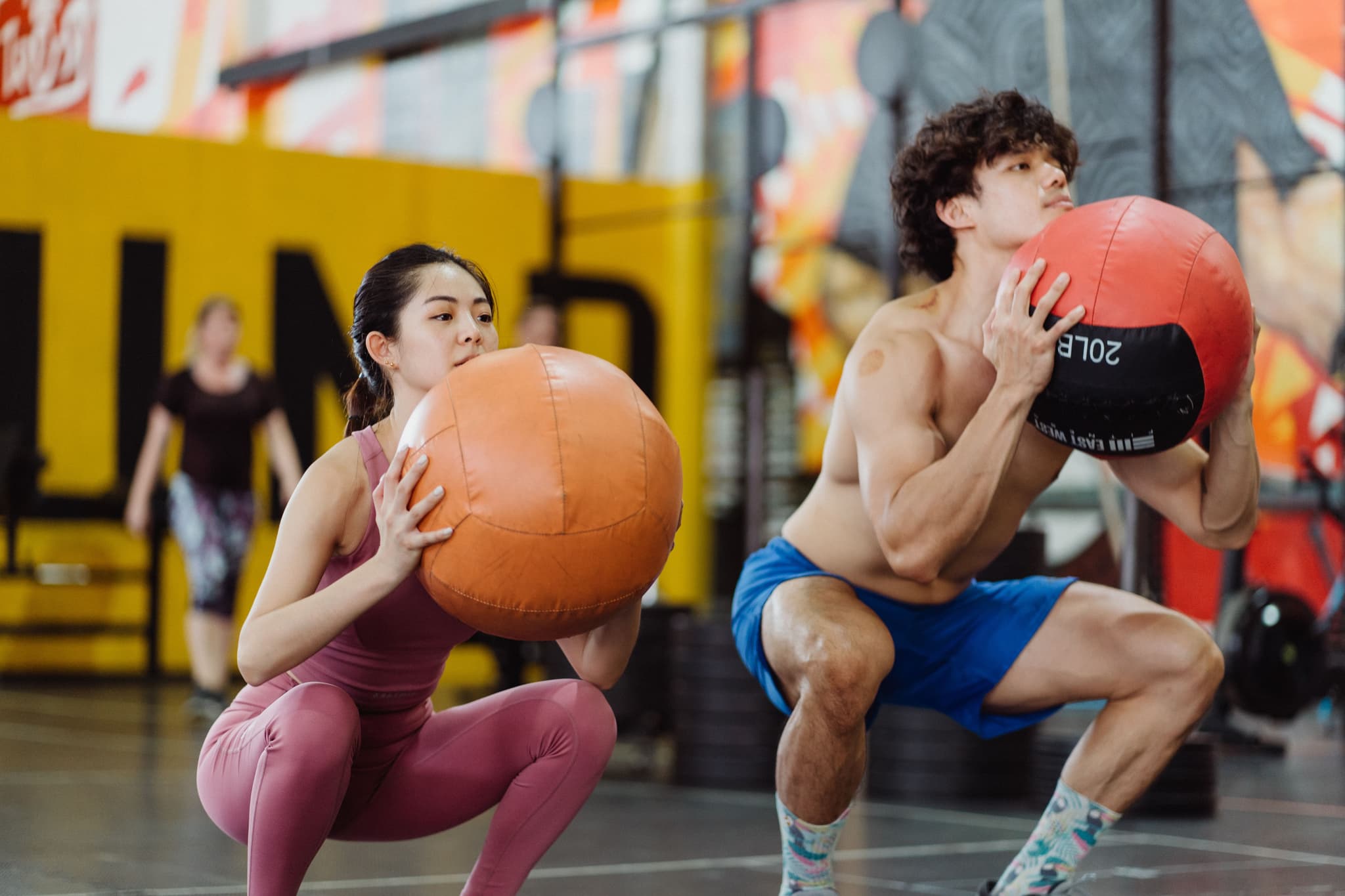
The goblet squat looks simple. One dumbbell, front-loaded, feet somewhere between hip and shoulder width. But the question of what goblet squat muscles worked gets oversimplified almost every time it comes up, reduced to "quads and glutes" without any explanation of why the loading position produces that recruitment pattern or what you can actually do to shift it.
This is not a beginner breakdown. It assumes you already squat and know the movement. The focus is on why the front-loaded position produces the recruitment pattern it does and, more practically, how to manipulate stance width and technique to bias the load toward your specific training goal. Adjust your stance by a few inches and you change which muscles absorb the majority of the work. That's worth understanding precisely.
Understanding Goblet Squat Muscles Worked
The goblet squat muscles worked breakdown starts with the position itself.
Goblet Squat Muscles Worked
The goblet squat loads weight in front of your body, forcing an upright torso that increases knee flexion demand and shifts mechanical stress toward the quads and glutes. This anterior loading position is what separates the goblet squat from other squat variations and determines which muscles carry the most work.
Primary movers:
Quadriceps — primary driver due to increased knee flexion demand created by the upright torso position
Glutes (gluteus maximus) — heavily loaded as the hips extend out of the bottom position
Hip adductors — active contributors to squat depth and medial hip stability throughout the rep
Secondary and stabilizing muscles:
Core (transverse abdominis, erector spinae) — braced isometrically to hold the anterior load and protect spinal position
Upper back (rhomboids, mid-trapezius) — recruited to prevent the weight from pulling the chest forward
Calves (gastrocnemius, soleus) — stabilize the ankle as the knee tracks forward over the toes
Knowing which muscles are doing the work gives you the foundation to adjust your stance, depth, and load with a specific purpose rather than just guessing.
Why the Front-Loaded Position Changes Muscle Recruitment
The Torso Angle Problem: Why Trunk Lean Determines Which Muscles Work
Trunk lean is not a style preference. It is the single variable that most directly dictates which muscles absorb the majority of the load in a squat.
As your torso tips forward, the moment arm at the hip joint lengthens. A longer hip moment arm means your glutes and hamstrings have to generate more force to complete the lift. Pull that torso back toward vertical, and the moment arm shifts toward the knee, placing a greater mechanical demand on the quadriceps. The same movement pattern at two different torso angles produces a meaningfully different training stimulus.
This is the mechanical logic behind goblet squat technique. An upright torso is not just a coaching cue you follow because your trainer said so. It is a direct consequence of where the load sits relative to your center of mass. When you hold a weight in front of your body, your trunk position becomes a biomechanical outcome of load placement, not merely an instruction to follow.
How Anterior Loading Creates a Quad-Dominant Environment
Holding a dumbbell or kettlebell at chest height moves the load in front of your midline. That forward displacement acts as a counterbalance, requiring you to stay tall to keep the weight stable. If your chest drops, the load pulls you further forward, so your body self-corrects.
The orientation of the trunk relative to the tibia—and therefore the hip-to-knee flexion moment ratio—is influenced by where the load is placed. When the load is placed anteriorly, the trunk is typically held in a more upright position. A traditional barbell back squat is typically performed with greater trunk flexion. In a goblet squat, mid-foot balance is maintained through a more vertical shin-and-torso alignment, which keeps the knee tracking forward and sustains quad tension through the full range.
The result is a squatting environment where your quads are doing more work by design, not by accident. That distinction matters when you are choosing exercises for a specific training outcome.
Primary Goblet Squat Muscles Worked — and Why They Load That Way
The goblet squat muscles worked include the quadriceps as the dominant mover, glutes as secondary prime movers, and core stabilizers that support the pattern. Understanding which muscles fire and how hard they work is the foundation for programming this lift effectively.
Quadriceps: The Dominant Mover and the Evidence Behind It
The quads are the primary movers in a goblet squat. A 2021 study by Collins et al., published in the Journal of Strength and Conditioning Research, compared EMG activity and ground reaction forces between the goblet squat and the landmine squat in 16 men and 16 women, with each variation loaded at 30% of body mass. The goblet squat produced significantly higher quadriceps activation, consistent with the knee-dominant mechanics the upright torso position creates.
If your goal is to load the quads with a squat pattern that's easy to coach and self-correct, this variation earns its place.
Glutes: Active but Depth-Dependent
The glutes are working. But calling them a primary mover at standard squat depth overstates their role.
Caterisano et al. (2002) compared three squat depths — partial (45° of knee flexion), parallel (90°), and full (~135°) — and found that the full squat elicited greater gluteus maximus activation than both the parallel and partial variations. Stopping at parallel limits hip range of motion and keeps glute involvement low. Go below parallel, and the contribution changes in a way that matters for programming.
This depth-and-glutes relationship has direct implications for how you set up the goblet squat in a training plan, and that's covered in the next section.
Core and Upper Back: Stabilizers With Real Structural Demand
Holding a load at chest height creates an anti-flexion demand on the spine. Your erectors and anterior core resist the weight pulling your torso forward, while the thoracic extensors work to keep your chest tall and the load close to your body.
These muscles are not the target. But without their contribution, the pattern breaks down. Poor bracing or weak thoracic extension usually shows up as the weight drifting forward, which most lifters don't immediately recognize as a stability failure.
Stance Width: The Most Powerful Variable for Shifting Muscle Emphasis
Most lifters pick a stance that feels comfortable and stay there. That's leaving muscle recruitment on the table. Stance width is a direct programming variable, and adjusting it changes which muscles take the majority of the load without touching load, tempo, or rep range.
This is a goblet squat form decision with real mechanical consequences, not a matter of personal preference.
Narrow Stance: Maximizing Quad Isolation
Bring your feet closer than shoulder-width, toes pointing forward or slightly out (10 to 15 degrees). This position restricts hip abduction and keeps the movement primarily in the sagittal plane, which allows a deeper knee bend and greater range of motion through the quads, while also demanding more core engagement to maintain your upright position.
Key cue: Push your knees directly over your toes throughout the descent. Any inward cave kills the stimulus.
Shoulder-Width Stance: The Balanced Default
Feet at shoulder-width with toes flared 15 to 30 degrees gives you the most consistent distribution of work across the quads, glutes, and adductors. EMG data reviewed by SBD Ireland on wide versus narrow squat variations confirms that moderate stance positioning produces solid activation across all three muscle groups without strongly biasing any single one.
Use this stance for general strength work, warm-up sets, and when your goal is overall lower-body development rather than targeted isolation.
Key cue: Stack your knees over your second toe. If your heels lift, widen slightly or address ankle mobility before loading.
Wide and Sumo Stance: Shifting Load to the Glutes
Step out beyond shoulder-width and flare your toes to 30 to 45 degrees. EMG research consistently shows that wider squat stances increase gluteus maximus activation, while quadriceps activity stays largely unchanged across stance widths. At a true sumo stance with a 45-degree toe flare, the glutes take on a greater share of the load.
This directly answers the question of whether goblet squats are effective for glute development. They are, but only if your stance is wide enough to put the glutes in a mechanically demanding position.
Key cue: Drive your knees out hard against your elbows at the bottom. If your knees track inward, reduce the weight or narrow the stance until your hip mobility catches up.
Stance | Primary Emphasis | Key Cue |
Narrow (inside shoulder-width) | Quads, core | Knees track over toes |
Shoulder-width | Quads, glutes, adductors (balanced) | Knees over second toe |
Wide / Sumo (45° flare) | Glutes, adductors | Drive knees out against elbows |
Once you know which muscles you're training in a given session, the correct stance choice becomes obvious. That clarity carries over into how you select load and volume, which is where the next piece of the programming picture sits.
Programming the Goblet Squat for Your Specific Goal
The mechanics are only useful if you structure them into a training plan that actually matches what you're trying to build. Here's how to program the goblet squat across three distinct goals, each with specific sets, reps, and tempo guidance to deliver measurable benefits.
Goal: Quad Hypertrophy — Load the Stretch, Eliminate the Bounce
The paused goblet squat is the most underused quad hypertrophy tool in most programs. By holding 2 to 3 seconds at the bottom of the rep, you eliminate the stretch-shortening cycle—the elastic rebound that lets your muscles cheat through the hardest part of the movement. Removing this rebound forces greater neuromuscular demand from the bottom position and increases the hypertrophy stimulus without requiring additional load.
Keep your stance narrow to moderate, feet roughly hip-width, toes slightly out. This keeps the torso upright and maximizes knee flexion range, which is where quad tension accumulates.
Quad Hypertrophy Protocol |
Sets: 3 to 4 |
Reps: 8 to 10 |
Tempo: 3 seconds down, 2 to 3 second pause at bottom, controlled drive up |
Load: Moderate. Enough that the pause feels like work, not a rest. |
Goal: Glute Development — Depth and Stance Are Non-Negotiable
Shallow squats do not train the glutes effectively. Research by Caterisano et al. (2002) compared three squat depths—partial at approximately 45 degrees of knee flexion, parallel at approximately 90 degrees, and full at approximately 135 degrees of knee flexion—and found that the full squat elicited greater gluteus maximus activation than the parallel and partial depths. If you're stopping at 90 degrees, you're leaving the glutes largely out of the movement.
Widen your stance to shoulder-width or just beyond, with toes turned out 30 to 45 degrees. EMG data supports wider stances for increasing hip adductor and glute involvement through the bottom range. Get to full depth on every rep, and do not bounce out of the hole.
Glute Development Protocol |
Sets: 3 to 4 |
Reps: 10 to 12 |
Tempo: 2 seconds down, 1 second pause at depth, strong drive through the heels |
Load: Moderate to moderately heavy. |
Goal: Functional Strength — Upright Position as a Transfer Tool
The goblet squat's front-loaded position produces a more upright torso than barbell back squat variations. Front-loaded positions naturally encourage a more upright torso, which reduces compressive and shear forces on the lumbar spine compared to back-loaded movements. That makes the movement pattern directly transferable to athletic and daily-life mechanics where spinal position under load matters.
For functional strength, train it heavier and avoid the temptation to pause. You want coordinated, full-speed force production through the full range.
Functional Strength Protocol |
Sets: 4 to 5 |
Reps: 5 to 6 |
Tempo: Controlled descent, no pause, drive fast |
Load: Heavy relative to your capacity with full depth maintained. |
Pick your goal, lock in the corresponding variables, and stop treating sets and reps as interchangeable across every outcome.
Goblet Squat Form: The Cues That Actually Affect Muscle Recruitment
Not every form cue moves the needle on muscle activation. Three do.
Keeping your heels flat and pressing them into the floor drives more load into the quads rather than distributing it backward toward the hips. If your heels rise, quad recruitment drops. That's the direct trade-off.
Depth controls glute involvement. Squatting to parallel keeps the movement quad-dominant. Descending below parallel, where the hip drops beneath the knee, pulls the glutes deeper into their active range and increases the demand on them at the bottom of the rep.
Upper back tension, specifically pulling your shoulder blades together and keeping your chest up against the weight of the goblet load, increases the anti-flexion demand on your core. Lose that tension and the weight pulls you forward, shifting the mechanical chain in a direction that was already covered by stance and torso position.
Goblet Squat vs. Front Squat, Back Squat, and Landmine Squat
Goblet Squat vs. Back Squat: Trunk Angle and Posterior Chain Trade-Offs
The back squat places the load behind your center of mass, which forces a more horizontal trunk angle to maintain balance. That forward lean shifts demand toward the hips, glutes, and spinal erectors. The goblet squat keeps the load anterior, which lets you stay upright and routes more work into the quads. Anterior loading reduces lumbar shear stress compared to posterior barbell placement, making the goblet squat the lower-risk option for lifters with back sensitivities.
Goblet Squat vs. Front Squat: Same Position, Different Demands
Both variations load anteriorly, so the trunk mechanics are similar. The difference is capacity and spinal demand. A barbell front squat allows far heavier loading, which increases compressive force on the spine and requires a high degree of thoracic mobility and wrist flexibility. The goblet squat sidesteps those barriers entirely. For building quad volume at moderate loads without the technical overhead of a barbell rack position, the goblet squat is the more practical tool.
Goblet Squat vs. Landmine Squat: Quad Activation and Posterior Chain Demand
A 2021 study in the Journal of Strength and Conditioning Research (Collins et al.) measured EMG activity and ground reaction forces across both movements in 16 men and 16 women, each performing five reps loaded at 30% of body mass. The goblet squat produced higher quad activation, with EMG signals recorded for the vastus medialis, vastus lateralis, semitendinosus, and biceps femoris. The landmine squat, with its angled loading vector, shifts more demand to the hips and posterior chain. If quad development is the target, the data backs the goblet squat as the better choice between the two.
The goblet squat fills a specific gap: anterior loading, strong quad bias, and low spinal stress. It complements barbell squats rather than replacing them.
Frequently Asked Questions About Goblet Squat Muscles and Programming
What muscles does a goblet squat work?
A goblet squat primarily works the quadriceps, glutes, and core, with secondary involvement from the adductors, hamstrings, and upper back. The front-loaded position forces a more upright torso, which increases knee flexion and places greater mechanical tension on the quadriceps—that's why quad recruitment tends to run higher than in a back squat. For the full breakdown of primary versus secondary muscles, see the featured snippet section at the top of this article.
Are goblet squats good for glutes?
Goblet squats work the glutes, and depth is the variable that controls how much. Research by Caterisano et al. (2002) found that gluteus maximus activity increases with squat depth, making parallel or below-parallel the target range if glute development is the priority. More recent work by Da Silva found the opposite when external load was matched to each depth, so the research is mixed. Aim for full depth, but load matters too.
Do goblet squats work your back?
Yes, though as a stabilizer rather than a primary mover. Holding the weight aloft challenges the upper back and core, turning the goblet squat into an effective full-body stimulus. That stabilization demand builds postural endurance, not maximal back strength.
How many sets and reps should I do for goblet squats?
Three to four sets of 8 to 15 reps covers most training goals. Heavier loads in the 6 to 8 rep range favor strength adaptation, while lighter loads taken to depth with controlled tempo drive hypertrophy. Goal-specific set and rep structures are laid out in the programming section earlier in this article.
The Bottom Line
The goblet squat muscles worked depend on how you set it up. Anterior loading sets the mechanical foundation, keeping your torso upright and shifting the hip-to-knee flexion moment ratio, but stance width, depth, and tempo determine exactly where that demand lands.
For quad hypertrophy, use a narrow stance, full depth, and a controlled pause. For glute development, widen your stance with toes turned out — research confirms that increasing squat depth and moving to a wider stance both raise gluteus maximus activation. For athletic movement quality, use a moderate stance with tempo work to reinforce control through the full range.
Pick your goal, set your stance, and program one of the three tracks above for four weeks. The difference in which muscles you feel will be immediate and measurable.
Related Articles
Dumbbell Arm Exercises for Beginners: Why Free Weights Beat Cables
Cables feel safer, but they hide the mistakes that matter most. See why dumbbell arm exercises beginners should master first build real strength, better balance, and honest form fast.
Step-Ups for Hamstrings: Box Height, Stance & Form Guide
Are step-ups actually a hamstring exercise, or just quads in disguise? Here's how box height, stance, and hip hinge decide the answer.
7 Progressive Overload Mistakes Beginners Make (and Fixes)
Stalled lifts? You might be making one of these 7 progressive overload mistakes beginners make without realizing it. Get the symptoms, causes, and exact fixes before it costs you months.