
Bulgarian Split Squat Muscles: How to Bias Quads, Glutes, Hams
Quads, glutes, hamstrings, adductors — which one actually dominates? See what EMG research reveals about bulgarian split squat muscles and how to bias the results.
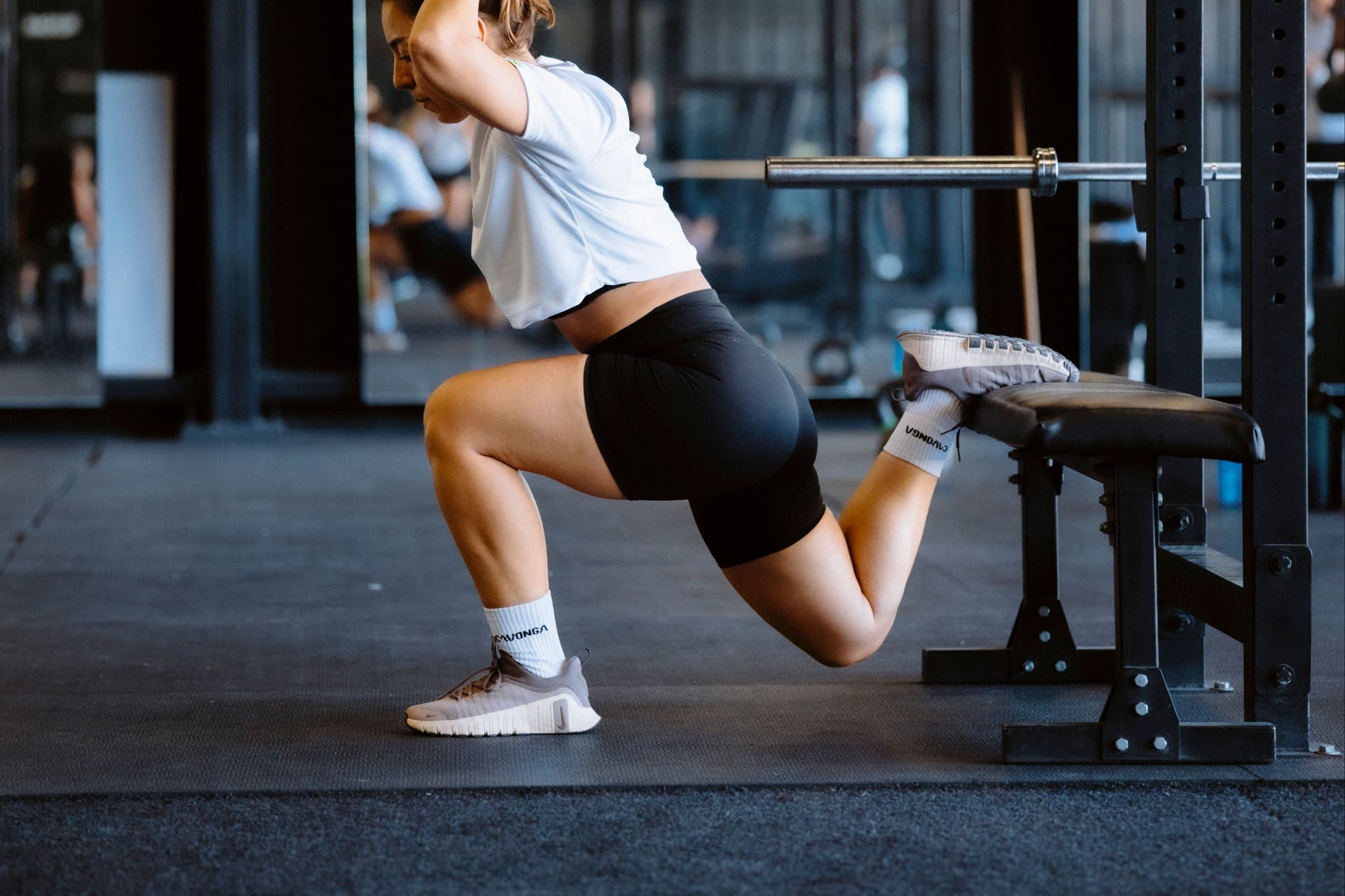
Ask five lifters which muscles the Bulgarian split squat muscles work hardest and you'll get five different answers, most of them guesses dressed up as facts. The front leg and back leg aren't doing the same job. Lumping "quads, glutes, hamstrings, adductors" into one list won't tell you which muscle actually dominates or how to shift that balance on purpose.
This guide skips the recycled advice and goes straight to the EMG data: a 2025 trial in BMC Sports Science, Medicine and Rehabilitation, Helme et al.'s 2022 study on rear-foot-elevated split squats, and Topçu et al.'s work published in Scientific Reports. You'll see how split squat muscle activation splits between your working leg and your stabilizing leg, why trunk angle can shift the exercise from quad-dominant to glute-dominant, and where your hamstrings and core actually fit into the picture. Then you'll get coaching cues on torso position, stance width, and rear-foot placement so you can bias the muscle group you're training for instead of leaving it to chance.
Bulgarian Split Squat Muscles: The Quick, Science-Backed Answer
The bulgarian split squat muscles work in two distinct roles: the front leg drives the movement through knee and hip extension, while the back leg stabilizes the pelvis and trunk. A 2025 EMG study on trained football players published in Scientific Reports found that the quadriceps consistently showed higher activation than the hamstrings across all movement phases, with the glutes at intermediate levels.
Front leg (working leg), ranked by activation:
Quadriceps: highest EMG output, doing most of the knee extension work
Glutes (max and medius): second-highest, driving hip extension and controlling lateral stability
Adductors: activated to help control the split stance
Back leg (rear leg), stabilizer role:
Glutes: fire isometrically to keep the pelvis level
Erector spinae: engage to resist trunk lean
Hip flexors: work eccentrically to control the stretch at the bottom position
A 2022 study by Park and Kim investigated how trunk angle changes the quadriceps-to-hamstring ratio during the Bulgarian split squat. Keeping the torso upright shifted more work onto the quads, while a 30-degree trunk lean pulled more of the load onto the hamstrings. Coaches programming this lift for knee health or hamstring development should treat torso angle as a variable to control, not a detail to ignore.
Front Leg vs. Back Leg: What EMG Data Reveals About Split Squat Muscle Activation
Split squat muscle activation isn't evenly distributed. The two legs do fundamentally different jobs, and EMG data backs that up with actual numbers.
A study published in Scientific Reports measured lower-limb muscle activation during the Bulgarian split squat in 23 trained male football players, testing how rear-foot surface conditions affected recruitment through the lift. The BF, VL, VM, and GM muscles were more highly activated during the ascent than during the descent phase on all surfaces. Trained athletes with established motor control make a more useful baseline than untrained subjects with inconsistent movement patterns.
What Muscles Does the Bulgarian Split Squat Work?
The bulgarian split squat muscles engaged depend on which leg you're looking at. The front leg drives the movement through the quads, glutes, and adductors. The back leg stabilizes. Here's the breakdown:
Quadriceps — primary mover on the front leg
Glutes — secondary force producer on front leg; stabilizer on back leg
Adductors — inner thigh stabilization, both legs
Hamstrings — minor contributor to hip extension on front leg
Gastrocnemius — calf activation during push-off phase
Front Leg: The Primary Driver of Force and Quad Activation
In the Bulgarian split squat, the front leg carries the bulk of the mechanical load. The quadriceps handle much of the work of decelerating the descent and producing the force needed to stand back up, with glute activation running at a lower percentage of maximum voluntary contraction.
Back Leg: Stabilizer, Not Passenger
The back leg isn't dead weight resting on a bench. EMG readings show low-to-moderate glute and adductor activity throughout the rep, work focused on maintaining hip position and preventing lateral drift rather than generating force.
That stabilization demand explains why the back leg fatigues differently than the front leg. It holds the position instead of driving the movement. That difference is what makes loading and foot placement change the whole activation pattern.
Quads vs. Glutes: Which Muscle Group Actually Works Harder in the Bulgarian Split Squat?
Trunk position changes the answer more than exercise selection does. Lean forward and the glutes take on more of the load. Stay upright and the quads dominate.
A 2025 study by Aygun-Polat and colleagues, published in BMC Sports Science, Medicine and Rehabilitation, tested this directly with electromyography during the Bulgarian split squat. Twenty-one trained female athletes performed four variations of the exercise while researchers measured activation in eight lower extremity and trunk muscles, including the gluteus maximus, vastus lateralis, rectus femoris, and vastus medialis.
Trunk flexion increased activation in the gluteus maximus, biceps femoris, and rectus femoris compared with a neutral trunk position.
That third muscle matters. Rectus femoris is one of the four quadriceps muscles, so leaning forward doesn't just recruit more glute. It also drives up activity in part of the quad group while pulling in more hamstring (biceps femoris) work at the same time. A forward lean spreads the load across more muscle groups rather than simply trading quad work for glute work.
For programming purposes, the practical takeaway still holds: staying more upright through the torso keeps the front thigh under more consistent tension, while leaning forward over the front knee shifts more demand onto the posterior chain. The EMG differences were measurable and consistent, which makes trunk angle a real training lever for split squat muscle activation, not a minor cue.
Most lifters settle into whatever trunk position feels natural, usually a slight lean that lands somewhere between the two extremes. Once you know that torso angle does real mechanical work, you can set it on purpose based on whether you're chasing quad size, glute size, or a mix of both.
Do Bulgarian split squats work the hamstrings?
Bulgarian split squats do engage the hamstrings, but they function as stabilizers rather than prime movers. How hard they fire depends on trunk angle as much as glute activity does.
Research on split squat muscle activation shows that controlled resisted single-leg squats strengthen the quadriceps while facilitating hamstring coactivation, which reduces anterior tibial shear forces. The mechanism is straightforward: the hamstrings provide a stabilizing force at the knee by producing a posteriorly directed force on the tibia to counteract the anterior tibial force imparted by the quadriceps. That tug-of-war keeps the knee stable and can reduce strain on the ACL, one of the overlooked benefits of the Bulgarian squat benefits for anyone rehabbing a knee or trying to keep one healthy long term.
Kulas et al. demonstrated that moderate trunk flexion, around 40 degrees, during single-leg squats reduced ACL loading, likely due to a shift in muscular demand from the quadriceps toward the hamstrings. A 2025 study in BMC Sports Science, Medicine and Rehabilitation backs this up. Increased trunk flexion enhances hamstring engagement and reduces ACL tension, potentially lowering injury risk. That tracks mechanically: more forward lean means more hip flexion at the bottom, and the hamstrings, as hip extensors, get pulled into the work.
Stay upright, though, and hamstring involvement drops off. The knee dominates the movement, the quads take over, and the hamstrings go almost passive.
Hamstring activation in the Bulgarian split squat isn't fixed. Torso angle changes it, so you can dial it up or down depending on what you're training for.
The Stabilizers You're Ignoring: Core, Erector Spinae, and Calves
Most breakdowns of bulgarian split squat muscles stop at quads, glutes, and hamstrings. That skips the muscles working hardest to keep you from tipping over, and it matters if you care about split squat muscle activation as a whole system rather than a highlight reel.
Erector Spinae and Unstable Rear-Foot Setups
Your setup changes which muscles get recruited to keep your spine upright. A 2025 study by Aygun-Polat and colleagues, published in BMC Sports Science, Medicine and Rehabilitation, tested how trunk position and surface stability affect muscle activation during the Bulgarian split squat.
Suspension-based BSS resulted in significantly greater activation of the erector spinae (p = 0.046), while trunk flexion increased activation in the gluteus maximus, biceps femoris, and rectus femoris muscles.
A fixed rear foot lets your spine coast. A suspended one, where the rear foot rests in an unstable strap instead of on a solid bench, forces the erectors to fire continuously to keep your torso from rotating or collapsing forward. Trunk position, not leg drive, is what recruits the spinal stabilizers.
Core and Calves: The Quiet Contributors
Any single leg squat variation demands constant core bracing. You're balancing on one foot with a moving load overhead or in your hands, and your obliques and transverse abdominis work to prevent side-to-side sway through the entire rep.
Calves get less attention, but they're doing real work at the ankle, making small, constant adjustments to keep your base of support stable. Train them deliberately, or you're leaving part of the balance equation unaddressed.
How to Bias Which Bulgarian Split Squat Muscles Fire: Coaching Cues That Actually Work
Once you understand how load shifts between legs and muscle groups, the real question is how to control which muscles activate during a Bulgarian split squat. Three variables drive that: torso angle, stance width, and rear-foot position.
Torso Angle: Upright for Quads, Leaned Forward for Glutes/Hams
Your torso angle is the single biggest lever you have.
Stay tall and vertical: the knee travels forward and the quads take on more of the load.
Lean forward from the hips: the hip hinge increases and the glutes and hamstrings pick up more of the work.
Keep the lean controlled: don't collapse through the spine to fake a hip hinge.
A crossover study on trained women tested lunges in straight and inclined trunk positions. Erector spinae activation rose from about 20% MVIC with a straight trunk to roughly 40% MVIC when the trunk was inclined. Gluteus maximus activation also climbed, but mainly during the step-forward and walking lunge variations rather than as a direct result of trunk lean alone. Rectus femoris activation did not stay flat when the trunk leaned forward; the quad still fires, but the glutes and hamstrings dominate the movement pattern. Program the lean on purpose. Don't let it show up as a side effect of fatigue late in a set.
Stance Width and Foot Elevation: Fine-Tuning the Load
Stance length changes the joint angles at the knee and hip before you even move.
Shorter stance: more knee flexion, more quad demand.
Longer stance: more hip flexion, more glute and hamstring recruitment.
Elevate the front foot slightly on a plate if you want extra range without sacrificing balance.
Rear-Foot Stability: Ground vs. Elevated vs. Suspended
The back leg's job is stability, not force production. Where you place it still changes how hard your stabilizers have to work.
Bench or box: standard elevation, moderate stabilizer demand.
Suspension strap (TRX): higher instability, more core and hip stabilizer recruitment.
Flat ground (deficit reverse lunge variant): less instability, more direct load on the front leg.
A 2025 study published in BMC Sports Science, Medicine and Rehabilitation tested four Bulgarian split squat setups: ground-based with trunk flexion, ground-based with a neutral trunk, suspension-based with trunk flexion, and suspension-based with a neutral trunk, while tracking erector spinae, gluteus maximus, biceps femoris, rectus femoris, semitendinosus, vastus medialis, vastus lateralis, and gluteus medius activity. Pick your variation based on the muscle you want to hit that session, not just whatever bench or strap happens to be open.
Bulgarian Squat Benefits: Why This Single-Leg Squat Beats the Back Squat for Some Lifters
This exercise doesn't win on calories burned or how hard it feels. The case for it comes down to knee mechanics.
Kulas and colleagues studied how trunk position modulates anterior cruciate ligament forces and strains during a single-leg squat. That's a narrower finding than a straight comparison between single-leg and bilateral loading: the study isolates trunk angle as the variable that shifts ACL strain during a single-leg squat, not a head-to-head test against the back squat. Still, the takeaway for lifters holds. Controlling trunk position on a single-leg squat gives you a lever to manage knee stress that a back squat doesn't offer in the same way, which matters if you're nursing old knee issues or trying to add volume without grinding down cartilage over years of heavy squatting.
Then there's the hamstring-to-quad relationship. A healthier H:Q ratio matters beyond the numbers on a chart. It tracks with lower hamstring strain risk in athletes who sprint or change direction.
Add the front-leg loading data. Your working leg often carries a higher percentage of bodyweight per limb than it would during a back squat at the same load, because the rear leg barely contributes to the drive.
That's three separate mechanisms: joint strain, muscle balance, and per-leg loading, all pointing the same direction. None of them require you to feel wrecked to know the exercise is doing its job.
That's the evidence case. Next up, the muscles doing the actual work.
FAQ: Bulgarian Split Squat Muscle Questions, Answered
What muscles does a Bulgarian split squat work?
A Bulgarian split squat primarily targets the quadriceps and glutes, with secondary activation from the hamstrings, adductors, and calves. The front leg's quads handle most of the knee extension, while the glutes drive hip extension out of the bottom position. EMG research on split squat muscle activation found that the quadriceps muscles consistently exhibited higher EMG amplitudes than the hamstrings, whereas the glute max showed intermediate activation levels. Hamstrings, adductors, and calves contribute as secondary stabilizers rather than prime movers.
Is the front leg or back leg doing more work in a Bulgarian split squat?
The front leg does most of the work. Its quads and glutes produce far more activation than the rear leg, which mainly stabilizes and offers a small amount of push-off assistance. Treat the rear leg as a kickstand, not a second engine.
Are Bulgarian split squats good for glute growth?
Yes. A 2025 study in BMC Sports Science, Medicine and Rehabilitation found that trunk flexion during the Bulgarian split squat significantly increased activation of the glutes, biceps femoris, and rectus femoris compared to a neutral trunk position. Add the extended range of motion the elevated rear foot allows, and you get a solid stimulus for glute hypertrophy without loading the spine the way a heavy back squat does.
How do you target quads vs. glutes in a Bulgarian split squat?
Torso position is your main lever. An EMG study from BMC Sports Science, Medicine and Rehabilitation found that keeping your torso upright puts more emphasis on the quads, while leaning forward at the hips increases glute and hip extensor involvement. Stance width plays a smaller supporting role. Torso angle does the heavy lifting.
Decide which muscle group you're after before you drop into the rep. That call matters more than adding extra sets.
The Bottom Line
Bulgarian split squat muscles respond to how you set it up, not the exercise itself. The front leg absorbs the bulk of the mechanical demand, the back leg stabilizes, and your core and calves work harder than most lifters realize. Trunk angle is the control switch. Lean forward and you pull more glute and hamstring drive out of hip extension. Stay upright and the quads take over the knee extension work.
Leaning your trunk forward puts more emphasis on the glutes and hamstrings, while keeping your trunk upright targets the quads more. That's the difference between a quad-dominant accessory lift and a posterior-chain builder using the same stance.
Stop treating this as one exercise with one output. Pick a trunk angle on purpose next session: upright for quads, forward lean for glutes and hamstrings. Watch how differently your muscles respond when you're driving the variable instead of letting it drive you.
Related Articles
Dumbbell Arm Exercises for Beginners: Why Free Weights Beat Cables
Cables feel safer, but they hide the mistakes that matter most. See why dumbbell arm exercises beginners should master first build real strength, better balance, and honest form fast.
Step-Ups for Hamstrings: Box Height, Stance & Form Guide
Are step-ups actually a hamstring exercise, or just quads in disguise? Here's how box height, stance, and hip hinge decide the answer.
7 Progressive Overload Mistakes Beginners Make (and Fixes)
Stalled lifts? You might be making one of these 7 progressive overload mistakes beginners make without realizing it. Get the symptoms, causes, and exact fixes before it costs you months.