
Step-Ups for Hamstrings: Box Height, Stance & Form Guide
Are step-ups actually a hamstring exercise, or just quads in disguise? Here's how box height, stance, and hip hinge decide the answer.
Search "step-ups for hamstrings" and you'll find two opposite answers. One camp calls step-ups a top-tier hamstring and glute builder. Another says your quads do all the work while your hamstrings barely twitch. Both camps are looking at real EMG data. They're just describing different versions of the same exercise.
The difference comes down to setup. Box height changes joint angles. Foot placement shifts the load. Torso position decides whether your hips or your knees drive the rep. Get those three variables wrong, and step-ups train your quads by default. When you set them up correctly, step-ups for hamstrings become a genuine posterior chain builder.
This guide breaks down the box height, stance, and hip-hinge mechanics that turn step-ups into an effective hamstring activation exercise, based on the research instead of gym-floor opinions.
Do Step-Ups Work Hamstrings? The Short Answer
Yes, step-ups for hamstrings work, but only under specific conditions. Most lifters turn step-ups into a quad-dominant movement without realizing it. Research comparing step-ups to single-leg squats found the step-up appears more ideal for activating the quadriceps, while the single-leg squat is more effective for activating the hamstrings and glutes.
Fix your setup, though, and hamstring activation step-ups become real. You can pull genuine work from the hamstrings and glutes instead of letting the quads take over.
Three variables decide how much hamstring you recruit:
Box height.
Taller boxes force more hip flexion, which pulls the hamstrings into the lift as hip extensors.
Torso angle.
Lean forward slightly at the hip instead of staying upright. A slight forward torso angle loads the posterior chain instead of dumping everything onto the quads.
Knee path.
Keep your knee tracking over your mid-foot, not shooting forward past your toes. A forward-drifting knee shortens the hip hinge and shifts tension away from the hamstring.
Get those three right, and step-ups stop acting like a knee-dominant leg press. They start training your posterior chain the way they're supposed to. The rest of this guide covers how to dial in each variable.
The Real Debate: Prime Mover or Just a Stabilizer?
Search around and you'll find conflicting claims about step-ups for hamstrings. Some sources call them a quad exercise with the hamstrings barely along for the ride. Others treat them as a real posterior chain builder. Both sides have data to point to.
Why Some EMG Data Says Hamstrings Are Minor Players
A JOSPT electromyography study measured hamstring activation during step-ups and found hamstring MVIC at roughly 20–30% while quad activation ran nearly double that.
A PMC study compared squats, step-ups, and step-downs but measured only gluteus medius and gluteus maximus activation, not hamstring activity. Squat produced the lowest activation for both GMax and GMed, with no significant difference in GMax activation across the three exercises. That study can't tell you much about hamstring involvement. Other EMG work tracking the hamstrings via biceps femoris tends to show squats beating step-ups for hamstring recruitment. That's the case people make for calling step-ups a quad-and-glute exercise, full stop.
Why That's Not the Whole Story
Box height and stance width weren't standardized across these studies, and that gap matters. One research team noted their higher hamstring and glute numbers compared to earlier work likely came down to setup: the earlier study used lower loads and a shorter box (15.24 cm) compared to their own protocol. A systematic review in the Journal of Sports Sciences found activation patterns shift significantly with knee flexion angle and hip position.
Deeper knee flexion at the top position, closer to 90 degrees, recruits the hamstrings as hip extensors, not just as knee stabilizers. Shallow step-ups skip that mechanism entirely. A low box with a short stride and minimal hip flexion trains the quads almost exclusively. A tall box with a long stride and a deep hip hinge pulls the hamstrings into the work.
The EMG data isn't inaccurate. It's measuring a different exercise than the one built for hamstring activation. Set up your step-ups posterior chain style—taller box, longer stride, deeper hip flexion—and the activation numbers shift accordingly.
The Mechanism: Hip-Hinge vs Upright Torso
Step-ups for hamstrings come down to one setup choice: how you position your torso. Stand tall and drive through the step, and your quads take over. Hinge forward at the hip, and your hamstrings get pulled into the job.
Torso angle changes which muscles have to work to keep you from falling over. That's basic leverage, not personal preference. Research on the closely related Bulgarian split squat confirms the pattern: staying tall and vertical sends the knee forward and puts more load on the quads, while leaning forward from the hips increases the hip hinge and shifts more of the work to the glutes and hamstrings.
What Changes When You Hinge at the Hip
When you lean your torso forward, you stretch your hamstrings across two joints. They're already lengthened at the hip. Now they have to contract hard to extend it and pull you up onto the box.
A forward hip hinge shifts tension from the knee joint toward the hip joint. That shift is what separates a hamstring-focused step-up from a quad-dominant stair climb.
Keep your chest up and stack your hips directly under your shoulders. Your knee does most of the work extending. Hamstrings stay along for the ride.
Why Knee-Over-Midfoot Shifts Load to the Glutes Instead
A common mistake: lifters hinge forward correctly, then let their knee drift past their toes anyway. That knee travel shifts the emphasis back toward quad-dominant knee extension, even with a bent torso.
Keep your knee stacked over your midfoot as you drive up. That alignment forces your hip to do the extending, not your knee. Glutes and hamstrings pick up the slack together.
When your torso hinge and knee path line up, your hamstring activation step-ups finally get the workload they're built for.
Box Height for Hamstring-Focused Step-Ups
Box height changes muscle recruitment more than most lifters realize. Go too low, and your quads dominate the rep. Get the height right, and your hamstrings finally do their job.
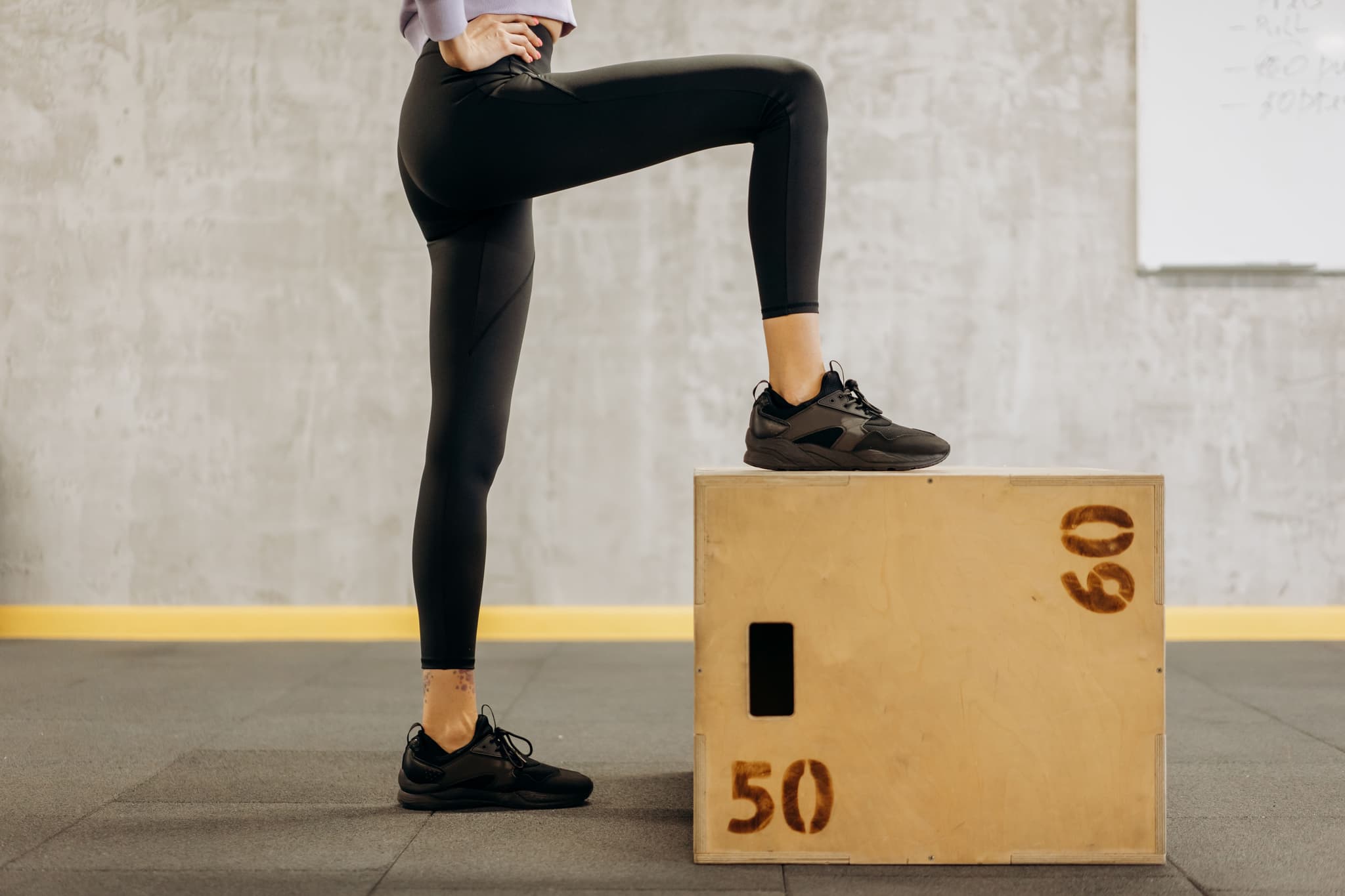
Short answer: Use a box around 18 inches for hamstring and glute-focused step-ups. That height forces enough hip flexion to load the posterior chain without turning the movement into a squat.
The 18-Inch Benchmark From EMG Research
The research doesn't say what most fitness articles claim it does. Using a lower box height when performing the step-up, approximately 20% of leg length according to McCurdy et al. 2005, resulted in greater quadriceps activation compared to higher box heights. Flip that around: a taller box demands more hip flexion at the bottom, which shifts work away from the quads and onto the glutes and hamstrings.
Eighteen inches isn't a number that won a head-to-head test against other heights. It's the box height researchers commonly use when studying step-up variations. A 2012 EMG study by Simenz and colleagues measured muscle activation in 15 women performing four step-up variations on an 18-inch box at 6-rep-max loads. That height became a practical default because most lifters get enough hip flexion at 18 inches to recruit the hamstrings and glutes without the rep turning into a squat.
Below that height, quad involvement climbs and hamstring demand drops off. The extra hip flexion at 18 inches asks the hamstrings to do real work through hip extension instead of leaving the job to the quads. This is why hamstring activation step-ups require careful box selection—the posterior chain only engages fully when the starting position creates sufficient hip flexion.
It's also close to standard plyo box height, so you can find one at almost any gym without hunting for a specific size.
Adjusting Height for Your Height and Hip Mobility
The 18-inch mark works as a starting point, not a universal rule. Taller lifters with longer femurs may need slightly higher boxes to hit the same hip angle.
If your hip mobility is limited, a taller box can push you into compensation patterns like lumbar rounding. Drop down an inch or two until you can maintain a flat back through the full range.
Test your height by checking your hip crease at the top position. If your thigh sits parallel to the ground with hips fully open, you've found your number.
Stance Depth and Foot Placement: Fine-Tuning the Emphasis
Box height sets the stage. Foot placement decides how the scene plays out.
Where you plant your foot on the box changes the joint angles at your hip and knee. Place your foot close to the edge, and your ankle and knee flex more, pulling the quads back into the movement. Push your foot toward the middle or rear of the box, and your hip has to flex harder to start the rep. That extra hip flexion is what loads the hamstrings properly during a step-up exercise.
Stance width matters less than most people assume. Foot distance from the box matters more. A deeper foot placement forces a longer lever at the hip, and a longer lever means more hamstring and glute demand.
A study out of the University of Konstanz compared hamstring, quadriceps, and gluteal activation across several lower-body resistance exercises, including the step-up, lunge, squat, and deadlift. The study found that exercises such as the step-up and lunge are best for gluteus medius and gluteus maximus activation, likely due to their unilateral nature.
Unilateral loading adds another layer. Holding a single dumbbell on the working-leg side forces your hip stabilizers and hamstrings to control the frontal plane. Bilateral loading spreads that demand out and lets your quads compensate more easily.
Combine a taller box, a hip hinge, and a deep foot placement, and you've built a step-up variation that challenges your posterior chain. Get one of those wrong, and your quads will find a way back into the rep.
Step-Up Variations Compared: Quad-Dominant vs Hamstring/Glute-Dominant
Not all step-ups train the same muscles. The variation you pick decides whether you build quads or strengthen your posterior chain. Here's the breakdown.
Lateral Step-Ups (Quad-Dominant)
Lateral step-ups load the knee more than the hip. You step sideways onto the box and keep your torso upright the whole time. That posture limits hip flexion, so the quads absorb most of the work.
If your goal is hamstring activation step-ups, skip this variation.
Hip-Hinge Forward Step-Ups (Hamstring/Glute-Biased)
Forward step-ups done with a forward hip hinge shift the load toward the glutes and hamstrings. You step straight up onto the box, tip your chest forward, and drive your hips back before you extend the knee. This pattern emphasizes the posterior chain more than an upright step-up does.
Quad-Focused vs. Hamstring-Focused Step-Ups:
Variation | Torso Position | Primary Movers | Best For |
Lateral Step-Up | Upright | Quads | Knee stability, frontal plane strength |
Hip-Hinge Forward Step-Up | Forward lean | Hamstrings, glutes | Posterior chain strength, hamstring step-up exercise |
If you've been doing lateral step-ups and calling it hamstring work, that's the mismatch. Switch to the hinge pattern and the muscle recruitment follows.
How to Perform Step-Ups for Hamstrings: Step-by-Step Form
Setup and Foot Placement
Load a bar or grab dumbbells before you step onto the box. Set your box at the height you've already dialed in for hamstring bias.
Plant your whole foot flat on the box, not just the ball of your foot. Your heel needs full contact for what comes next. Point your toes straight ahead, not flared out.
The Hip-Hinge Descent
Before you drive up, hinge. Push your hips back, not down. This cue is what separates a hamstring-focused step-up from a quad-dominant one.
Lean your torso forward from the hips, keeping your chest proud but angled toward the box. Keep a slight bend in your standing knee. Don't let that knee travel forward past your toes as you set up. Forward knee drift shifts load back to the quads and cancels out the hamstring activation step-ups demand.
Research on hip-flexion angle backs this up: as the hip flexes more, hamstring torque output goes up. Your hinge is what creates that angle, so don't skip it to save time.
Driving Through the Heel
Once you're hinged and set, drive through your heel, not your forefoot. Press your heel into the box like you're trying to dent it.
Extend your hip to stand tall, squeezing your glutes and hamstrings hard at the top. Don't let your trailing leg push off the ground to help. The working leg on the box should carry the entire rep.
Control the descent with the same hip hinge you started with. A lot of hamstring growth happens during that eccentric phase, so don't rush it.
Lock this sequence in before you start adjusting rep ranges and load.
Programming Step-Ups for Hamstring and Posterior Chain Growth
Form gets you into the right pattern. Programming decides whether that pattern builds muscle.
Load and Rep Ranges Based on the Research
Researchers evaluated the activation of the biceps femoris, gluteus maximus, gluteus medius, rectus femoris, semitendinosus, vastus lateralis, and vastus medialis during four variations of the step-up exercise.
Fifteen women who regularly engaged in lower body resistance training performed the four exercises with 6-repetition maximum loads on an 18-inch plyometric box.
That detail matters, but not in the way you might expect. The researchers tested step-ups only at a 6-rep max. They didn't compare that load against lighter, higher-rep sets, so the study can't tell you how hamstring activation shifts across rep ranges. What it does confirm is that a heavy 6-rep-max load produces solid EMG output in the biceps femoris and semitendinosus.
Use that as your baseline for hamstring activation step-ups. Work in sets of 4 to 6 reps per leg, loaded heavy enough that rep 6 is genuinely hard. Three to four sets per session is enough. In practice, higher-rep step-ups tend to shift the work toward the quads, so keep the loads heavy and the reps low if hamstring development is the goal.
Rest 90 to 120 seconds between sets. You need full recovery to keep the load heavy and the hip hinge intact.
Where Step-Ups Fit in a Posterior Chain Session
Program step-ups after your primary hinge movement, not before it. Deadlifts or RDLs first, step-ups second.
This order lets you load the hinge pattern when you're fresh, then reinforce it unilaterally while fatigued. Two sessions per week is plenty for most lifters.
Keep the knee tracking back over the heel throughout. That's what shifts load onto the hamstrings instead of the glutes. Pair step-ups with a hamstring curl or good morning to round out the session.
FAQ: Step-Ups and Hamstring Training
Are step-ups good for glutes or quads?
Yes, both. A study out of the University of Konstanz found that exercises such as the step-up and lunge rank among the best for glute medius and glute maximus activation, likely because of the unilateral nature of the movement. Box height and knee position decide which muscle group gets the bigger hit. Using a higher box height during step-ups leads to greater activation of the gluteus maximus, since a higher box requires more hip extension.
A lower box height, roughly 20% of leg length, shifts more work to the quadriceps.
What muscles do step-ups work overall?
Step-ups train quads, glutes, hamstrings, and calves in one move. A PLOS ONE EMG study comparing lateral step-ups, forward lunges, and monopodal squats measured glute medius, glute maximus, biceps femoris, and quad activation, and found the monopodal squat produced higher EMG readings than the step-up and lunge in nearly every muscle tested. Your core and hip stabilizers work overtime too, keeping your pelvis from tipping with each step.
How do step-ups activate the hamstrings?
Step-ups for hamstrings work through knee flexion and hip extension control rather than the deep stretch a deadlift creates. During the drive phase, your hamstrings stabilize the knee and assist hip extension. This builds hamstring activation and posterior chain strength, especially on the stepping leg.
Can step-ups replace deadlifts or RDLs for hamstrings?
Not fully. Deadlifts and RDLs stretch the hamstrings under load through hip hinging. Step-ups train them more isometrically, for stability and knee flexion control. Use step-ups as an accessory, not a substitute. A 2012 EMG study measured biceps femoris and semitendinosus activation during four step-up variations, including the step-up, crossover step-up, diagonal step-up, and lateral step-up.
Fifteen women who trained their lower body regularly performed the exercises with 6-rep-max loads on an 18-inch plyometric box. The results showed real hamstring recruitment, but nothing close to the stretch-under-tension demand a hip hinge creates.
Pair both movements if you want complete hamstring coverage. One trains the stretch, the other trains the stability.
The Bottom Line
Step-ups aren't a myth, but they aren't automatically a hamstring exercise either. They're a movement you control. Box height, hip-hinge angle, and knee path are the dials you turn, and where you set them determines whether your quads or your hamstrings do the work. Stand tall on a low box with your foot forward, and you've built a quad exercise. Hinge forward on a taller box with your foot planted back, and you've built posterior chain strength with step-ups. Once you understand the mechanics, it comes down to setup choices, not luck.
Stop guessing. Set your box at 18 inches, drive your hips back into a hinge before you push through the step, and keep your knee tracking behind your toes throughout the rep. Run that setup with the programming protocol laid out here for four to six weeks. Track your hamstring and glute development, then reassess and adjust the variables from there.
Related Articles
Dumbbell Arm Exercises for Beginners: Why Free Weights Beat Cables
Cables feel safer, but they hide the mistakes that matter most. See why dumbbell arm exercises beginners should master first build real strength, better balance, and honest form fast.
7 Progressive Overload Mistakes Beginners Make (and Fixes)
Stalled lifts? You might be making one of these 7 progressive overload mistakes beginners make without realizing it. Get the symptoms, causes, and exact fixes before it costs you months.
How to Progress Isometric Exercises Without Adding Weight
Stuck holding the same plank time for weeks? Learn how to progress isometric exercises using a 6-step framework that goes beyond just holding longer.