
Best Cable Arm Exercises for Constant Tension and Pump
Dumbbells let your biceps rest at lockout. Cables never do. Here's the exact list of best cable arm exercises, with tempo, rest, and reps included.
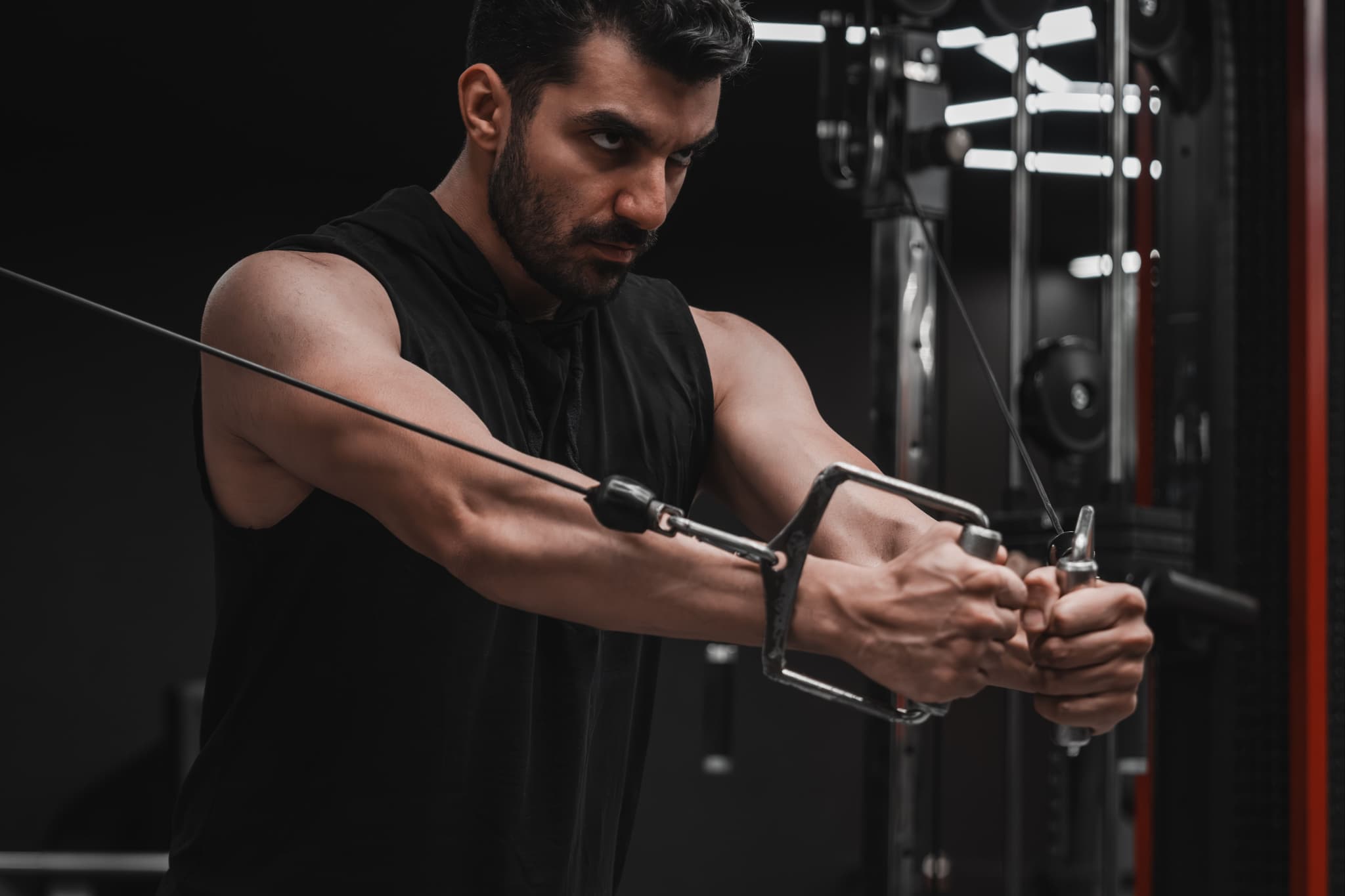
A dumbbell curl gives your biceps a break at the top of every rep. Cables don't. That's the real reason the best cable arm exercises feel harder even at lighter weight, and it's why most lists on this topic miss the point entirely. They hand you a name and a photo, then leave you guessing on sets and rest.
The pulley keeps your muscles loaded from the first inch of the movement to the last. No dead spot at lockout, no rest at the stretch. That constant tension stacks mechanical tension on top of metabolic stress, the two factors that actually build muscle. Soreness the next day doesn't count for much.
Each move below comes with a tempo, a rest period, and a rep range. You'll get exact numbers, not vague advice to "feel the burn." Follow the setup and your arms will be working from the first rep to the last.
Why Cable Exercises for Arms Create Constant Tension (and Why That Matters)
The Short Answer: How Cables Deliver Constant Tension
Cables keep resistance on your muscle through the entire range of motion. There's no dead spot at the top or bottom. That constant load keeps your arms under tension longer, which drives more metabolic stress and a bigger pump than free weights during the same set. This is the foundation of a constant tension arm workout.
Mechanical Tension vs. Metabolic Stress (and Why Muscle Damage Isn't the Goal)
Free weights lose tension at certain joint angles. Lock out a dumbbell curl and your biceps get a break. Cables don't give you that break.
Hypertrophy research points to three anabolic signals: mechanical tension, metabolic stress, and muscle damage, according to a Sports Medicine review on ScienceDirect. Mechanical tension, generated through resistance training, has been shown to be a primary driver of hypertrophy.
Muscle damage used to get credit for growth. That's outdated thinking. While muscle damage has been traditionally associated with growth, current research suggests it may be a contributing but not essential factor. Tension and metabolic stress do the heavy lifting, no actual tissue damage required.
This is where cable exercises for arms earn their spot in your program. They keep tension high at the stretch and at the lockout, the two points where dumbbells and barbells quit on you.
That constant load also builds metabolic stress fast. When your muscles are working hard to overcome the demand you're putting them through, they start to accumulate byproducts like lactate, hydrogen ions, and other metabolites. This buildup makes your muscles swell, burn, and fatigue, and while uncomfortable, it actually signals your body to grow.
The pump isn't just a look. It's a sign your training is stacking the right signals for arm growth.
Free weights still have a place in your program. But if you want a legit reason to add cable work, this is it. Constant tension plus metabolic stress means more growth stimulus per set, no extra damage needed.
That's the mechanism. Now let's get into the best cable arm exercises that use it best.
The Best Cable Arm Exercises for Biceps (Pump-Focused Picks)
These are the best cable arm exercises for biceps when you want a pump, not just strength numbers. Each one hits a different part of the tension curve. Stack them right and your biceps won't have anywhere to hide.
Cable Curl (Straight Bar): Constant-Tension Stretch
Attach a straight bar to a low pulley. Stand tall, elbows pinned to your sides.
Curl up on a 1-count, pause hard for 1 second at the top, then lower on a 3-count. That's your 3-1-1 tempo.
Run 3 sets of 10-12 reps. Rest 60 seconds between sets.
The cable keeps your biceps loaded even at full stretch, a spot where dumbbells go slack.
High Cable Curl (Cross-Body): Peak Contraction Finisher
Set two pulleys to shoulder height. Grab a handle in each hand, arms out to your sides like a goalpost.
Curl your hands toward your ears on a 2-count squeeze, hold for 1 second, release on a 2-count. Use a 2-1-2 tempo.
Do 3 sets of 12-15 reps. Rest 45 seconds.
This one locks tension into peak contraction, the spot where most curls lose it completely.
Bayesian Cable Curl: Lengthened-Position Overload
Face away from a low pulley, cable behind you, arm extended back.
Curl forward on a 1-count, squeeze, then stretch back slow on a 3-count. Tempo is 3-1-1.
Run 3 sets of 8-10 reps per arm. Rest 60 seconds.
A 2025 EMG study found statistically significant differences in muscle activation between the dumbbell biceps curl and the Bayesian curl, with the dumbbell curl producing greater activation (111.46 ± 26.80 versus 93.39 ± 15.65, p = 0.003, large effect size). Cables don't automatically beat free weights on activation. Use this move for the stretch position it creates, not because "cable equals more muscle."
Rope Hammer Curl: Brachialis Bias for Arm Thickness
Clip a rope attachment to a low pulley. Grip it with a neutral, palms-in stance.
Curl on a 1-count, squeeze at the top, lower on a 2-count. Tempo: 2-1-1.
Hit 3 sets of 12 reps. Rest 45 seconds.
This targets the brachialis, the muscle that pushes your biceps up and out. Add it last, once your arms are already fatigued.
Your triceps deserve the same attention to tempo and tension. That's next.
The Best Cable Arm Exercises for Triceps (Pump-Focused Picks)
Pressing builds triceps strength. Cables build triceps size.
A study comparing bench press variations found the triceps brachii showed higher activation on the dumbbell bench press, while the biceps brachii showed greater activity on the cable bench press (p≤0.05), according to research published in the International Journal of Strength and Conditioning.
That's the case for keeping heavy pressing in your program. Cables aren't a replacement for that stimulus. Use them to finish the job pressing starts: isolate the triceps and chase the pump your bench day doesn't deliver.
These are the best cable arm exercises for triceps when your goal is size, not just lockout strength.
Rope Pushdown: Elbow-Locked Tension for the Lateral Head
Attach a rope to a high pulley. Pin your elbows to your ribs and keep them there for the whole set.
Push down and spread the rope apart at the bottom. Control the eccentric on a 2-second count, pause briefly at full extension, then reset.
3 sets of 12–15 reps. Rest 60 seconds between sets.
Tension cue: Keep your elbows locked in place. Any drift forward turns this into a shoulder exercise.
Overhead Cable Extension: Long-Head Stretch Under Load
Set the pulley low, face away from the machine, and grab a rope attachment overhead. Step forward until your arms are extended.
Lower the rope behind your head on a slow 3-second eccentric. Stretch hard at the bottom, then extend fully without letting your elbows flare.
3 sets of 10–12 reps. Rest 75 seconds.
Tension cue: Chase the stretch at the bottom. That's where the long head grows.
Cable Kickback: Peak Squeeze for the Lockout
Set the pulley low behind you. Hinge at the hips, keep your upper arm parallel to the floor, and extend your forearm back.
Squeeze hard for a full second at lockout before you bend back to the start. Keep the tempo controlled. No swinging.
3 sets of 15 reps per arm. Rest 45 seconds.
Tension cue: The squeeze at the top is the whole point of this movement.
Single-Arm Reverse-Grip Pushdown: Medial Head Isolation
Attach a single handle to a high pulley. Grab it with an underhand grip, elbow locked to your side.
Push down slow, rotate your wrist slightly at the bottom for a harder squeeze, then return under control.
3 sets of 12 reps per arm. Rest 45 seconds.
Tension cue: The underhand grip shifts the load to the medial head. Feel it work before you add weight.
Stack these after your pressing work, not before it. Your triceps will thank you on the next bench day.
Bonus Cable Exercises for Forearms and Shoulders That Support Arm Growth
Your arms don't grow in isolation. Strong forearms and stable shoulders back up every curl and pressdown you do. Add these two moves if you've got time left in your session.
Cable Wrist Curl / Reverse Wrist Curl
Attach a straight bar to a low pulley. Kneel or sit, rest your forearm on your thigh, and let your wrist hang off the edge.
Curl the bar up using only your wrist. Control the way back down. Flip your grip for reverse wrist curls to hit the extensors on the back of your forearm.
Do 3 sets of 15-20 reps with light weight and full range. Your grip on heavy curls and pressdowns depends on this.
Cable Front Raise (for Delt-Arm Synergy in Pressing)
Set the pulley low, grab the handle with one hand, and raise your arm straight out to shoulder height. Keep your elbow slightly bent, not locked.
This targets the anterior delt, the muscle that drives pressing and overhead work. A weak front delt caps how much load your triceps can handle on presses.
Do three sets of 12 per arm.
Neither move belongs in your main arm day lineup, but they close gaps that limit your pressing and pulling strength everywhere else.
How to Program a Constant Tension Arm Workout for Max Pump
Picking good exercises only gets you halfway. How you sequence them and how long you rest decides whether you build tension or just burn time.
A constant tension arm workout needs both signals. Mechanical tension builds the muscle. Metabolic stress finishes the job.
Rep Range and Rest: Heavy-for-Tension vs. High-Rep-for-Burn
Exercises with high resistance and longer rest periods primarily lead to mechanical stress on the muscle fibers, while high repetition numbers with short breaks between sets cause greater metabolic stress. You need both in the same session.
Use this split:
Phase | Reps | Rest | Goal |
Tension | 6-8 | 90 sec | Load the fiber, build strength base |
Pump | 15-20 | 30 sec | Flood the muscle, chase the burn |
Start heavy. Finish light. Don't reverse the order or you'll gas out before the tension work matters.
Exercise Order: Compound-to-Isolation Supersets That Stack Both Signals
Open with a compound-style cable press or pulldown movement at 6-8 reps. Rest 90 seconds. That's your tension phase.
Then superset into an isolation cable move (curl, pressdown, whatever hits the same muscle) at 15-20 reps with 30 seconds rest. That's your pump phase.
Run this pairing for three rounds. Your arms get loaded first, then flooded.
The best cable arm exercises follow this structure. Next, plug in the exact cable moves that fit each phase.
Cable Machine Arm Routine for Best Results
This cable machine arm routine takes 20-25 minutes. No wasted sets, no guessing on rest.
The Full Session (Exercise Order, Sets, Tempo, Rest)
1. Rope Hammer Curl superset with Overhead Cable Extension 3 rounds. 12 reps each side, no rest between exercises. Tempo: 2 seconds up, 2 seconds down. Rest 60 seconds after the pair.
2. Cable Pressdown superset with Low-Pulley Curl 3 rounds. 10-12 reps each. Tempo: 1 second up, 3 seconds down on the pressdown. Rest 60 seconds after the pair.
3. Single-Arm Cable Curl 2 sets of 10 per arm. Tempo: controlled, no swinging. Rest 45 seconds between sets.
4. Drop-set finisher: Straight-Bar Cable Curl One working set to failure at your normal weight. Drop the pin 30%, go again to failure. Drop again, finish the set. No rest between drops.
Total volume lands around 14-16 working sets. Research on hypertrophy training generally points to 10-20 sets per muscle group per week as the productive range, so this session gives you a solid chunk of that volume in one sitting without burying you for tomorrow.
Why Cable Exercises for Arms Create Constant Tension
Cables maintain load throughout the entire range of motion. Unlike dumbbells, where tension drops at the top of a curl, a cable keeps your muscle working from start to finish. That constant tension is what drives the arm pump and forces adaptation.
How to Track Your Cable Arm Workout Progress
Building this session by hand takes effort. You have to track tempo and rest periods, then remember which drop-set weight worked last time.
SHRED handles the sequencing automatically. Open the app, pick "arm pump session," and it lays out this exact structure. Supersets get flagged and rest timers run in the background. Drop-set weights get logged, so you're not doing math between sets.
You just lift. The app tracks what matters.
Cable vs. Free Weights for Arms: What the EMG Data Actually Shows
Cables keep tension consistent through the full range of motion, while free weights can produce higher peak activation depending on the movement. Neither wins outright—the best choice depends on the exercise angle and your training goal.
An EMG study comparing bench press variations found the cable version resulted in greater activation of biceps brachii, whereas the dumbbell version resulted in greater activation of triceps brachii. Your arms have to stabilize against a constant, multi-directional pull throughout a cable press, and that stabilization demand is what drives the extra biceps activity.
Cables aren't automatically the better choice for biceps work, though. The same research group tested a traditional dumbbell curl against a cable curl, and the dumbbell curl won by a wide margin: statistically significant differences (p = 0.003) were observed in the EMG amplitude between the biceps curl (111.46 ± 26.80) and the cable curl (93.39 ± 15.65), with a large effect size (d = 0.82).
Gravity-based resistance still creates a stronger peak contraction in a straightforward curling pattern. Cables perform better when the exercise angle changes through the rep, not in a single-plane curl like that one.
Use free weights when you want peak tension in a fixed range, like a strict dumbbell curl. Use cables when the movement crosses planes, like presses, or when you want constant tension arm workouts that never drop off, like pressdowns and cross-body curls.
Smart training uses both. The best cable arm exercises below lean on what cables do best.
FAQs: Cable Arm Training, Answered Fast
What Cable Attachments Do You Need for the Best Cable Arm Exercises?
You need a straight bar, a rope, and a single-grip handle. The straight bar works for pressdowns and curls, the rope hits triceps from a different angle, and the single handle lets you train one arm at a time to fix imbalances.
How Many Sets and Reps Should You Do for Cable Exercises for Arms?
Run 3-4 sets of 10-15 reps with short rest for a pump-focused session. High-resistance, longer-rest training drives mechanical stress, while high-rep, short-rest work drives metabolic stress instead. Cables are built for the second approach. Keep rest under 60 seconds if size is the goal.
Can You Build Big Arms with Just a Cable Machine?
Yes. Cables keep constant tension on the muscle through the full rep, which free weights can't always do. But don't assume cables always win: a 2025 EMG study in the journal Muscles found that the dumbbell biceps curl elicited significantly greater muscle activation compared to the cable curl, suggesting that the conventional movement places a higher mechanical and neuromuscular demand on the biceps brachii.
A separate EMG study comparing dumbbell and cable bench press found the biceps showed greater activity on the cable bench press, while triceps activation was higher on the dumbbell bench press. Use cables for constant tension and pump work. Use free weights for peak activation when you need it.
Program your arm day around that split instead of picking a side.
The Bottom Line
Constant tension doesn't build arms by itself. Mechanical tension and metabolic stress have to work together, backed by real programming, to force growth. Pick the best cable arm exercises and still botch your tempo or rest periods, and you're leaving the pump on the table. Guessing your way through supersets and rest windows turns sessions into wasted time.
You don't need to guess. The SHRED app takes the routine outlined above and structures it for you: rounds, reps, tempo, and rest, all tracked so you're not doing math between sets. Show up and execute.
Load the session and run it. Your arms will feel the difference before you rack the last rep.
Related Articles
Dumbbell Arm Exercises for Beginners: Why Free Weights Beat Cables
Cables feel safer, but they hide the mistakes that matter most. See why dumbbell arm exercises beginners should master first build real strength, better balance, and honest form fast.
Step-Ups for Hamstrings: Box Height, Stance & Form Guide
Are step-ups actually a hamstring exercise, or just quads in disguise? Here's how box height, stance, and hip hinge decide the answer.
7 Progressive Overload Mistakes Beginners Make (and Fixes)
Stalled lifts? You might be making one of these 7 progressive overload mistakes beginners make without realizing it. Get the symptoms, causes, and exact fixes before it costs you months.