
Front Squats vs Back Squats: Muscle Differences Explained
Front squats and back squats don't just feel different — they load your muscles differently in ways most guides get wrong. Here's what the mechanics and EMG data actually show.
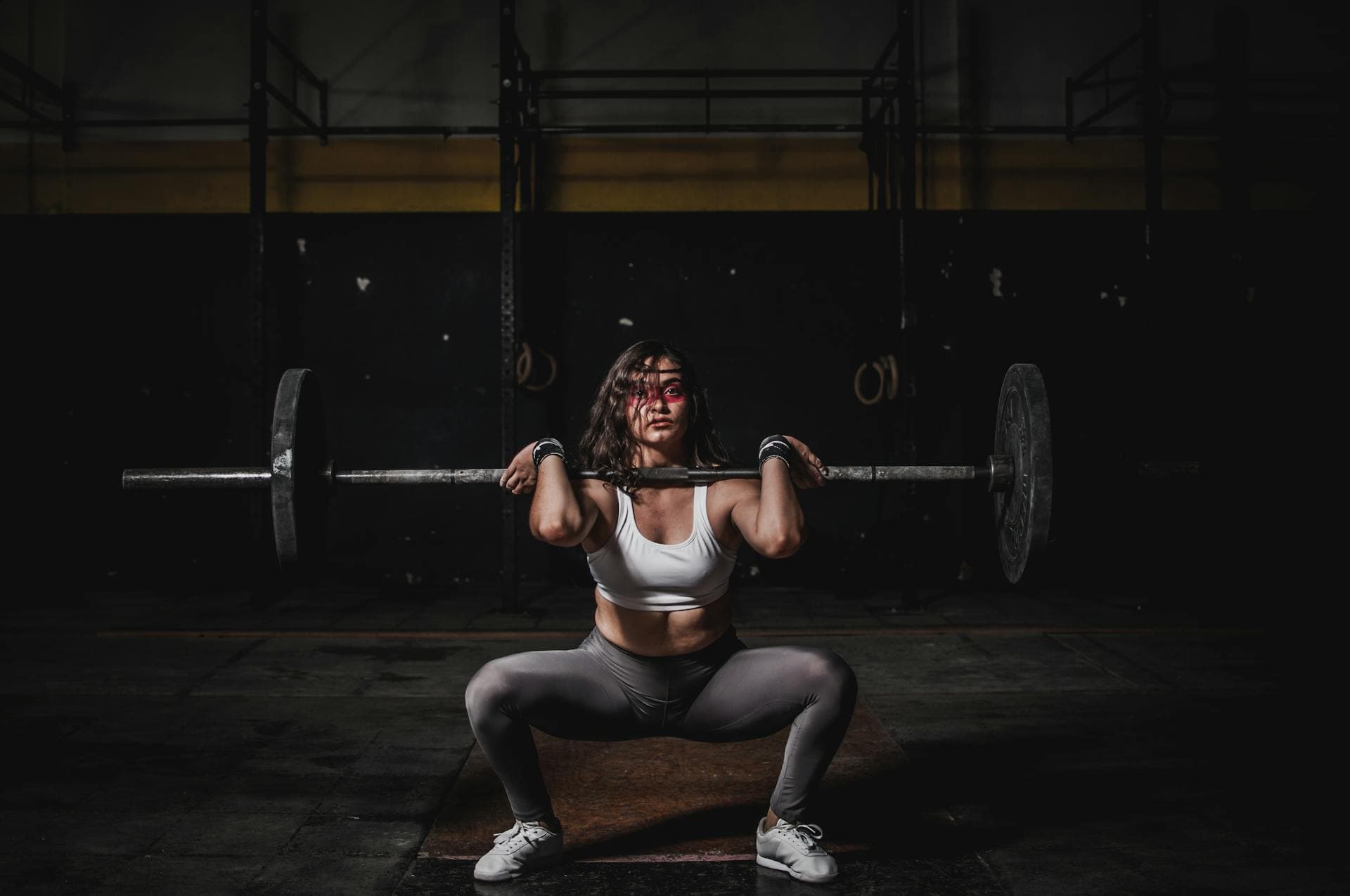
Most lifters treat front and back squats as interchangeable leg exercises. Understanding the muscle recruitment differences between front squats vs back squats muscles requires starting one level deeper, with the mechanics that drive recruitment in the first place. Bar position is not a comfort preference. It is a mechanical input that determines torso angle, which reshapes moment arms across your joints, shifting the demand between muscle groups in precise, predictable ways.
The difference is not simply front squats for quads and back squats for glutes. That framing is too blunt to be useful. The actual split is more specific, including a high-bar versus low-bar distinction that most guides collapse into a single category.
The main difference between a low-bar and high-bar back squat is bar position: the low-bar squat places the bar along the rear deltoids, while the high-bar squat positions it across the trapezius, and that slight alteration produces a different torso angle during the descent. Each variation produces different moment arms and different muscle emphasis. This article maps all three against the data, and closes with one finding on erector spinae activation that contradicts nearly everything you've read about where the front squat actually loads your body.
Research shows the front squat produces approximately 25% greater erector spinae EMG activity than the back squat, a result that runs counter to the widespread assumption that the front squat's more upright torso reduces lower-back demand.
Bar Position Changes Everything: Here Is the Mechanical Reason Why
Where the bar sits on your body is not a stylistic preference. It is a variable that reshapes the entire mechanical chain of the squat, from how your torso orients in space to which muscle groups are forced to generate the most force. Understand this chain, and every squat programming decision you make gets sharper.
Torso Angle Is the Actual Variable, Not Bar Height
Moving the bar from a high-back to a low-back position shifts your center of mass rearward. To keep that mass balanced over your base of support, your torso has to incline forward. This is a physics constraint, not a technique flaw.
Research published in the Journal of Sports Sciences by Yavuz et al. (2015) confirmed this directly: the back squat exhibited significantly greater trunk lean than the front squat, with no differences occurring in knee joint kinematics throughout the movement. That finding matters because it tells you torso angle, not what the knee is doing, is the primary driver of back squat muscle activation differences between these two lifts.
How Moment Arms Determine Quad vs. Hip Extensor Dominance
A moment arm is the perpendicular distance between a joint's axis of rotation and the line of force acting on it. The larger the moment arm, the greater the torque demand on the muscles crossing that joint.
In the low-bar back squat, the increased forward lean places a larger rotational demand on the hip extensors, specifically the gluteus maximus. This geometric shift increases the potential for lifting heavier absolute loads with a low-bar position compared to the high-bar position.
Shift the bar to the front rack position and the torso stays upright, shortening the hip moment arm and transferring the dominant torque demand toward the knee extensors. The quads have to work harder because the geometry demands it.
That mechanical redistribution is the foundation for every muscle-by-muscle difference covered ahead.
Front Squats vs Back Squats Muscles: The Key Differences at a Glance
The muscle emphasis shifts meaningfully between these two variations. Understanding how front squats vs back squats muscles differ helps you select the variation that matches your training goal.
Variation | Primary Muscles Emphasized | Biomechanical Driver |
Front Squat | Quadriceps (especially vastus medialis), upper back, core | Upright torso increases knee travel and anterior quad demand |
Back Squat (High Bar) | Quadriceps, glutes, hamstrings | Moderate forward lean distributes load across the posterior chain |
Back Squat (Low Bar) | Glutes, hamstrings, spinal erectors | Greater hip hinge shifts force demand to the semitendinosus and glutes |
Your choice of variation does not just change feel—it changes which tissue absorbs the load.
Yavuz et al. (2015) found greater vastus medialis EMG in the front squat during the ascending phase, while the back squat produced greater semitendinosus activation, confirming that hamstring recruitment scales with forward lean.
Front Squat Muscle Groups: Why the Upright Torso Loads the Quads So Hard
The front squat's upright torso position is not a stylistic outcome. It is the mechanical reason front squats vs back squats muscles differ in ways that directly affect training results.
Quadriceps, Especially Vastus Medialis
A more vertical trunk shifts your center of mass forward and increases demand on the knee extensors throughout the movement. Research by Yavuz et al., published in the Journal of Sports Sciences (2015), found that front squat vastus medialis EMG was significantly greater than back squat during the ascending phase (P < 0.05, d = 0.62) and across the whole movement (P < 0.05, d = 0.41). The vastus medialis, the teardrop-shaped muscle on the medial side of the thigh, drives both knee stability and terminal extension. If that muscle is a weak point in your development, the front squat gives you a direct mechanical route to address it.
The same study found greater semitendinosus activation in the back squat during the ascending phase (P < 0.05, d = 0.79), confirming that posterior chain demand shifts meaningfully between the two variations.
Upper Back and Anterior Core as Active Stabilizers
With the bar resting across the front of your shoulders, your upper back and anterior core work continuously to prevent forward collapse. This is not accessory stabilization. It is load-bearing work under real resistance.
Yavuz et al. confirmed that the back squat produced significantly greater trunk lean than the front squat, with no differences in knee joint kinematics between variations. Torso angle, not knee mechanics, is what separates these two patterns at the muscular level.
The erector spinae response adds another dimension to this picture, covered in full in the next section.
Back Squat Muscle Activation: High Bar and Low Bar Are Not the Same Exercise
Most lifters treat "back squat" as a single category. It isn't. Bar position changes your torso angle, your moment arms, and ultimately which muscles are doing the most work. The differences between front squats vs back squats muscles become even clearer when you compare high-bar and low-bar positioning—grouping these under one label produces programming decisions that don't match your actual training goals.
High-Bar Back Squat: A More Quad-Biased Pattern
In the high-bar variation, the bar rests across the upper traps. This allows a more upright torso, a movement pattern that keeps your center of mass closer to vertical and drives greater knee flexion. The result is a mechanical setup that resembles the front squat more closely than most lifters realize, with the quadriceps as the primary driver and a shorter hip moment arm limiting posterior chain demand. If your goal is quad hypertrophy and you're choosing between high-bar and front squats, you're splitting a narrower difference than the labels suggest.
Low-Bar Back Squat: How Forward Lean Recruits Glutes, Adductors, and Erectors
Drop the bar to the posterior deltoids and the mechanics shift substantially. Research published in the International Journal of Environmental Research and Public Health (2021) confirms that low-bar placement requires greater torso inclination to produce the same moment around the hip joint. That forward lean increases the gluteus maximus internal moment arm and enables heavier absolute loads. The adductor magnus becomes a meaningful contributor as hip extension demand rises, and the erector spinae work harder to control the inclined trunk throughout the movement.
This is why back squat muscle activation data varies so much across studies. Researchers are not always measuring the same exercise.
One area where the distinction narrows: hamstring involvement. EMG data for the semitendinosus remains relatively modest across both back squat variations compared to hip-dominant movements like Romanian deadlifts. The back squat is not a reliable hamstring developer regardless of bar position.
For a full breakdown of how these two bar placements compare across load, joint stress, and sport specificity, the [high-bar vs. low-bar guide] covers the programming trade-offs in detail.
Which Squat Variation Matches Your Training Goal: A Specific Answer
This squat variation comparison has one job: give you a clear answer based on what the muscle data already established.
Goal: Quad Size and Knee Strength
Use the front squat or high-bar back squat. Both produce greater knee flexion torque and direct more demand into the quadriceps than the low-bar position. If knee rehabilitation or quad hypertrophy is the target, the upright torso mechanics of the front squat make it the sharper tool.
Goal: Glute and Hamstring Development or Maximal Load
Use the low-bar back squat. The forward torso lean increases hip extensor moment arms, shifting mechanical demand to the glutes and hamstrings. It also allows heavier absolute loading, which is why it dominates powerlifting. If posterior chain development or peak strength output is the priority, low-bar is the correct prescription.
Goal: Athletic Carry-Over or Olympic Lifting Prep
Use the front squat. The upright torso, anterior core demand, and receiving position in the clean make it directly transferable to sport and Olympic lifting mechanics. Front squats also produce roughly 25% greater erector spinae activation than back squats, per EMG research published in the Journal of Strength and Conditioning Research, which matters for trunk stiffness under athletic load. For context, squat variations drive erector spinae activation to 70–100% of MVC at working intensities, far beyond the 20–45% MVC that isolated core exercises produce.
The Case for Programming Both in the Same Block
You do not have to choose permanently. Front squats develop the quad strength and trunk position that improve your back squat. Back squats build the posterior chain and load tolerance that support heavier front squat cycles. Run them together, and each variation reinforces the other's limiting factors.
The Erector Spinae Paradox: Front Squats Work Your Lower Back More Than Back Squats
The most misunderstood finding in squat research is this: front squats produce approximately 25% greater erector spinae EMG activity than back squats. That contradicts nearly everything you've read about this lift. The assumption that a more upright torso reduces lower back demand is not just incomplete. It is wrong.
Why Upright Does Not Mean Unloaded for the Spinal Erectors
The forward position of a front-loaded barbell creates a persistent forward pull on your center of mass throughout the entire range of motion. Your erectors have to resist that pull, fighting spinal flexion every inch of the descent and ascent. That constant anti-flexion demand under load drives erector activation higher than the more familiar hip-hinge mechanics of a back squat.
This is not a minor distinction. Nuzzo et al. (2008) found 70–100% MVC activation in the erector spinae during squats and deadlifts at 50–100% of 1-RM intensity. Isolated core exercises, by comparison, produced only 20–45% MVC—a critical gap that explains why front squats cannot be replaced by prone bridges or back extensions alone.
Front Squat vs. Back Squat: Muscle Activation Comparison
Muscle Group | Front Squat | Back Squat | Biomechanical Reason |
Erector Spinae | ~25% higher EMG | Baseline | Forward barbell position demands greater anti-flexion resistance |
Quadriceps | Higher activation | Moderate | Upright torso shifts load anteriorly |
Glutes | Moderate | Higher activation | Hip-hinge mechanics favor posterior chain |
Core (Rectus Abdominis) | Higher demand | Moderate | Anti-flexion requires greater anterior stability |
What This Means for Lower Back Strength and Programming
Calling the front squat "easier on the lower back" misrepresents the stimulus. The spine is not being spared. It is being loaded differently, through an anti-flexion challenge that isolated back extensions cannot replicate at that intensity.
If lower back strength is a gap in your training, the front squat is not the cautious choice. It is a direct solution—one that back squat muscle activation data alone cannot explain.
Frequently Asked Questions: Front Squats vs Back Squats
Do front squats work the same muscles as back squats?
No. Both front squats and back squats recruit quads, glutes, hamstrings, and erectors, but load distribution differs significantly. Front squats increase knee flexion torque and drive greater demand into the quads, while back squats shift emphasis toward the posterior chain, particularly in the low-bar position.
Are front squats better for quads than back squats?
Yes. The upright torso and forward knee travel in front squats produce greater quadriceps activation than back squats. A 2015 study in the Journal of Sports Sciences found vastus medialis activity was significantly greater in front squats, tied to the mechanical relationship between trunk angle and knee extensor demand.
Which squat is better for glutes — front or back?
The low-bar back squat targets glutes more effectively. Its greater forward lean increases the hip extension moment arm, directing more mechanical demand into the glutes and hamstrings. Front squats and high-bar variations do not replicate that posterior chain loading pattern.
Are front squats harder than back squats?
Yes. The front rack position demands wrist and thoracic mobility most lifters lack, and the forward-loaded bar raises balance demands considerably. You'll also move less absolute load, which affects how you structure progressive overload.
Is the front squat safer for your lower back?
Not necessarily. The erector spinae paradox detailed earlier shows front squats generate roughly 25% greater lower back muscle activity than back squats. The risk profile changes with each variation — it does not simply decrease.
Which squat is better for building muscle overall?
Your goal determines the answer. Front squats and high-bar back squats favor quad hypertrophy. Low-bar back squats target the posterior chain more aggressively. A well-designed program uses both squat variations rather than defaulting to one.
Do front squats work the same muscles as back squats?
Both lifts recruit the quads, glutes, hamstrings, and erectors, but load distribution differs. The front squat increases knee flexion torque and drives more demand into the quads, while the back squat shifts emphasis toward the posterior chain, particularly in the low-bar position. Understanding these front squat muscle groups versus back squat muscle activation patterns is essential for selecting the right variation for your goals.
Are front squats better for quads than back squats?
Yes. The upright torso and forward knee travel in the front squat produce greater quadriceps activation than either back squat variation. A 2015 study in the Journal of Sports Sciences confirms this, finding that vastus medialis activity was significantly greater in the front squat, tied directly to the mechanical relationship between trunk angle and knee extensor demand.
Which squat is better for glutes — front or back?
The low-bar back squat. Its greater forward lean increases the hip extension moment arm, directing more mechanical demand into the glutes and hamstrings. Neither the front squat nor the high-bar variation replicates that posterior chain loading pattern.
Are front squats harder than back squats?
Technically, yes. The front rack position demands wrist and thoracic mobility most lifters haven't developed, and the forward-loaded bar raises the balance challenge considerably. You'll also move less absolute load, which affects how you structure progressive overload.
Is the front squat safer for your lower back?
Not the way most people assume. The erector spinae paradox detailed earlier in this article shows front squats generate roughly 25% greater lower back muscle activity than back squats. The risk profile changes with each variation. It does not simply decrease.
Which squat is better for building muscle overall?
Your goal determines the answer. Front squats and high-bar back squats favor quad hypertrophy. Low-bar back squats target the posterior chain more aggressively. A well-designed program uses both rather than defaulting to one.
Your bar position is a programming decision, not a preference. Treat it that way.
The Bottom Line
Bar position is not a preference. It is the variable that sets your torso angle, your torso angle sets your moment arms, and your moment arms determine which muscles carry the greatest mechanical load. That single chain of causality explains every difference between front squats vs back squats muscles covered in this article.
So here is your next action. If quadriceps development is the goal, program front squats or high-bar back squats. If maximum posterior chain strength and peak loading are the priority, train the low-bar back squat. If spinal erector development matters to you, front squats are already doing more work there than most coaches will tell you.
Pick the variation that matches what you are actually trying to build, then train it with intent.
If you want that decision built into a structured plan, SHRED's squat-specific programming takes the guesswork out of the equation and puts the mechanics to work for you.
Related Articles
Dumbbell Arm Exercises for Beginners: Why Free Weights Beat Cables
Cables feel safer, but they hide the mistakes that matter most. See why dumbbell arm exercises beginners should master first build real strength, better balance, and honest form fast.
Step-Ups for Hamstrings: Box Height, Stance & Form Guide
Are step-ups actually a hamstring exercise, or just quads in disguise? Here's how box height, stance, and hip hinge decide the answer.
7 Progressive Overload Mistakes Beginners Make (and Fixes)
Stalled lifts? You might be making one of these 7 progressive overload mistakes beginners make without realizing it. Get the symptoms, causes, and exact fixes before it costs you months.