
Pistol Squat Muscles Worked: A Phase-by-Phase Guide
Quads and glutes are only half the story. See exactly which muscles the pistol squat targets at every phase, and why the extended leg works just as hard as the squatting one.
Pistol Squat Muscles Worked
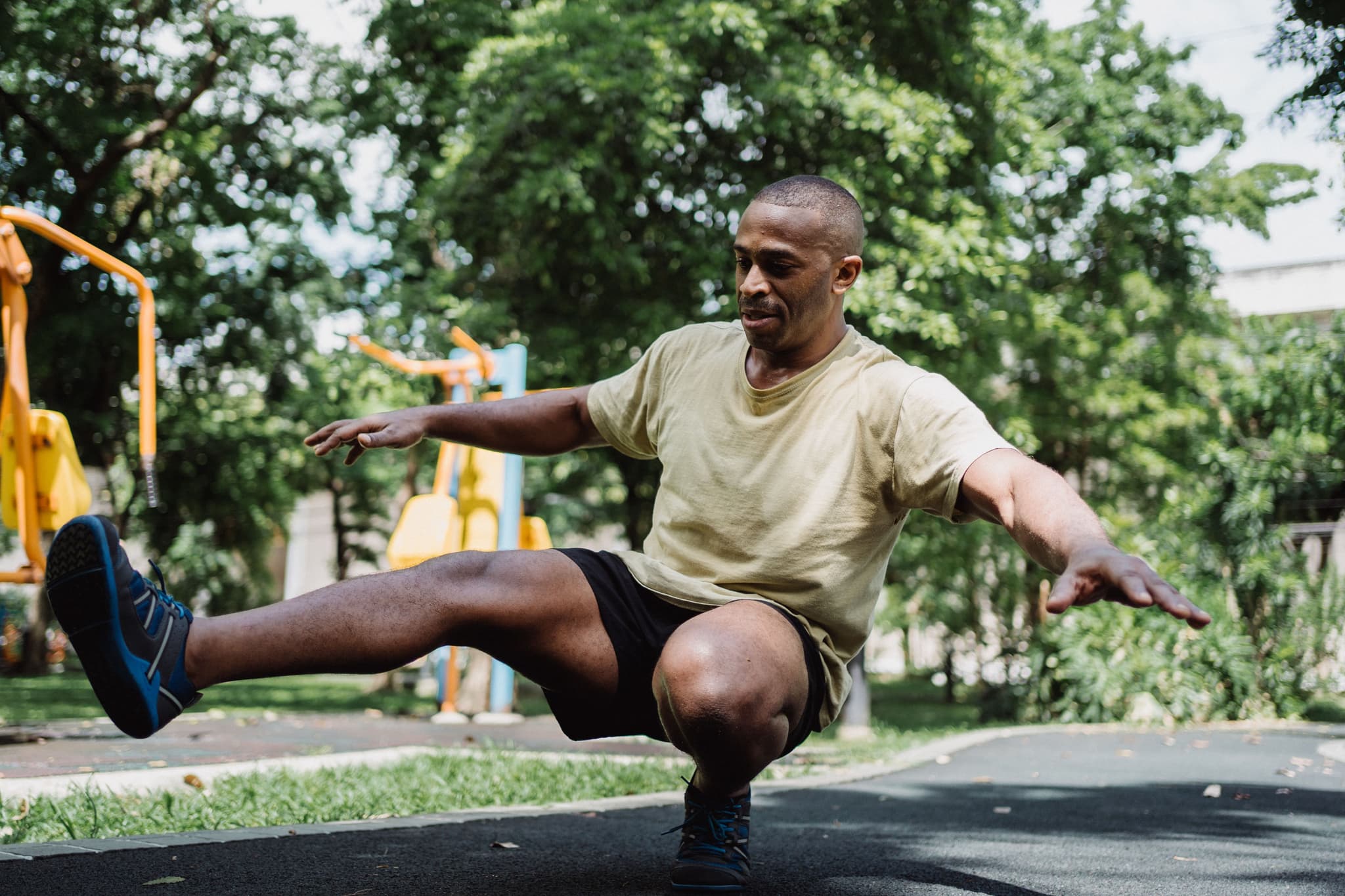
Ask most people what muscles a pistol squat works, and you'll get the same three answers: quads, glutes, hamstrings. That answer isn't wrong, but it misses more than half the story. The muscle demand at the bottom of a pistol squat looks nothing like the demand at the top, and the leg extended out in front of you works just as hard as the leg doing the squatting, in a completely different way.
Hip flexors work actively to hold the non-working leg extended out in front throughout the entire movement, which is why that "resting" leg burns as much as the working one by the end of a set.
Primary movers: quadriceps, glutes, hamstrings (working leg) Secondary stabilizers: hip flexors (extended leg), core, adductors, calves, tibialis anterior Key difference: Unlike a bilateral squat, a single-leg squat demands constant stabilization from smaller muscles to prevent rotation and collapse.
This guide breaks the movement down phase by phase, from setup to standing, so you can see exactly which muscles carry the load at each point in the rep. You'll also learn why a single-leg squat doesn't just cut the work of a bilateral squat in half, what that means for building real strength versus just surviving the pattern, and how to program pistols once your body is ready for them.
The pistol squat is a single-leg squat variation that demands far more from stabilizer muscles than bilateral movements. Your working leg's quadriceps, glutes, and hamstrings drive the movement, but the real challenge comes from muscles that barely activate in a standard back squat. The glute medius, hip abductors, and ankle stabilizers work overtime to prevent your knee from collapsing inward and keep you balanced on one foot. Your core locks down hard to stop your torso from rotating or tipping forward.
Quadriceps (rectus femoris, vastus lateralis, vastus medialis): drive knee extension
Glute maximus: powers hip extension out of the bottom position
Hamstrings: control knee flexion and assist hip stability
Glute medius and hip abductors: prevent the knee from caving inward
Core (obliques, transverse abdominis): keeps the torso upright against rotation
Ankle and calf stabilizers: manage balance on a single point of contact
The unilateral demand changes how load distributes through each phase of the movement.
Why the Single-Leg Squat Loads Muscle Differently Than a Bilateral Squat
Doubling the number of legs on the ground doesn't just split the workload in half. Ask someone to squat with both legs, then test each leg alone, and the math often doesn't add up the way you'd expect. That's why a single-leg squat can't be treated as a scaled-down version of a back squat. The nervous system handles the two situations differently, and that difference is what makes the pistol squat worth programming on its own merits.
What Muscles Are Worked in a Pistol Squat vs. a Bilateral Squat
A pistol squat muscles worked differently than a two-legged squat because only one leg bears the load. The primary movers—quads, glutes, and hamstrings—must generate force unilaterally, while stabilizer muscles in the core, hip, and ankle work harder to prevent rotation and collapse. The key distinction: in a single-leg squat, each leg operates as an independent neuromuscular unit rather than as part of a coordinated pair.
The Bilateral Deficit, Explained
During maximal contractions, the sum of forces exerted by homonymous muscles unilaterally is typically higher than the sum of forces exerted by the same muscles bilaterally, a phenomenon known as the bilateral strength deficit. Studies estimating the size of this gap have found ranges as low as roughly 5 percent in some leg exercises and considerably higher in others, depending on the joint action and contraction type tested. In plain terms, your legs don't always cooperate as efficiently as you'd assume when they're working at the same time.
Why This Isn't True for Every Lifter
The deficit isn't universal, and that matters. Although the physiological mechanisms of the bilateral deficit aren't fully understood, interhemispheric inhibition has been considered the primary neurological cause, alongside biomechanical factors like postural differences and changes in movement patterns. Trained populations respond differently. Athletes who perform predominantly bilateral actions, such as weightlifters, have been shown to exhibit bilateral facilitation, producing more force with both legs than either leg alone could generate.
That split matters for how you think about single-leg work. If training history shapes how the nervous system recruits muscle during unilateral movement, then the muscles worked in a pistol squat aren't half a squat. They're a different neuromuscular event, one worth examining leg by leg.
Pistol Squat Muscles Worked Phase by Phase
A single rep breaks down into four distinct phases, and the muscle demands shift at each one. Knowing this sequence turns the muscles-worked list into something you can coach, on yourself or on a training client.
What Muscles Does a Pistol Squat Work?
A pistol squat is a single-leg squat that demands stabilization and strength across the entire lower body and core. The primary movers are the quadriceps and gluteus maximus on the working leg, supported by the adductors, ankle stabilizers, and erector spinae. Unlike a bilateral squat, the pistol squat forces one leg to handle all the load, which intensifies demand on stabilizer muscles and makes balance a limiting factor.
Primary movers:
quadriceps, gluteus maximus
Secondary stabilizers:
adductors, gluteus medius, ankle stabilizers (peroneals, tibialis posterior)
Postural support:
erector spinae, core, obliques
Setup and Balance Bracing
Before you bend a single joint, your standing leg's ankle stabilizers (the peroneals and tibialis posterior) start working to keep your foot from rolling. Your core and obliques brace hard here, locking your torso into a position that won't collapse once gravity starts pulling.
The gluteus medius on the standing leg activates early too. It prevents the opposite side of the pelvis from dropping when a limb is taken off the ground, since the pelvis on that side will tend to drop through a loss of support from below. If it's weak, you'll feel your hip wobble before you even start the descent.
Eccentric Descent: Quadriceps and Hip Control
The lowering phase of a pistol squat muscles worked is where the quadriceps do most of the visible work, controlling knee flexion under load. The quadriceps aren't working alone. Your gluteus maximus lengthens under tension to control hip flexion, and your adductors kick in to keep the knee tracking over the foot instead of caving inward.
Your erector spinae stay isometrically active through the whole descent, keeping your spine from rounding as your torso leans forward to counterbalance the extended leg. This is a heavier ask than in a bilateral squat, because you don't have a second base of support sharing the load.
Bottom Position
At full depth, the quadriceps and glutes are near their longest muscle length while still under load, which is exactly why this position feels so unforgiving. The adductors are maxed out too, working to stabilize the femur when the hip is this deeply flexed and internally rotated.
Ankle mobility becomes the limiting factor for a lot of lifters right here. If your calf complex can't lengthen enough to let your knee travel over your toes, you'll lose balance or drop your heel before you ever get the chance to drive back up.
Concentric Drive: Glute and Quad Extension
The upward phase demands maximum output from the gluteus maximus and quadriceps together, with the glutes taking over more of the load as your hip extends. This is where hip extension strength separates people who can pistol squat from people who can only lower into one.
Your core and erector spinae are still firing to keep your torso from pitching forward as you stand, and the standing leg's ankle stabilizers keep making tiny corrections until you lock out.
The Overlooked Muscle Group: What the Elevated Leg Is Doing
Every guide to the pistol squat obsesses over the leg doing the work. Almost none of them talk about the leg hanging in front of you, and that leg is not just along for the ride.
What Muscles Work During the Non-Working Leg Phase
The elevated leg in a pistol squat isn't passive. Your hip flexors work actively to hold the non-working leg extended out in front throughout the entire movement, primarily the iliopsoas, which crosses your hip to run from your spine to your upper leg, and your rectus femoris, the only quadriceps muscle that also crosses your hip. Try holding your leg parallel to the ground for 20 seconds while standing still and you'll feel the hip flexors light up fast. Now add the demand of squatting on the other leg at the same time.
Strength isn't the only cost. Hamstring flexibility matters because the non-working leg needs to stay extended throughout the movement, and tight hamstrings will pull it down and make the exercise significantly harder. If your posterior chain doesn't tolerate that stretch well, you'll feel it pulling at the back of the knee before your quads even start burning on the working side.
This is why some lifters with plenty of single leg squat strength still can't get into a full pistol squat. The limiting factor isn't the working leg's output. It's the extended leg's inability to hold a straight-line position under stretch, hip flexors firing and hamstrings lengthening, for the full range of the movement.
Train hip flexor endurance and hamstring flexibility as their own goals, separate from squat practice, and the working leg's strength shows up in the full movement much sooner.
Pistol Squat Muscles Worked and Benefits as a Bodyweight Squat Variation
A pistol squat doesn't build muscle the same way a barbell squat does, but that doesn't make it a gimmick with a strength label slapped on it either. The answer depends on what you're measuring.
Bilateral vs. Unilateral Training: What the Research Shows
Häkkinen and colleagues tested this directly, training one group with bilateral squats and another with unilateral work. The bilateral group saw a bigger jump in bilateral 1RM, while the unilateral group gained more single-leg strength in each leg. Quadriceps hypertrophy showed no significant difference between the two groups.
That result matters more than the strength numbers. A 2025 meta-analysis by Kassiano and colleagues reported that while muscle hypertrophy showed no significant difference between bilateral and unilateral training, strength adaptations appeared to favor different goals depending on the training style. Muscle doesn't care how many legs are on the ground. It cares about tension, effort, and proximity to failure.
The pistol squat won't replace a heavy barbell squat if raw bilateral strength is your goal. As a hypertrophy tool, it holds its own, and it adds per-leg strength balance, stabilizer demand, and mobility work packed into one movement.
Most lifters never get to test that hypertrophy potential. The movement demands roughly 35 to 40 degrees of ankle dorsiflexion, tested with a simple knee-to-wall check. Restricted ankle mobility is the main reason people compensate with a heel lift, knee valgus, or a trunk lean that turns the squat into a good morning.
Pistol Squat Muscles Worked and Programming: Sets, Reps, and Mobility Prerequisites
Deciding to add pistols to a program is only half the equation. The other half is figuring out whether your body is actually prepared for the pattern, and how to load it so it produces results instead of compensations.
Ankle Mobility Requirements
Pistol squats require approximately 35-40 degrees of ankle dorsiflexion, the ability to push your knee 4-5 inches past your toes while keeping your heel flat on the ground, according to Odin Fitness. That's well beyond what most lifters bring to a standard bodyweight squat.
Test it with the knee-to-wall lunge: get into a half-kneeling position, drive your front knee toward the wall while keeping your heel flat, and measure how far your foot can sit from the wall before the heel lifts. If you can't hit that range, restricted dorsiflexion becomes the primary limiter, and it shows up downstream as heel lift, knee valgus, or a trunk lean so severe the squat turns into a hip hinge with extra steps.
Screening Before You Load the Pattern
Don't skip the screen just because someone looks athletic. TrainHeroic's coaching resources point out that single-leg strength deficits and mobility restrictions often hide in people who squat heavy bilaterally without issue. Check ankle dorsiflexion, single-leg balance for at least 20 to 30 seconds per side, and basic hip control before adding load or depth demands.
Sample Set/Rep Ranges for Hypertrophy vs. Strength
Goal | Sets | Reps | Notes |
Hypertrophy | 3-4 | 6-10 per leg | Slow eccentric, pause at depth |
Strength | 4-5 | 3-5 per leg | Add external load (vest, dumbbell) |
Skill/Mobility | 2-3 | 5-8 per leg | Focus on control, not fatigue |
A Sports Medicine review by Kassiano and colleagues, which included nine studies comparing unilateral and bilateral training methods, backs up the general pattern: the choice of exercise doesn't seem to matter much when it comes to building muscle, both can lead to gains as long as training volume and intensity are high enough. That data supports treating pistols as a legitimate hypertrophy tool rather than a novelty exercise, provided the mobility prerequisites are in place first.
Frequently Asked Questions About Pistol Squat Muscles Worked
What muscles do pistol squats work?
The pistol squat is a single-leg squat variation where one leg bears your full body weight through a deep squat while the other leg extends forward. Your quadriceps act as the primary mover, absorbing and reversing your entire body weight with no load sharing. Your glutes and adductors stabilize your knee to prevent inward collapse, while your deep core muscles prevent torso rotation. Ankle and foot stabilizers engage heavily—work they rarely face in bilateral squats.
Why are pistol squats so hard?
The difficulty comes from stacking three demands at once: strength, balance, and mobility. You need enough single-leg quad strength to control a full range-of-motion squat, enough ankle and hip mobility to sit down without your heel lifting, and enough stability to avoid tipping over. Most lifters have decent strength but fail on the mobility or balance piece, which is why the movement feels harder than the load suggests.
Do pistol squats work hamstrings?
Yes, though as a supporting player rather than the star. Your hamstrings help control the descent and assist your glutes with hip extension on the way up, especially if you sit back into the squat rather than staying upright. They won't get the same stimulus as a Romanian deadlift, but they're not sitting idle either.
The Bottom Line
The pistol squat muscles worked include your quads, glutes, and stabilizers, but they don't all fire the same way in a single rep. The quads control the descent eccentrically, then drive the stand back up concentrically. The glutes fire hardest at hip extension near lockout. The elevated leg's quad stays active the whole time just to keep that leg from touching the ground, and the ankle, hip, and core stabilizers work continuously to keep you from tipping over. One leg handles the full range of motion while the other stays rigid in front of you, running on different timelines but toward the same rep.
Build a strong, technically sound bilateral squat first. Clear the ankle and hip mobility prerequisites before you add load. Then layer in single-leg work to close the strength and stability gaps a barbell squat can't touch. Get that sequence right and the pistol squat earns its spot in your program instead of becoming a stunt you post and never repeat.
Related Articles
Dumbbell Arm Exercises for Beginners: Why Free Weights Beat Cables
Cables feel safer, but they hide the mistakes that matter most. See why dumbbell arm exercises beginners should master first build real strength, better balance, and honest form fast.
Step-Ups for Hamstrings: Box Height, Stance & Form Guide
Are step-ups actually a hamstring exercise, or just quads in disguise? Here's how box height, stance, and hip hinge decide the answer.
7 Progressive Overload Mistakes Beginners Make (and Fixes)
Stalled lifts? You might be making one of these 7 progressive overload mistakes beginners make without realizing it. Get the symptoms, causes, and exact fixes before it costs you months.