
Hack Squat Muscles Worked: The 45-Degree Angle Changes Everything
Ever wonder why hack squats torch your quads differently than barbells? The 45-degree track changes everything about which muscles fire—here's the full breakdown.
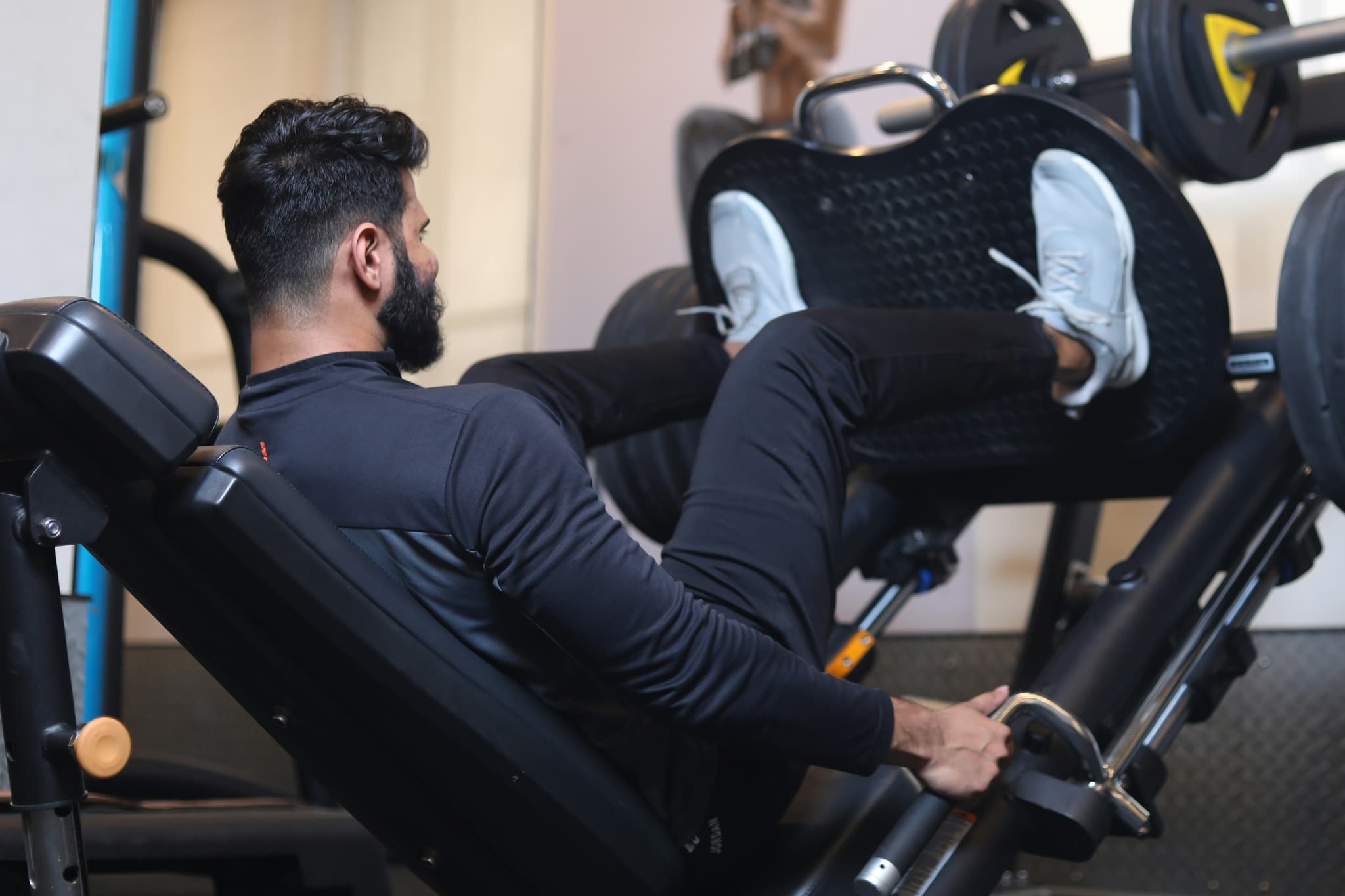
Load a hack squat machine and your hips barely bend. The machine provides a fixed movement path along an angled track, typically at around 45 degrees, built for focused quadriceps development with reduced technical demands. That angle pins your torso to the pad before you unrack a single plate, and it strips hip flexion out of the movement almost entirely. Your knees end up doing the negotiating that your hips, spine, and ankles usually split among themselves.
The back pad enforces an upright trunk angle, which shifts the load from the hips to the quadriceps. That's why the hack squat muscles worked are primarily the quad group. Foot position on the platform changes which part of the quad fires hardest: a lower foot placement can help you target the vastus medialis (the muscle just above the kneecap), while a higher stance shifts emphasis toward the glutes and hamstrings. The rectus femoris, vastus lateralis, vastus medialis, and vastus intermedius all contribute to the movement, but their activation levels shift based on foot placement. Swap in a barbell squat for a few sets and you won't load the same tissue the same way.
This piece breaks down the biomechanics behind that angle, then gets specific about where to place your feet if you're chasing a particular quad head instead of a generic pump.
Hack Squat Muscles Worked: The Quick Answer
The hack squat muscles worked are dominated by the quadriceps. The fixed foot platform and 45-degree back pad lock your torso in place, so your knees do most of the work instead of your hips. That backward lean removes much of the balance demand a barbell squat requires, letting you push harder on the muscles that extend the knee.
Here's the breakdown:
Rectus femoris
(primary): the two-joint quad muscle running down the center of the thigh
Vastus lateralis
(primary): outer quad, heavily loaded through the full rep
Vastus medialis
(primary): inner quad, key for knee stability near lockout
Vastus intermedius
(primary): deep quad muscle under the rectus femoris, hard to feel but working the entire time
Gluteus maximus
(secondary): assists hip extension, especially near the top
Adductor magnus
(secondary): stabilizes the hips through the descent
That quad emphasis explains why lifters use this machine for leg size. The next section breaks down why the angle makes such a difference.
Why the 45-Degree Angle Changes Everything: The Biomechanics Behind Hack Squat Muscles Worked
The number that matters here isn't the machine's brand or pad thickness. It's the angle between your trunk and your tibia, and the hack squat fixes that angle before you even load a plate.
What Muscles Does the Hack Squat Work?
The hack squat targets the quadriceps as the primary mover, with secondary engagement from the glutes and hamstrings. The four quad heads—rectus femoris, vastus lateralis, vastus medialis, and vastus intermedius—handle most of the load because the machine's fixed backrest keeps your torso upright and increases the knee flexion moment throughout the lift.
How Trunk Angle Controls the Knee-vs-Hip Extensor Split
Every squat pattern splits work between two joint moments: a knee flexion moment that the quads resist, and a hip flexion moment that the glutes and hamstrings resist. Which muscle group does more work depends almost entirely on how far your trunk leans forward relative to your shins.
In a barbell back squat, your torso has to lean forward to keep the bar over your midfoot as you descend. That forward lean increases the hip flexion moment, which is why barbell squats build serious posterior chain strength alongside quad size. The hack squat vs barbell squat difference comes down to this single mechanical constraint: the backrest removes the forward lean option.
Trunk-Tibia Angle as the Primary Predictor of Quad Bias
Trunk-tibia angle is the prime predictor of the hip and knee moment during the squat, according to research by Straub, Barrack, Cannon, and Powers. Their work established the mechanism: sagittal plane inclination of the trunk and tibia independently modulate hip and knee extensor moments during squatting, and the difference between trunk and tibia inclination approximates the relative demand on the hip and knee extensors. Straub and Powers laid out the practical version in their 2024 review in the International Journal of Sports Physical Therapy: squatting with the trunk in a more upright position increases the knee flexion moment while decreasing the hip flexion moment.
The hack squat's backrest locks your trunk close to upright relative to your shin no matter how deep you go. Your tibia still translates forward over your toes as you descend, but your torso can't compensate by leaning forward the way it does under a free bar. That fixed relationship between trunk and tibia spikes the knee flexion moment and mutes the hip flexion moment on every rep.
This is a mechanical constraint, not a training cue you have to remember. Once you understand what the backrest is doing to your joint angles, the rest of your hack squat technique starts making sense.
Mapping the Four Quad Heads: Foot Placement as a Targeting Tool
The quadriceps aren't one muscle. They're four: rectus femoris, vastus lateralis, vastus medialis, and vastus intermedius. On the hack squat, the muscles worked depend heavily on where you place your feet on the platform. Foot placement is your primary lever for deciding which quad head absorbs the most tension on any given set.
Most gym-goers skip past this detail. It's the difference between a machine that "hits quads" and a machine you can actually program with intent.
Narrow, Feet-Inside Stance: Maximizing Rectus Femoris and Overall Quad Activation
Bring your feet close together and set them low or centered on the platform. This narrows your base and increases knee flexion demand across the board.
Stance width alone has a smaller effect on which specific quad head fires than most lifters assume. Research on squat stance suggests that stance width does not cause isolation within the quadriceps but does influence muscle activity on the medial thigh and buttocks. Where a narrow stance can still matter is torso angle: a tighter base tends to force a more upright trunk, and since the rectus femoris crosses the hip as well as the knee, less hip extension shifts more of the workload onto that muscle. Treat this as a secondary effect from torso position, not a guaranteed switch that isolates rectus femoris on its own.
Narrow and inside keeps total quad activation high, with rectus femoris playing a bigger supporting role.
Low Foot Placement: Targeting the Vastus Medialis via Greater Knee Flexion
Slide your feet down toward the bottom edge of the platform. This forces your knees further forward and deeper into flexion at the bottom of the rep.
Deeper knee flexion is the real driver here. A study on narrow and wide stance squats found no significant differences between stances for vastus medialis to vastus lateralis (VMO:VL) ratios, but the ratio was significantly higher with increasing knee flexion angles. In plain terms: the deeper your knee bends, the more the vastus medialis, the teardrop muscle above your inner knee, gets called on relative to the outer quad. That's the mechanism low foot placement exploits, and it's a head many lifters struggle to build with standard barbell work.
Low foot placement is your vastus medialis builder.
High and Wide Placement: Shifting Load to Glutes and Adductor Magnus
Move your feet up toward the top of the platform and widen your stance. This shortens the knee's range of motion and shifts the hip into a bigger role.
Placing the feet lower on the platform leads to greater quad activation, whereas higher foot placement activates the glutes more. Placing your feet higher and further forward shifts the load from the knees toward the hips, which requires more hip extension, the glutes' primary job. This shifts load toward the posterior chain, hitting the glutes and adductor magnus harder while quad involvement drops relative to the narrow stance.
High and wide trades quad isolation for glute and adductor work.
Hack Squat vs Barbell Squat: Why the Muscles Worked Differ
A barbell squat gives you a free bar path. You control where the bar travels, so your hips, spine, and ankles negotiate the descent together. Small shifts in trunk lean change how much work your glutes and hamstrings take on versus your quads.
The hack squat removes that negotiation. The backrest and shoulder pads lock your trunk angle before you unrack the sled, so your knee is left doing most of the mechanical work. That's the core difference: one lets your trunk move, the other doesn't. This is why the hack squat muscles worked are predominantly quad-focused, while a barbell squat distributes load across multiple lower-body chains.
Research on squat mechanics backs this up. Straub and Powers, in a biomechanical review published in the International Journal of Sports Physical Therapy titled "A Biomechanical Review of the Squat Exercise: Implications for Clinical Practice," showed that squatting with the trunk in a more upright position increases the knee flexion moment while decreasing the hip flexion moment. In plain terms, lean forward and you shift load toward the hips (glutes and hamstrings); stay upright and the knees, meaning the quads, pick up more of the work. A barbell squat lets you lean forward under load, shifting stress toward the posterior chain. A hack squat won't let you make that adjustment even if your body wants to.
That fixed trunk angle also changes your injury risk profile. Barbell squats demand trunk stability from your core and spinal erectors under a moving load. Hack squats hand you that stability, so your lower back stays passive while your knees absorb nearly all the mechanical stress.
Neither pattern is better on its own. If you're chasing quad hypertrophy without recruiting your posterior chain as a stabilizer, the hack squat's fixed path does something a barbell squat can't.
What the Hack Squat Doesn't Do: Hamstrings, Glutes, and Spinal Erectors
The hack squat is a quad-dominant machine, but marketing copy for gym equipment claims a machine works "everything." The hack squat doesn't, and pretending otherwise sets you up for a weak posterior chain.
Does the Hack Squat Work Hamstrings?
EMG research comparing squat variations found that erector spinae and semitendinosus (hamstring) activation during hack squat were significantly lower than all other squat variations. The fixed torso angle is the reason. Your hamstrings cross both the hip and knee joints, and they rely on hip flexion under load to generate real tension. Lock your trunk against a padded backrest and you strip out most of that hip movement before the set even starts.
Is the Hack Squat Good for Glutes?
Glute involvement is minimally significant on the hack squat. Research on hack squat mechanics notes that the fixed back pad eliminates the forward lean that recruits glutes and erectors in free-weight squats, concentrating demand on the quadriceps. On the hack squat, the pad handles the stabilizing work your glutes would normally take on, so they still fire, but at a fraction of what a barbell squat demands.
Spinal Erectors and Trunk Stability
Spinal erectors get the smallest share of all. A study comparing trunk muscle activation between the two exercises found back squat trunk muscle activation was significantly greater than hack squat for all muscles and phases except rectus abdominis in the concentric phase. The researchers concluded that the back squat is more effective than the hack squat at activating the muscles of the trunk, and therefore arguably more effective at developing trunk strength and stability for dynamic athletic performance. The hack squat's back pad does that stabilizing job for you, which is exactly why lifters with lower back issues gravitate toward it. Less erector demand means less spinal fatigue during the set, but it also means you're not training that stabilization capacity.
None of this makes the hack squat a lesser exercise. It's a specific tool built to isolate the quads, and specific tools work best paired with something that covers what they leave out.
Hack Squat Benefits for Quad-Focused Training
The real payoff of the hack squat shows up when you compare it against everything else on the squat rack. Researchers ran EMG tests on 14 healthy men across five squat variations—hack, front, back, sumo, and Zercher—and found that erector spinae and semitendinosus activity during the hack squat were significantly lower than all other variations (p < 0.05). The researchers concluded that the hack squat may be a good choice for better knee and spinal stabilization. That gap is what makes the hack squat useful as a dedicated quad-focused squat. You get knee extensor recruitment without asking your lower back or hamstrings to co-sign the lift.
That matters most on high-volume leg days. Free-weight squats tax your spinal stabilizers set after set, and by your fourth or fifth working set, grip and back fatigue often end the exercise before your quads are actually done. The hack squat removes that ceiling. You can push the quads closer to failure because the machine, not your erectors, holds the trunk in place.
Programmed after a compound lift like the back squat or deadlift, the hack squat lets you finish the job on the quads specifically, adding targeted volume without stacking more fatigue onto a spine that's already worked. This is one of the clearest hack squat benefits when you stack it against a barbell squat for pure quad development.
Frequently Asked Questions About Hack Squat Muscles Worked
What muscles does a hack squat work?
A hack squat primarily targets the quadriceps, specifically the rectus femoris, vastus lateralis, vastus medialis, and vastus intermedius. The fixed 45-degree track locks your body into a vertical pressing pattern, which removes the balance demands of free-weight squats and directs nearly all the load to your knee extensors. Secondary muscles include the glutes, hamstrings, and adductors, though they receive far less tension than in a barbell squat. Your core and stabilizer muscles stay mostly inactive because the machine handles the balance work.
What is the difference between a hack squat and a regular squat?
The angle changes the demand on your body. A regular barbell squat loads your spine directly and asks your hips, ankles, and trunk muscles to stabilize a free-moving bar. The hack squat locks you into a fixed 45-degree track, which removes most of the balance work and shifts the load almost entirely onto the knee extensors.
Machine-based squat variations like the hack squat cut down on trunk and hip involvement compared to free-weight squats, since the fixed track handles the stabilization your core would otherwise do. Less total-body coordination, more direct quad tension. Neither version is objectively better. They train different things.
Is hack squat better than leg press?
Not necessarily better, just different in setup. The hack squat has you standing upright against a back pad with your legs driving the platform, which keeps some spinal loading in play and demands more ankle and knee coordination than a leg press. A leg press seats you at an angle with your back fully supported, isolating the legs even further and removing almost all stabilizer involvement.
If your goal is pure quad isolation with the least technical demand, leg press wins. If you want a squat pattern that still builds some structural tolerance while keeping the emphasis on the quads, the hack squat is the better tool for the job.
The Bottom Line
The fixed 45-degree angle is the entire mechanism, not a design quirk. It locks your trunk in place, strips away hip torque, and hands the workload almost entirely to your quads. That turns your foot position into a dial you can adjust rather than a detail you can ignore. Understanding which hack squat muscles worked depends on where you place your feet on the platform.
A narrow foot stance places greater emphasis on the outer quadriceps (vastus lateralis), while a wide foot stance targets the inner quadriceps (vastus medialis). The rectus femoris and vastus intermedius also contribute, but foot position shifts the load between these heads. Precision is the real value here. Where you stand on the platform, not the machine alone, determines which quad head picks up the extra work.
Don't file this away as trivia for your next gym session. Walk in with a plan. Pick the foot placement that matches the quad head you're chasing, load the plate, and let the angle do what a free-standing barbell never could.
Related Articles
Dumbbell Arm Exercises for Beginners: Why Free Weights Beat Cables
Cables feel safer, but they hide the mistakes that matter most. See why dumbbell arm exercises beginners should master first build real strength, better balance, and honest form fast.
Step-Ups for Hamstrings: Box Height, Stance & Form Guide
Are step-ups actually a hamstring exercise, or just quads in disguise? Here's how box height, stance, and hip hinge decide the answer.
7 Progressive Overload Mistakes Beginners Make (and Fixes)
Stalled lifts? You might be making one of these 7 progressive overload mistakes beginners make without realizing it. Get the symptoms, causes, and exact fixes before it costs you months.