
Anterior Pelvic Tilt From Sitting: How to Fix It
Sitting all day wrecking your posture and your lifts? Learn whether anterior pelvic tilt from sitting is actually your problem and get a training-integrated fix that works.
How to Fix Anterior Pelvic Tilt From Sitting All Day
If you spend the better part of your day at a desk, you've likely heard that anterior pelvic tilt from sitting is wrecking your posture and your lifts. The standard response is a short list of hip flexor stretches and a reminder to sit up straight. That advice ignores what you actually do in the gym, and it skips something worth knowing: sitting alone may not be the cause, and some degree of forward pelvic tilt is normal anatomy, not a postural failure.
That distinction matters before you change anything.
This article respects the counter-evidence. It looks at what's actually tight and what's actually weak, and it builds the fix around the training you're already doing rather than asking you to bolt on a separate rehab circuit. By the end, you'll know whether anterior pelvic tilt from sitting is genuinely excessive in your case, which muscles are responsible, and exactly how to correct it without abandoning your program.
What Anterior Pelvic Tilt Actually Is, and How Much Is Normal
Most people who get told they have anterior pelvic tilt treat it like a diagnosis. It isn't. It's a description of how your pelvis sits in space, and some degree of forward tilt is normal anatomy, not a postural failure.
The Clinical Definition and What the Numbers Mean
Anterior pelvic tilt means the front of your pelvis drops lower than the back, increasing the curve in your lumbar spine. Commonly cited norms put normal tilt at roughly 4–7 degrees in males and 7–10 degrees in females, though there is considerable variability across asymptomatic individuals. One radiographic study found an average of 13 degrees with a range spanning from –4.5 to 27 degrees in adults with no symptoms. That visible arch in your lower back isn't a red flag by default. It becomes a problem when it's excessive, fixed, and paired with symptoms like lower back pain from sitting or hip tightness.
The actual clinical issue isn't the tilt itself. It's the loss of motor control that makes it permanent.
Quick Answer: How to Fix Anterior Pelvic Tilt From Sitting All Day
Anterior pelvic tilt from sitting develops when prolonged hip flexion tightens the hip flexors and shuts down the glutes, locking the pelvis in a forward position. Fix it in four steps:
Assess
your actual tilt against the sex-specific norms
Release
overactive hip flexors and lumbar extensors
Activate
inhibited glutes and deep abdominals
Integrate
neutral pelvic positioning into loaded movement patterns
The sections below break down each step with the specific exercises that move the needle.
Does Sitting All Day Actually Cause Anterior Pelvic Tilt?
U.S. adults average 9.5 hours of sedentary time per day. Sedentary jobs have increased 83% since 1950. The assumption that follows—that all that sitting is tilting your pelvis forward—seems logical. It's also not well supported by the research.
What a 2021 Study Found (And Why It Matters)
A 2021 study by Koumantakis et al. found that neither inactivity (sitting hours per day) nor leisure-time sport activity was related to lumbopelvic posture. Sitting more did not meaningfully change how people's pelvis sat at rest. If you've seen this cited by E3 Rehab or similar sources, you already know the straightforward "sitting causes anterior pelvic tilt" story has real cracks in it.
An article that ignores this data isn't giving you an accurate picture.
The Functional Problem Sitting Actually Creates for Lifters
The story gets more specific here. Sustained sitting may not structurally tilt your pelvis in a resting posture, but it does selectively inhibit your glutes and adaptively shorten your hip flexors over time. Those two things don't show up on a static postural assessment. They show up under load.
When you squat, deadlift, or hinge with inhibited glutes and shortened hip flexors, your pelvis tips forward to compensate. That's functional anterior pelvic tilt, and it's the version that damages your training and contributes to lower back pain in people with sitting-heavy lifestyles.
The question isn't whether sitting changes your resting pelvic position. The question is what sitting does to the muscles that control pelvic position when it counts.
How to Know If You Have Anterior Pelvic Tilt From Sitting
Two quick tests tell you most of what you need to know. Neither requires equipment, and neither takes more than a minute. What they reveal is less about whether you have tilt and more about whether it's excessive or driving your lower back pain from sitting.
The Thomas Test: Assessing Hip Flexor Tightness
This test checks whether your hip flexors are shortened enough to pull your pelvis forward passively.
Sit at the edge of a firm surface — a bed or a sturdy table works.
Lie back and pull both knees to your chest.
Lower one leg slowly, keeping the other knee hugged in.
Let the lowered leg relax completely.
If your thigh drops flat or close to flat, your hip flexors have reasonable length. If it floats up and stays elevated, that's tightness on that side. Tightness in the iliopsoas can contribute to increased lumbar lordosis and anterior pelvic tilt due to its attachments to the lumbar spine and pelvis, which makes this a practical first screen.
The Standing Wall Test: Reading Your Resting Pelvic Position
Stand with your back against a flat wall, heels two to three inches out.
Notice the gap between your lower back and the wall.
Try to slide your hand into that space.
A gap that fits your hand flat, palm against the wall, is typical. A gap large enough to fit your fist through suggests an exaggerated forward tilt at rest.
Both tests point to the same underlying pattern: hip flexors pulling forward, glutes no longer counteracting that pull. That's where the fix lives.
The Muscles Responsible: What's Tight, What's Weak, and Why It Matters Under Load
A tilted pelvis doesn't happen in isolation. It reflects a predictable imbalance where certain muscles become chronically shortened and pull too hard, while others shut down and stop providing any counter-force. Knowing which is which tells you where to put your training attention.
When anterior pelvic tilt from sitting persists, the load consequences become obvious: lower back pain from sitting worsens, and under a barbell the pattern breaks down fast.
Tight and Overactive: Hip Flexors and Lumbar Erectors
The iliopsoas and rectus femoris attach directly to the pelvis and lumbar spine. Sitting for hours shortens them, and that shortened position doesn't fully reset when you stand up. They keep pulling the front of the pelvis downward through every movement you make, including every rep you put under load.
The lumbar erectors reinforce this by drawing the top of the pelvis backward and increasing lumbar curve. Together, these two forces compress the posterior facet joints while the anterior tissues stay chronically shortened.
Weak and Inhibited: Glutes, Hamstrings, and the Deep Core
The muscles that should anchor the pelvis posteriorly are the glutes, hamstrings, and the deep core. With anterior pelvic tilt, all three are inhibited.
Research has shown a reduction or delay in gluteus maximus activity in individuals with anterior pelvic tilt, and the Brookbush Institute's models of lumbopelvic dysfunction identify gluteal inhibition as a direct consequence of hip flexor dominance, a predictable neuromuscular outcome.
The deep core, specifically the transverse abdominis and multifidus, loses its capacity to brace the lumbar spine from the inside. Without that internal anchor, the pelvis has nothing holding it in place when load arrives.
Put this pattern under a barbell and the consequences show up fast: butt wink at the bottom of a squat, lumbar breakdown off the floor in a deadlift, the pelvis dumping forward in any hip hinge. Choi et al. studied 21 healthy university students using EMG to record gluteus maximus activity during bridging exercises, finding that band-resisted hip abduction produced a 21.1% mean increase in gluteus maximus activation and a 20.5% mean decrease in anterior pelvic tilt angle. Those numbers point directly to what needs fixing first.
The Pre-Lift Correction Routine: How to Prepare Your Pelvis Before You Train
Do this before you touch the bar. Not after. Not on a separate "mobility day." The window between walking in from a full workday of sitting and loading a barbell is exactly when this work belongs, because the muscles that govern pelvic position are still switched off from hours of compression and inactivity.
The sequence runs two phases. Ten to twelve minutes total.
Step 1: Release Work — 90/90 Hip Flexor Stretch and Thoracic Rotation
Start with the 90/90 hip flexor stretch. Set up with your front shin parallel to the wall and your rear knee down, hips squared. Drive your rear hip forward until you feel the stretch through the front of that hip. Hold for 60 to 90 seconds per side. Research shows hip flexor stretching can produce an immediate reduction in anterior pelvic tilt, though lasting correction depends on how consistently you pair the release with strength work.
Follow that with a quadruped thoracic rotation. From hands and knees, place one hand behind your head and rotate your elbow toward the ceiling, letting the thoracic spine open. Three to five slow reps each side. This counters the thoracic rounding that compounds hip flexor tension under load.
Step 2: Activation — Banded Glute Bridge and Dead Bug
A standard glute bridge works. A banded glute bridge works considerably better. A 2015 EMG study by Choi and colleagues found that adding band-resisted hip abduction to a bridge produced a 21.1% mean increase in gluteus maximus activity and a 20.5% mean decrease in anterior pelvic tilt angle (Choi SA, Cynn HS, Yi CH, et al., Journal of Electromyography and Kinesiology, 25: 310–315). Place a light resistance band just above the knees, press out against it through the entire movement, and do three sets of ten.
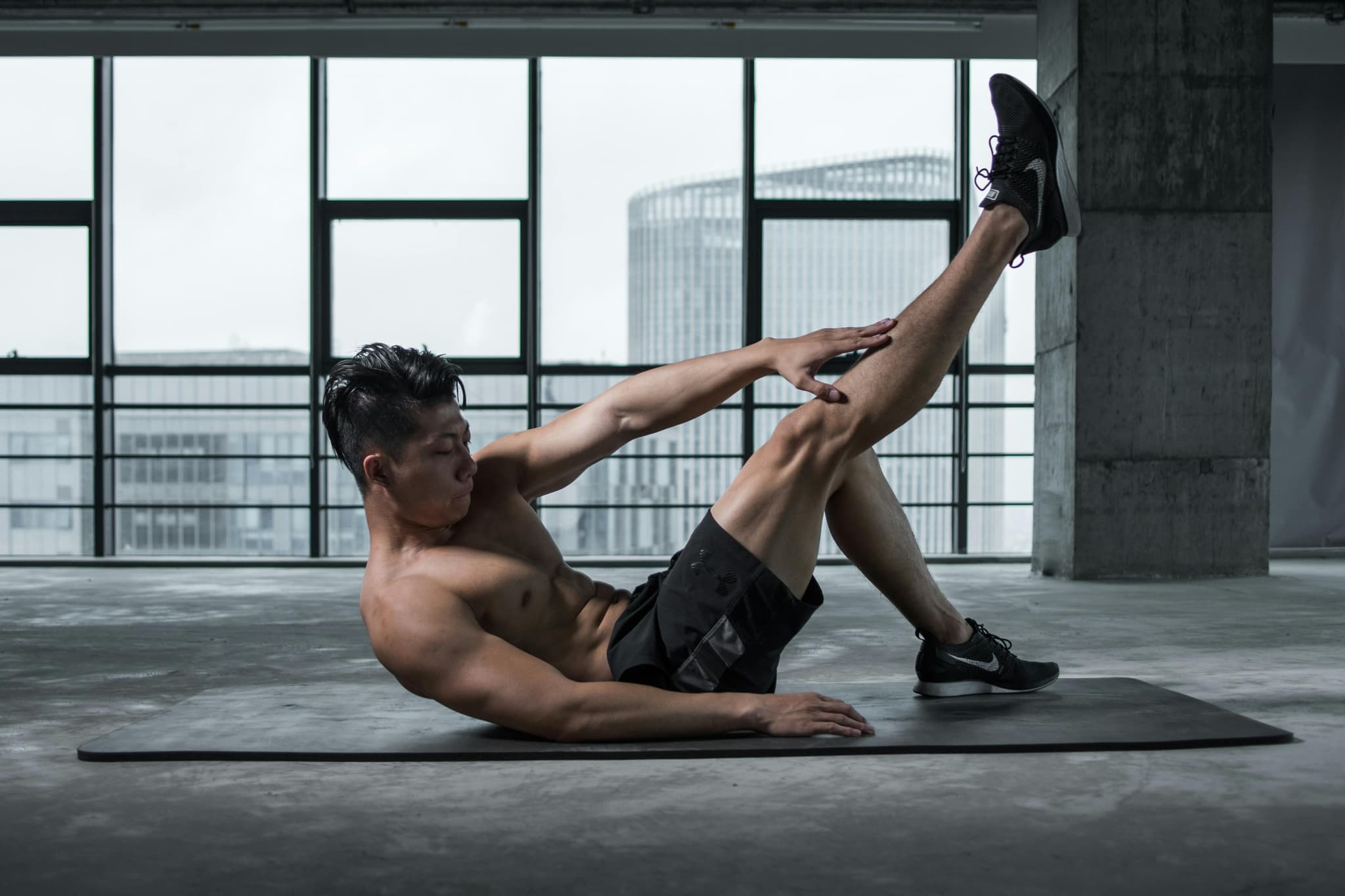
Then run two sets of dead bugs. Extend the opposite arm and leg while pressing your lower back firmly into the floor. Slow, controlled, no breath-holding.
Once you've worked through both phases, the muscles responsible for pelvic control are primed. Now you're ready to load them.
Fixing Anterior Pelvic Tilt from Sitting: Resistance-Training Corrections That Actually Transfer
Most posture correction exercises get prescribed as homework. Isolated stretches, standalone rehab circuits, things you're supposed to do on top of your existing training. That model fails because nobody actually does it. A better approach buries the correction inside the work you're already programmed to do.
Band-Resisted Hip Thrusts: The EMG Case for Adding a Loop Band
Place a light resistance band just above your knees on your next hip thrust. That single change produces measurable results.
A 2015 study by Choi et al., published in the Journal of Electromyography and Kinesiology, found that adding band-resisted hip abduction to a bridge exercise increased gluteus maximus activity by 21.1% and reduced anterior pelvic tilt angle by 20.5% compared to the standard version. Those aren't marginal adjustments.
Note: the Choi et al. study was conducted on a floor bridge, not a loaded hip thrust. The band cue transfers to hip thrusts by the same mechanism, but the data comes from the bodyweight bridge.
The mechanism is external rotation demand. Pressing out against the band recruits the posterior fibers of the glute max more aggressively than hip extension alone. For programming, run 3 sets of 10 to 12 reps with a 2-second pause at lockout. The pause forces you to find full hip extension without compensating by cranking your lumbar spine. If your lower back is taking the load at the top, you're not in neutral and you're not getting the benefit.
Cueing Neutral Pelvis in Your Squat and Deadlift Setup
Your squat and deadlift already require a neutral spine. The problem is that most lifters set up with anterior tilt baked in, especially after sitting all day, and then try to brace over a compromised position. Fix the setup, not the brace.
Before unracking for a squat, perform a deliberate posterior pelvic tuck, then release about 20% of it. That's neutral. Lock that in before you breathe and brace. On the deadlift, the same principle applies at the hip hinge. Drive your hips back, find tension in the hamstrings, and confirm your pelvis is level before the pull initiates. One cue that works: "pull your hip bones toward your ribcage."
Accessory Programming: Two Exercises Worth Adding to Your Current Split
Add these to your current lower body days rather than creating a separate session.
Copenhagen plank: 3 sets of 20 to 30 seconds per side. Strong adductors enhance pelvic stability and improve overall core integration, and the Copenhagen plank targets them directly in ways that conventional glute work misses. Weak adductors often accompany anterior tilt, particularly on one side.
Reverse hyperextension or 45-degree back extension with posterior tilt emphasis: 3 sets of 15 reps, focusing on squeezing the glutes hard at peak extension rather than using momentum. This trains the glutes and hamstrings through hip extension under load, reinforcing the same pattern you're building in the hip thrust.
Correction timelines vary. Some research suggests hip flexor length responds quickly, while structural changes to tilt pattern take closer to eight weeks with consistent training. Stay in these movements long enough to see the carry-over.
How Long Does It Take to Fix Anterior Pelvic Tilt From Sitting?
The honest answer is: it depends on what you mean by "fix."
There are two distinct phases, and they operate on very different timelines. Knowing which phase you're in tells you whether your progress is on track or whether you're expecting the wrong thing at the wrong time.
Phase 1: Functional relief (1 to 2 sessions)
Hip flexor stretches can reduce anterior pelvic tilt almost immediately. One session won't structurally correct anything, but you can restore enough range of motion to move, lift, and feel noticeably better within a single training day.
Phase 2: Lasting muscular rebalancing (6 to 12 weeks)
This is where anterior pelvic tilt from sitting actually gets corrected at the source. Weak glutes and deep core muscles need consistent loading over weeks to rebuild the output that keeps your pelvis neutral under real-world demand. Mild to moderate cases typically improve within 6 to 12 weeks with focused corrective exercise, with the timeline depending on how long the tilt has been present, consistency with training, and individual differences.
The biggest factor in the timeline is consistency, not intensity. Ten minutes of targeted work every day produces faster results than a 45-minute session twice a week. The correction happens in the gym, and the compound lifts you're already doing are the primary vehicle for getting there.
Frequently Asked Questions
Can anterior pelvic tilt cause lower back pain?
Yes. An exaggerated forward tilt increases lumbar lordosis, which compresses the posterior structures of the lower spine and shifts load away from where it should be absorbed. Research confirms a significant relationship between anterior pelvic tilt and lumbar lordosis, with subjects who have lower back pain from sitting and other prolonged postures showing greater anterior pelvic tilt than those without.
Correcting the tilt doesn't guarantee pain relief, but it removes a consistent mechanical contributor.
Does sitting cause anterior pelvic tilt?
Prolonged sitting reinforces it. When you sit for hours, the hip flexors adapt to a shortened position, and the glutes become inhibited from disuse while the hip flexors grow neurologically dominant. The muscles that should posteriorly tilt the pelvis—including the hamstrings, glutes, and deep abdominals—stop firing effectively.
Over months and years, that imbalance becomes your default posture. The problem isn't a single posture but the accumulated hours spent in positions that reward tightness in front and passivity behind.
Is anterior pelvic tilt permanent if I've had it for years?
No. Muscle imbalances are adaptations, and adaptations are reversible. Years of reinforcement means the pattern is more ingrained, so correction takes longer, but the underlying tissues retain their capacity to change. Consistent posture correction exercises that target the right muscles produce real structural improvement. Duration affects your timeline, not your ceiling.
The Bottom Line
Anterior pelvic tilt from sitting is a muscular pattern that responds to training. The good news: you don't need a separate mobility day or rehab program to fix it.
Before your next lower-body session, run the two-drill warm-up from Section 5 and add the loop band to your hip thrusts. That's your starting point. A smarter warm-up and more intentional cuing of the work you're already doing.
Do that consistently, and this stops being a posture problem and starts being a performance advantage. A pelvis that sits and loads correctly gives you a stronger squat base, a safer pull off the floor, and less of the nagging lower back tightness that follows eight hours at a desk. Ten minutes of focused work per session. Start today.