
Yoga Poses for Muscle Recovery: Upper Body, Legs, Full Body
Skipped the cooldown again? These yoga poses for muscle recovery are matched to leg day, upper body, or full-body burnout — ten minutes, zero guesswork.
You crushed leg day. Then you skipped the ten minutes that decide how you feel tomorrow.
Yoga poses for muscle recovery aren't a quick toe touch and a shrug. Match the poses to what you trained: upper body one day, legs the next, full body when everything's beat up at once.
Skip the generic stretching advice from a wellness blog. You get poses matched to your training day, a breakdown of what's actually happening in your nervous system and fascia, and a straight answer on whether recovery yoga goes before or after your lifts. It is generally recommended to do yoga after a weightlifting session, since excessive static stretching just before an intense weightlifting session might compromise the muscle's ability to contract efficiently. You'll also see how restorative and yin yoga differ, so you stop guessing which style fits your goal.
Ten minutes. Specific poses. Built around the way you already train.
The Science Behind Yoga Poses for Muscle Recovery (Why This Isn't Just Stretching)
Most lifters think recovery yoga after strength training just means touching your toes and calling it a day. Real recovery work targets two systems: your nervous system and your fascia. Both need specific input to reset.
Parasympathetic Downregulation: Why Breath-Paired Holds Beat Static Stretching
Your body needs to shift out of "fight or flight" after a heavy session. A study of 20 male athletes at Mae Fah Luang University compared 15 minutes of static stretching to 15 minutes of yoga following a high-intensity interval training session. The yoga group showed enhanced parasympathetic activity and reduced blood pressure compared to stretching alone.
Yoga's edge came from pairing postures with breath control, something static holds alone don't do. Your nervous system controls muscle tone. Tight, guarded muscles often come from nervous system stress, not just tissue damage. Long exhales during a hold signal safety to your brain, and your muscles respond by releasing tension you can't force out through pure stretching.
Fascia Remodeling and Sarcomerogenesis: What Long Holds Actually Change in Muscle Tissue
Holding a pose for two to three minutes does something a 15-second stretch can't. Skeletal muscle responds to passive overstretch through sarcomerogenesis—the creation and serial deposition of new sarcomere units that gradually reposition the muscle back into its optimal operating range.
Fascia responds to sustained load, not quick pulls. Short stretches barely touch the connective tissue wrapping your muscles. Longer holds create the mechanical stress fascia needs to remodel. That's the difference between temporary flexibility and lasting tissue change.
Quick Answer: The Best Yoga Poses for Muscle Recovery
The best yoga poses for muscle recovery target tight hips, shoulders, and hamstrings while calming your nervous system. Here are 10 essential poses for recovery yoga after strength training.
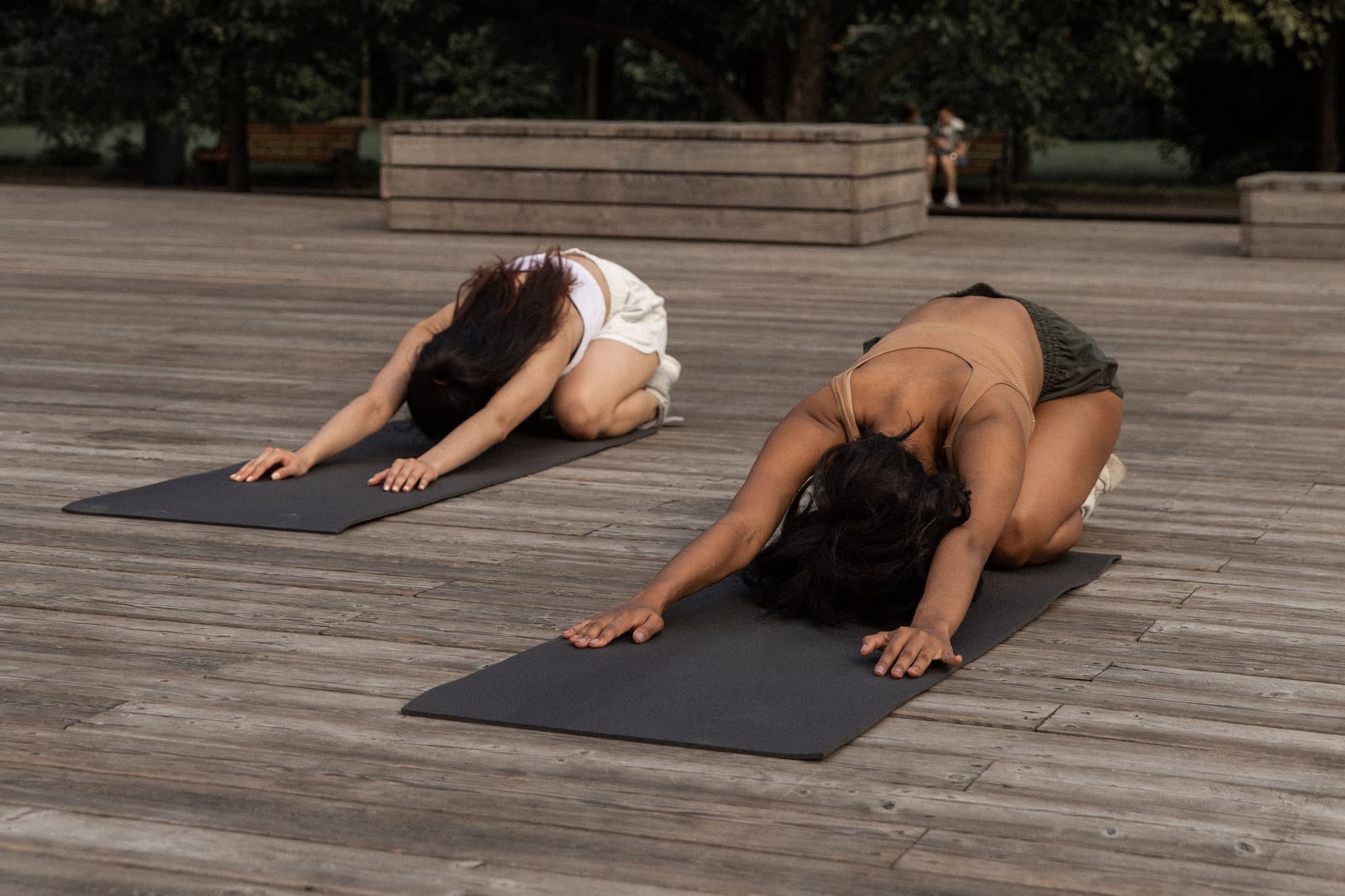
Child's Pose
- Stretches your lower back and lats while forcing slow, nasal breathing.
Thread the Needle
- Releases tight shoulders and mid-back after pressing sessions.
Reclined Pigeon
- Opens your hips and glutes without loading your knees.
Sphinx Pose
- Counters hunched posture and eases lower back tightness.
Legs Up the Wall
- Drains swelling from tired legs and lowers your heart rate.
Cat-Cow
- Mobilizes your spine after heavy squats or deadlifts.
Supine Twist
- Wrings out your obliques and low back.
Standing Forward Fold
- Lengthens hamstrings and calves after leg day.
Happy Baby
- Opens hips and grounds your nervous system before bed.
Corpse Pose
- Locks in the recovery response with five minutes of stillness.
Run through these after your next session. The breakdowns below show you exactly how to hold each one.
Yoga Poses for Muscle Recovery After Upper Body Day
Bench, overhead press, rows. They all load your shoulders in one direction. Recovery yoga after strength training flips that pattern and gives your joints room to move the way they were built to move.
These three poses target the exact tissue you just hammered.
Thread the Needle (Shoulder Capsule + Thoracic Rotation)
Start on all fours. Slide your right arm under your body, palm up, and let your shoulder and ear rest on the mat. Your left hand can stay planted or reach overhead.
Hold for 45 to 60 seconds per side. Breathe slow through your nose, four counts in, six counts out.
Pressing work compresses the front of your shoulder capsule. This pose opens it back up and adds rotation through your thoracic spine, a joint that gets stiff fast after upper body day.
Puppy Pose (Lat and Chest Opener)
Kneel, then walk your hands forward until your chest drops toward the floor. Hips stay stacked above your knees. Arms stay long, forehead or chin resting down.
Hold for 60 seconds. Exhale fully each breath, let your ribs expand into the stretch.
Your lats and pecs shorten every time you press or pull heavy. This pose pulls both back into a lengthened position and decompresses your spine at the same time.
Eagle Arms (Rear Delt and Rhomboid Release)
Cross your right arm under your left at the elbows, forearms stacked, palms pressing together if your shoulders allow it. Lift your elbows to shoulder height.
Hold 30 seconds per side. Breathe into your upper back, not your chest.
Rows and presses build tightness through your rear delts and rhomboids. Research backs up this approach: a randomized controlled trial found stretch-induced changes in fascia stiffness, where changes in fascia's mechanical properties (not just muscle) may contribute to increased range of motion following stretching. That means holds like this one do more than stretch muscle fiber. They work the connective tissue wrapped around it.
Give your legs the same attention next.
Yoga Poses for Muscle Recovery After Leg Day
Squats and deadlifts hammer your posterior chain and quads hard. Your fascia tightens up, your hip flexors shorten, and your lower back takes on stress it didn't sign up for.
These three poses target that damage directly. Save them for after your session, not before. Pre-exercise static stretching can decrease maximal strength and power performance, especially when held for extended durations. Keep this work for the cooldown.
Reclined Hand-to-Big-Toe Pose (Hamstring Fascia Release)
Lie on your back. Loop a strap or towel around your right foot. Extend that leg toward the ceiling, keeping your knee soft.
Hold for 60 to 90 seconds per side. This stretch lengthens the hamstring fascia without forcing your knee into a locked position.
Low Lunge with Quad Reach (Hip Flexor + Quad Length)
Step your right foot forward into a lunge. Drop your left knee down. Reach back and grab your left foot, pulling your heel toward your glute.
You'll feel this across your hip flexor and quad at the same time. Both get shortened from heavy squatting, so this combo hits two problem areas in one hold.
Supported Bridge (Glute and Lower Back Decompression)
Lie on your back, feet flat, knees bent. Slide a block under your sacrum for support. Let your glutes and lower back release completely into the prop.
This one's passive. No muscle engagement required. Your job is to breathe and let gravity do the work.
Go easy on intensity here. A 2021 systematic review found evidence on post-exercise stretching for recovery is insufficient to support related claims about speeding up strength or soreness recovery, so don't expect these holds to work miracles. Treat them as gentle resets, not deep stretching sessions. These best stretches for sore muscles work best when paired with adequate sleep and nutrition rather than as standalone recovery tools.
Full Body Recovery Yoga Sequence for Post-Workout or Rest Days
Full-body days beat up everything at once. Your legs, back, and shoulders take the hit together. This sequence covers multiple muscle groups and calms your nervous system in one session. Use it after cardio, circuit training, or on rest days when you're stiff all over but not sore in one specific spot.
This is restorative yoga for lifters, not a mobility warm-up. Save the deep static holds for after training. One study on lower-body resistance training investigated the acute effects of passive static and ballistic stretching on maximal repetition performance during a resistance training session, comparing it against a specific warm-up. The training session was composed of three sets of 12RM for leg press, leg extension, leg curl, and plantar flexors, and the researchers found significant differences in total reps between the stretching and warm-up conditions. Pre-lift stretching costs you strength. Post-lift stretching pays you back.
Child's Pose with Lateral Reach (Full Spine + Lat Stretch)
Kneel down and sit back on your heels. Walk your hands forward, then drift them to the right. Feel the stretch along your left lat and side body.
Hold for 30 seconds, then switch sides. This opens the whole posterior chain from your hips to your fingertips.
Supine Twist (Spinal Rotation and Nervous System Reset)
Lie on your back with your knees bent. Drop both knees to the right and open your arms out in a T. Turn your head left.
Hold for a minute on each side. Twists reset spinal rotation after hours of pressing, squatting, or pulling in one plane.
Legs-Up-The-Wall (Circulation and Parasympathetic Shift)
Scoot your hips to a wall and extend your legs straight up. Rest your arms at your sides, palms up.
Stay here for 5 minutes. This drains fluid from your legs and pulls your nervous system out of training mode fast.
Stretching work like this can reshape your fascia over time. Research on fascia remodeling and sarcomerogenesis shows measurable changes in muscle fascicle length and thickness with consistent stretch training. A single session won't do it. Make post-workout yoga a regular habit if you want those changes to stick.
Before or After Lifting? When to Actually Do Recovery Yoga
Do yoga after your workout or on rest days, not before lifting.
Lifters skip this rule all the time. You get to the gym, feel stiff, and drop into a long hamstring stretch before your first set. That habit costs you strength.
A study comparing passive static stretching to a sport-specific warm-up before a full lower-body session found that passive static stretching cut into performance the most, with subjects completing fewer total reps across their sets than after the specific warm-up. Other research backs this up: pre-exercise static stretching decreases maximal force production, jump height, and speed. The hit to strength shows up fast and can carry through your working sets.
Your muscles need tension to fire hard. A long static hold tells them to relax and lengthen. That's the wrong signal before squats or bench.
Save your yoga poses for after the barbell goes down. Your muscles are warm, your nervous system is winding down, and you're not asking for max output anymore. This is when static stretching helps you recover instead of working against you. Recovery yoga after strength training works best when your body is already fatigued and ready to adapt.
If you need to move before lifting, do dynamic work instead. Leg swings, arm circles, bodyweight squats. Save the yoga mat for the cooldown.
That timing shift alone fixes a mistake most lifters don't know they're making. Once your session's done, here's where to start.
Restorative Yoga vs. Yin Yoga: Which Style Actually Helps Muscle Recovery
Both styles use long holds and both look slow from the outside. That's where the similarity ends.
Restorative yoga uses props to fully support your body, so muscles stay passive while your nervous system downshifts. Think bolsters under your knees, blankets under your spine. Zero effort, zero stretch sensation. It's an approach developed by Iyengar to induce relaxation, reduce stress, and minimize muscular strain through props and supported poses held for extended periods, shifting the body toward parasympathetic nervous system activity. It's built for calming a system that's been running on cortisol and adrenaline all week.
Yin yoga targets connective tissue directly, holding poses 3 to 5 minutes with mild tension on the fascia. No props doing the work for you. You sit in mild discomfort on purpose, in what yin teachers call the "orange zone," because that's the zone where yin yoga works, stimulating your fascia and joints without triggering resistance or pain.
Restorative vs. Yin: Quick Comparison for Muscle Recovery
Goal | Best Style |
Calm nervous system, reduce cortisol | Restorative |
Release tight fascia, improve joint range | Yin |
Recover after heavy leg or pull day | Yin |
Recover after a stressful training block or poor sleep | Restorative |
If your muscles feel tight and stiff, yin yoga works better. If you feel wired and can't wind down after training, restorative yoga is your choice. Some lifters use both in the same week—yin for physical tightness, restorative for nervous system recovery.
Frequently Asked Questions About Yoga Poses for Muscle Recovery
Can yoga after workouts replace rest days or sleep?
No. Yoga supports recovery; it doesn't drive it. Muscle repair depends on sleep and calories, not stretching. Use yoga alongside rest days, not as a substitute for them.
Will yoga decrease muscle gains if I'm lifting heavy?
No, as long as you time it right. Static holds after training or on rest days won't touch your gains. The only risk is stretching heavy muscles right before you lift, which can reduce output for that session.
How often should I do recovery yoga after strength training?
Two to four sessions a week works for most lifters. Match it to your training split. Heavy leg or pull days benefit most from a session the next morning or that same evening.
Is yoga effective for reducing DOMS (delayed onset muscle soreness)?
Yes, to a point. Gentle movement increases blood flow to sore tissue. The Cleveland Clinic notes that moving your sore muscles can help loosen them up, and stretching your quads or going for a short walk can help you feel better. Research on stretching's effect on DOMS is mixed. Some reviews found stretching induced no recovery effect on leg extension peak torque, rowing times, creatine kinase levels, or DOMS compared to rest. Treat yoga as a way to ease stiffness and feel more mobile, not a guaranteed fix for soreness itself.
Try adding one of these best stretches for sore muscles to your next cooldown and see how your body responds by morning.
The Bottom Line
Yoga poses for muscle recovery work because you match the pose to the muscles you trained, not because you picked something gentle. Match the pose to the split: upper body day gets thoracic and shoulder work, leg day gets hips and hamstrings, full body day gets a downshift for your whole nervous system. That's the entire strategy. No single stretch fixes everything, and nothing here replaces sleep, calories, or your training program. Yoga sits next to those things, not in place of them.
Skip the debate about restorative versus yin. Stop overthinking sequencing. Cooldown isn't optional, so treat it as part of the workout, not an afterthought. Go back to today's training section, pick two or three poses that match what you just trained, and hold them before you leave the gym. Five minutes on the floor beats zero minutes every time. Ten minutes of static holds after training costs you nothing and saves you soreness tomorrow.