

Yoga Improves Strength Training: Mobility, Breath & Timing
Stalled squat depth? Rounded deadlift back? Yoga improves strength training by fixing the tissue quality and motor control extra volume never touches. Here's the lift-by-lift breakdown.
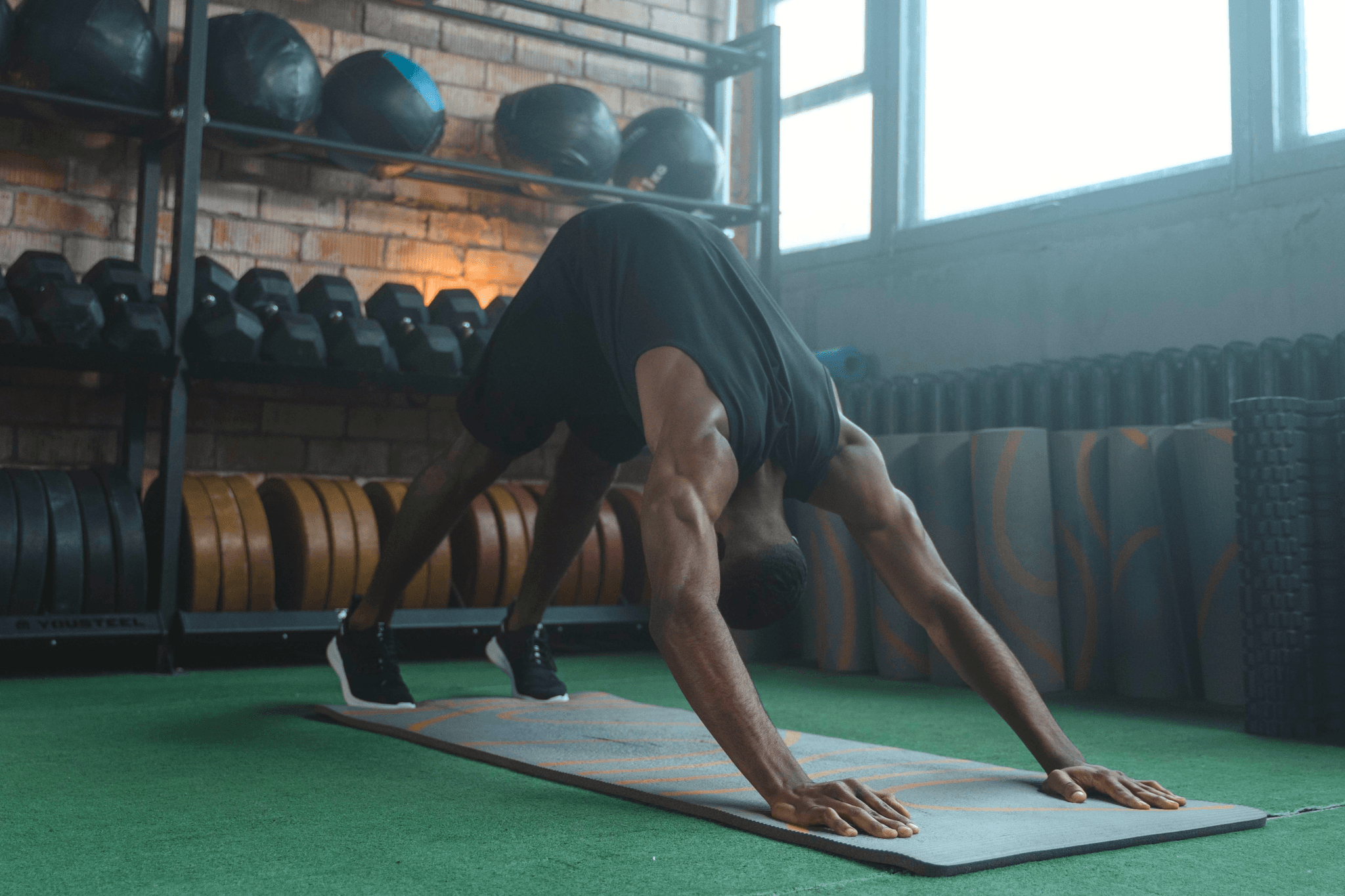
If your squat stalls at parallel or your lower back gives before your legs do, yoga improves strength training in ways extra volume never will. The problem is rarely your programming. It's the tissue quality and motor control you've never trained. A 12-week Hatha yoga study showed measurable improvements in muscular strength and endurance in adults, though subjects were general population, not trained athletes. What follows is a lift-by-lift technical breakdown of how yoga improves strength training performance: where restricted tissue is costing you depth and load on the squat, deadlift, and overhead press; how diaphragmatic breathing functions as spinal stabilization under a loaded bar; which yoga styles support your training versus compete with it; and exactly where to schedule it in your split without losing strength or muscle.
How Yoga Improves Strength Training: The Lift-by-Lift Breakdown
Mobility deficits don't show up as tightness. They show up as missed depth, rounded backs, and stalled loads. Here's exactly where restricted tissue is costing you on the platform.
Squat Depth: What Tight Hip Flexors and Calves Are Actually Costing You
If your squat doesn't reach parallel, the problem is usually upstream and downstream at the same time. Tight hip flexors pull your pelvis into anterior tilt, collapsing your lumbar curve at the bottom. Restricted calves limit ankle dorsiflexion, which forces your heels to rise or your knees to cave inward.
Flexibility for weightlifting starts here. When hip flexors and calves lengthen through consistent yoga work, your squat depth improves, your glutes reach full stretch-shortening range, and your quads generate more force through the drive phase. Research confirms that individuals with restricted hip flexor length display decreased gluteus maximus activation during a bilateral squat.
Deadlift: Why Hamstring Length Determines Whether Your Lower Back Gets Loaded
Tight hamstrings pull your pelvis into posterior tilt the moment you hinge. Your lumbar spine rounds to compensate, shifting the load from your posterior chain onto your erector spinae. That's not a technique problem. It's a tissue problem.
When hamstring length improves, your pelvis stays neutral through the setup, your hips drive back instead of dropping, and the bar stays close. The lift becomes a hip hinge instead of a back extension. Research shows that hamstring stretching significantly increases range of motion, with measurable increases in hip flexion and decreases in lumbar flexion during loaded hinge patterns. Yoga poses like standing forward folds and reclined hamstring stretches, held progressively over weeks, build the length required to load the pattern correctly.
Overhead Press and Back Squat: The Thoracic Mobility Problem Nobody Talks About
Thoracic extension and rotation drive two lifts most people treat as unrelated. In the overhead press, limited t-spine extension forces your shoulders to compensate by flaring or shrugging, pushing the bar forward of your base. In the back squat, the same restriction pulls your torso forward out of the hole.
According to SET Physical Therapy, if your thoracic spine is limiting shoulder flexion mobility, improving it allows the barbell to stack directly overhead more efficiently, and increased thoracic extension allows the barbell to sit more comfortably on your shoulders in the back squat. Mobility and strength training intersect most directly at the thoracic spine—a connection that yoga addresses through targeted extension and rotation work.
Bench Press: How Thoracic Extension Creates a Bigger Arch and More Pressing Power
A bigger arch isn't just a powerlifting trick. It shortens your range of motion, stabilizes your scapulae, and puts your pecs in a stronger pressing position. All of that depends on how much thoracic extension you actually have.
Yoga backbends, particularly Cobra and Wheel, build the spinal extension capacity that lets you set a solid arch and hold it under load. More thoracic extension means a shorter bar path from the top position of the bench to your chest, producing a more efficient press.
Time your yoga correctly, though. Static stretching before a workout can reduce maximal strength by 2–5.5% and power output by up to 2.8%, according to a 2013 meta-analysis published in the Scandinavian Journal of Medicine & Science in Sports. Save deep yin work for after training, and use dynamic flows for your warm-up.
The Breathing Technique Yoga Teaches That Functions Like a Lifting Belt
Most lifters think of pranayama as something you do at the end of a yoga class while lying on a mat. That framing undersells it completely. Diaphragmatic breathing, trained systematically through pranayama, is a spinal stabilization tool with a direct mechanical application under a loaded barbell. This is one of the most direct ways that yoga improves strength training outcomes.
Intra-Abdominal Pressure: Why Yoga Breath Training Stabilizes Your Spine
IAP refers to the pressure within the abdominal cavity, bounded superiorly by the diaphragm, inferiorly by the pelvic floor, and circumferentially by the abdominal wall and spine. When you breathe into your diaphragm correctly, you increase intra-abdominal pressure (IAP). Breathing exercises decrease spinal loading by raising IAP, and increased IAP reduces spine compression force. Research published on PubMed confirms that diaphragmatic breathing exercises increase the activity of the deep trunk muscles by raising intra-abdominal pressure, stabilizing the spine in a way that mirrors the mechanical function of a lifting belt.
A lifting belt works by giving your abdominals something to brace against. Your breath does the same thing, without the leather. This is one of the most direct yoga strength training benefits that carries over to heavy pulling and squatting, and it is built through repetition in pranayama practice, not through cuing alone.
How to Apply Diaphragmatic Breathing Before a Max-Effort Set
Step up to the bar. Before you unrack, take a slow breath into your belly, not your chest. Optimal respiration requires active control of the diaphragm, with the lower ribs staying low and only expanding laterally during inspiration, while the abdomen expands instead of the chest.
Then brace hard against that air pressure and hold it through the sticking point. This is the Valsalva maneuver done correctly, and yoga pranayama is one of the most effective ways to train the diaphragmatic control it requires.
Once your brace is reliable, your technique ceiling rises with it. A 12-week Hatha yoga intervention studied in 173 adults showed significant improvements in muscular strength and endurance, and breath training accounts for a meaningful part of that adaptation.
Should You Do Yoga Before or After Strength Training?
The Short Answer
The timing of yoga in your strength training routine depends on style and duration. Dynamic yoga under 15 minutes before lifting improves mobility and strength training performance without reducing strength output. Static or yin yoga held for 60 seconds or longer before lifting reduces strength output by 4 to 7.5 percent according to research in the Journal of Strength and Conditioning Research. Save long holds for after your workout when they won't compromise performance.
Before Training: Dynamic Yoga as a Performance Warm-Up
Vinyasa flows and Sun Salutation sequences move your joints through full ranges of motion without prolonged static holds. Keep sessions under 15 minutes and you get elevated tissue temperature, improved joint lubrication, and better movement prep without compromising your first working set. This approach to yoga improves strength training readiness by preparing your nervous system and connective tissue for load.
After Training: Static and Yin Yoga for Mobility and Strength Training Recovery
Post-session is when long holds pay off. Your muscles are warm, your nervous system is less primed for maximal output, and sustained stretching can drive genuine tissue adaptation over time. This is the window where flexibility for weightlifting develops—the hip flexor and hamstring length that feeds better squat depth in your next session.
Factor | Before Lifting | After Lifting |
Yoga style | Dynamic (Vinyasa, Sun Salutations) | Static, Yin, or restorative |
Duration | Under 15 minutes | 15 to 30 minutes |
Hold length | Under 30 seconds | 60 seconds or longer |
Effect on strength | No measurable reduction | Not applicable post-session |
Primary benefit | Movement prep and warm-up | Long-term mobility adaptation |
Sequence it correctly and yoga stops being a recovery tool you bolt on when something hurts. It becomes a structured input that feeds directly into training quality and yoga strength training benefits.
What Type of Yoga Actually Improves Strength Training Performance
Not all yoga produces the same training outcome. The style you choose, and when you use it, determines whether yoga improves strength training performance or competes with your lifts. Three styles are worth your attention: Vinyasa, Yin/Restorative, and Hatha. Each earns a specific place in a lifting program for different reasons.
Vinyasa and Sun Salutations: Pre-Lift Activation Without Strength Loss
Vinyasa links breath to movement through continuous, flowing sequences. A 10-minute Sun Salutation series on squat day raises core temperature, opens the thoracic spine, and primes hip mobility without the strength output cost that comes from long static holds. Keep it under 15 minutes and stay out of prolonged floor-based stretching before you load a bar.
Yin and Restorative: Post-Lift Tissue Work on Recovery Days
Yin yoga uses passive, long-duration holds targeting connective tissue rather than muscle. That makes it poorly suited before training but genuinely useful after. Program a 30-minute Yin session on a recovery day following a heavy lower-body block to address hip capsule and hamstring restriction that accumulates over a training cycle.
Hatha: The Baseline Protocol for Strength and Mobility Adaptations
Hatha is where yoga for muscle gains and strength actually shows up in the research. A 12-week Hatha yoga program produced measurable improvements in muscular strength, muscular endurance, cardiorespiratory endurance, and flexibility compared to a control group, according to a 2015 study published in Evidence-Based Complementary and Alternative Medicine. Frequency matters: research indicates that two sessions per week over eight weeks, totaling 180 minutes, produces consistent, trackable adaptation.
Two Hatha sessions per week fits cleanly into most four-day training splits without competing for recovery resources. That's the structure worth building around.
Programming Yoga Into Your Strength Training Split Without Losing Gains
Yoga does not cost you muscle. Poor scheduling does. The difference between yoga that supports your strength training and yoga that interferes with it comes down to when you place it and how long you hold.
Push/Pull/Legs: Where Yoga Sessions Slot Without Overlap
In a standard Push/Pull/Legs split, your highest-risk placement is before a heavy session. Keep yoga off the morning of a leg day if you plan to hold static poses for longer than 60 seconds. Research published in peer-reviewed literature confirms that static holds exceeding 60 seconds per muscle group reduce strength output by roughly 4 to 7.5 percent, with significant impairment likely at that threshold.
A clean PPL placement looks like this: Friday — lower body lift. Friday evening or Saturday morning — run a 20-minute Yin session targeting hip flexors and hamstrings. That tissue work aids recovery and carries over to your next squat session without touching your force output when it counts.
Upper/Lower Split: Pairing Yoga Style to Training Phase
Upper/Lower runs four days, leaving three days to work with. Wednesday — your mid-week gap between lower sessions — is where a 20- to 30-minute Hatha or Vinyasa session fits cleanly. Focus on thoracic rotation and hip mobility. Limited thoracic extension creates compensations in overhead pressing and back squatting, and addressing it here improves positioning before your next upper day without generating soreness.
Sunday — your full rest day — is where a longer Yin session belongs. Thirty to forty-five minutes targeting the posterior chain and hip complex supports active recovery without loading the tissue you just trained.
Minimum Effective Dose: Frequency and Duration That Actually Move the Needle
You do not need daily practice. Research cited by Shvasa points to measurable improvements in muscle strength, endurance, and flexibility from at least two sessions per week over eight weeks, totaling roughly 180 minutes of cumulative practice. That is two sessions of approximately 45 minutes each, or more frequent shorter sessions that reach the same total volume.
The relationship between mobility and strength training is additive when the scheduling is deliberate. Two sessions, placed after your hardest training days or on true rest days, is enough to shift your movement quality without creating fatigue that competes with your next lift.
Lifter FAQs: The Rest of What You Actually Want to Know
Can Yoga Replace Weightlifting?
No. Yoga and lifting produce different physiological adaptations, and one does not substitute for the other. Yoga improves mobility, body awareness, and recovery capacity; progressive overload builds contractile strength and muscle mass.
Will Yoga Make Me Lose Muscle or Strength?
Not if you program it correctly. The interference research is clear: yoga placed after your strength session, or as a standalone session on a recovery day, does not compromise muscle or strength gains. The risk only appears when you stack long static holds directly before heavy lifting.
Should I Do Yoga Before or After Strength Training?
After your strength session, or on a separate recovery day. Placing yoga after lifting preserves your power output and neuromuscular readiness for heavy compound movements, while still capturing the mobility and parasympathetic benefits that support muscle recovery and adaptation.
Does Yoga Help With Muscle Recovery After Lifting?
Yes. Yoga activates the parasympathetic nervous system, shifting your body out of the stress state that follows intense training and supporting tissue repair. The sustained lengthening of worked muscles also reduces delayed-onset muscle soreness and improves how you feel going into your next session.
Is Yoga Considered Strength Training?
No. A 2015 study published in Evidence-Based Complementary and Alternative Medicine found that Hatha yoga improved muscular strength and flexibility, but that adaptation ceiling is low for anyone already lifting. Yoga improves strength training outcomes through enhanced mobility and recovery—not by replacing progressive overload.
The Bottom Line
The barbell doesn't move better because you stretched. It moves better because you fixed the tissue restrictions limiting your mechanics, trained your diaphragm to generate real intra-abdominal pressure under load, and scheduled your yoga where it supports output instead of blunting it. That's the case for how yoga improves strength training: three performance levers, each with a direct return on the platform.
None of this works as a philosophy. It works as a practice placed deliberately inside a lifting program.
Pick one lift where you consistently lose position, whether that's squat depth, bar path overhead, or lower back rounding in the pull. Identify the mobility deficit linked to that lift from what you've read. Then add one 15-minute targeted session this week, nothing more.
One lift. One deficit. One session. Fix the weak point and load the bar heavier.