
Yoga for Lifting Form: Fix 6 Common Posture Faults
Rounded shoulders, tight hips, a caving low back — yoga improves lifting form and posture by fixing the joints heavy lifting alone can't reach. Here are 6 faults and their fixes.
Blame your hips, not your squat depth. Yoga improves your lifting form and posture by exposing the exact joints that cap your numbers before you ever load the bar. Rounded shoulders steal your bench arch. A locked-up thoracic spine won't let you brace under a heavy squat. Stiff hips cut your depth short, and blame gets pinned on ankle mobility instead.
Forget the rest-day-nicety label. This is a targeted fix for the mechanical faults that heavy lifting alone won't correct. You'll get six common posture breakdowns, the specific pose that fixes each one, and a clear plan for when to use yoga around your training so it actually helps instead of tiring you out. Stop chasing new cues under the bar. Fix the joints that make good form possible in the first place.
Can Yoga Improve Your Lifting Form and Posture?
Yes. Yoga can improve lifting form and posture by building joint mobility and body awareness that heavy lifting alone doesn't train. Barbell work makes you strong in a fixed range. Yoga extends that range and teaches you to feel where your spine, hips, and shoulders sit in space.
That awareness carries into your squat, deadlift, and press. You catch a rounding back or a caving knee before it wrecks your set.
Twenty minutes of targeted yoga, twice a week, can tighten up the faults costing you pounds on the bar. The six fixes below show you where to start.
Why Posture Breaks Down Your Lifts Before You Even Touch the Bar
Bad posture doesn't wait for max effort to show up. It's there on your warm-up set, quietly stealing leverage before you load the bar.
Rounded shoulders shorten your pressing range. A tucked pelvis flattens your deadlift arch. Neither shows up as pain right away. Both show up as a stalled PR eventually.
This is where body awareness in strength training starts to matter. You can't fix a fault you can't feel. Yoga trains that feedback loop directly, teaching your nervous system to detect small shifts in spine and hip position before they turn into compensations under load. That's how yoga can improve your lifting form and posture at the foundation level.
The research backs this up. In a small study led by Porcari, women who did Hatha yoga three times a week were able to perform an average of six more push-ups and 14 more sit-ups after eight weeks compared to those who did no yoga. None of them did other resistance training. That's strength carryover from mobility work alone.
A 12-week controlled trial found similar results at a broader level. Compared to controls, the yoga group achieved significant improvements in VO2max, curl-up and push-up tests, and flexibility measures in both genders. Better output, better range, less wasted energy compensating for tight hips or a stiff thoracic spine.
Yoga isn't a free pass, though. A study comparing yoga and resistance training groups found both improved quality-of-life measures, but yoga had a higher dropout rate. Ten of the original 27 participants (37%) in the yoga group and 6 of 25 (24%) in the resistance training groups dropped out. Consistency still decides results, no matter which tool you pick.
Skip mobility work and your form caps out early, no matter how much weight you can move. Add it, and every lift you already do gets more room to work.
The Fault-to-Fix Framework: 6 Posture Breakdowns and the Yoga Poses That Fix Them
Stop chasing new lifting cues and start fixing the joints that make those cues possible. Yoga can improve lifting form by targeting the specific mechanical leaks that show up under the bar. Below are six faults, the pose that fixes each one, and the payoff you'll feel on your next working set.
Fault #1: Rounded Shoulders Killing Your Bench Arch
Rounded shoulders pull your ribcage down and flatten your upper back. That kills the shelf you need for a stable bench arch and shortens your pressing range.
Pose: Supported Fish Pose. Lie back over a rolled towel or block placed between your shoulder blades. Let your arms fall open, palms up.
Coaching cue: Let the block do the work. Don't force the arch, breathe into it.
Lift payoff: Opens the chest and resets scapular position, so you get a real arch to drive your bench press off instead of faking one with lower back extension.
Fault #2: Tight Hips Capping Your Squat Depth
Stiff hip capsules stop your femur from rotating deep into the socket. You hit a wall before your hips even get below your knees, and you compensate with a forward lean or a heel lift.
Pose: Frog Pose. On hands and knees, walk your knees wide, shins parallel, and sink your hips back toward your heels.
Coaching cue: Sink slow. Chase depth, not speed.
Lift payoff: Builds hip capsule range so you can hit true depth without your lower back rounding out to make up the difference.
Fault #3: Thoracic Stiffness Blocking Your Brace and Overhead Stability
A stiff thoracic spine is a mechanical problem, not just a mobility inconvenience. Great lifting technique and a lower risk of shoulder injury depend on decent thoracic mobility, a point Dr. Aaron Horschig of Squat University has made repeatedly in his work with lifters. People who lack mobility through the thoracic spine are subject to more injuries involving the shoulder and neck, as well as having an increased prevalence of low back pain, according to NASM.
Pose: Thread the Needle. From all fours, slide one arm under your body and rotate your chest toward the floor. Rest your shoulder and the side of your head down.
Coaching cue: Rotate from the ribs, not the neck.
Lift payoff: Frees T-spine rotation and extension, which improves your brace under a heavy squat and gives your shoulders room to stack overhead.
Fault #4: Anterior Pelvic Tilt Wrecking Your Deadlift Setup
An anterior tilt drags your pelvis forward and locks your lower back into extension before you even grip the bar. That steals hip hinge range and forces your spine to absorb load meant for your hips.
Pose: Low Lunge with Reach. Step one foot forward into a lunge, drop the back knee, and reach both arms overhead while squeezing the back glute.
Coaching cue: Squeeze the back glute first, then reach.
Lift payoff: Lengthens hip flexors and teaches your pelvis to sit neutral, so your deadlift setup starts from a spine that's actually ready to pull.
Fault #5: Forward Head Posture Limiting Your Overhead Lockout
Forward head posture drags your chin ahead of your shoulders and locks your upper back into flexion. Poor thoracic alignment blocks the scapular motion your overhead strength depends on and caps your range.
Pose: Sphinx Pose with Chin Tuck. Prop up on your forearms, elbows under shoulders, and gently tuck your chin while lifting through your sternum.
Coaching cue: Lift your chest, not your chin.
Lift payoff: Restores the neck-to-thoracic alignment your overhead lockout depends on, so the bar can travel straight up instead of drifting forward.
Fault #6: Tight Hip Flexors Robbing Your Lockout Power
Tight hip flexors block full hip extension. That means you can't fully open your hips at the top of a deadlift, squat, or hip thrust, which cuts your lockout power right when you need it most.
Pose: Crescent Lunge with Pulse. Step into a deep lunge, back leg straight, and pulse forward slightly while keeping your back heel lifted.
Coaching cue: Pulse forward, keep the back leg long.
Lift payoff: Opens hip flexor length so your glutes can finish the job at lockout, instead of stalling out three inches from full extension.
Postural alignment lifting isn't about looking good between sets. Each pose here targets the exact joint restriction that's been capping your numbers. Pick the fault that matches your sticking point and start there.
How to Program Yoga Around Your Lifts: Warm-Up vs. Rest-Day
Yoga to improve lifting form and posture works best when sequenced correctly. The wrong pose on the wrong day either fatigues you before a set or does nothing for recovery.
Sequence your poses into two buckets: warm-up drills and rest-day restoration.
Warm-Up Yoga: Prime the Joints, Don't Fatigue Them
Before you lift, you want mobility, not muscle burnout. Stick to dynamic, low-hold poses.
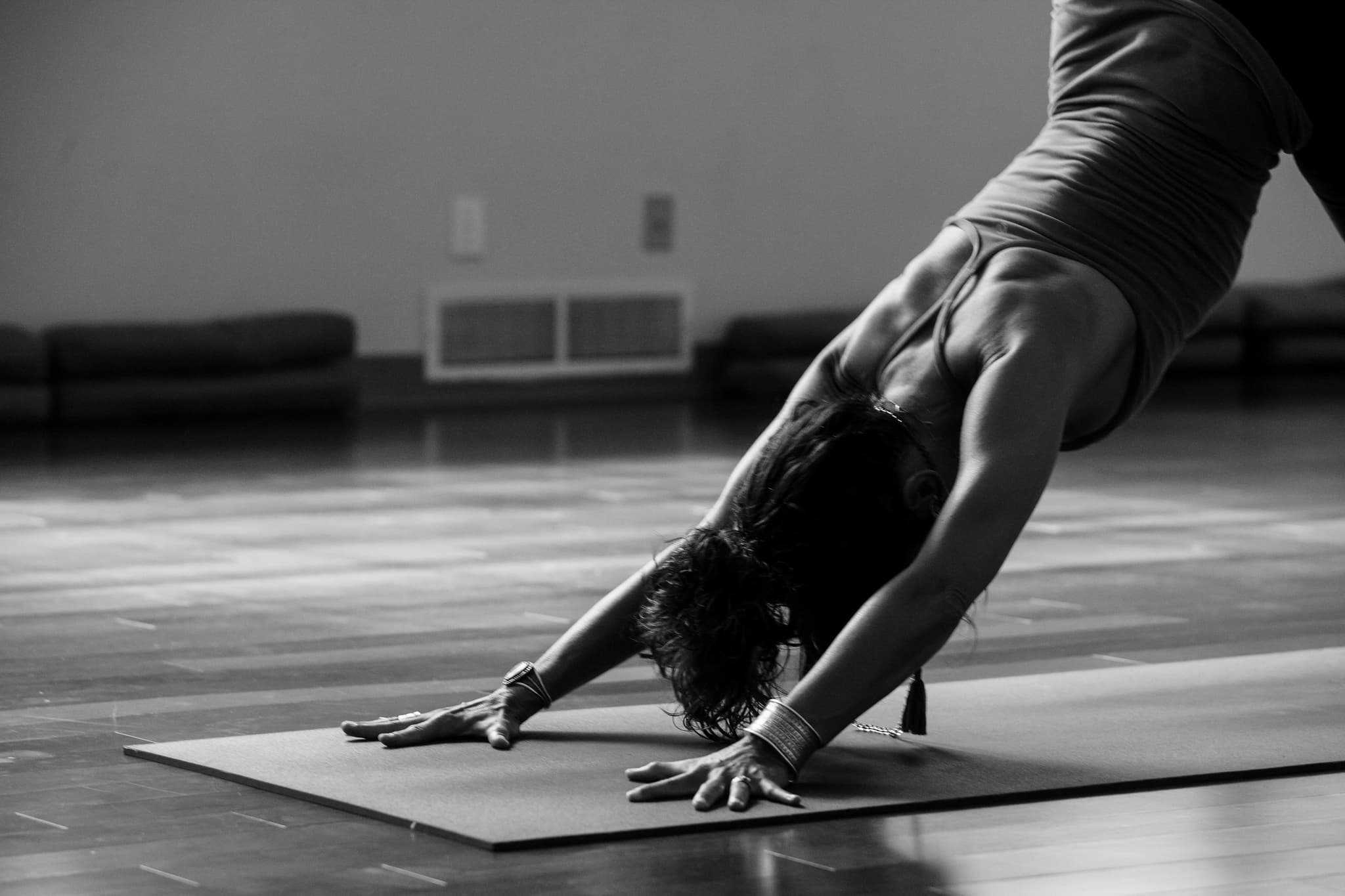
Cat-Cow, Downward Dog, and Low Lunge work here. Hold each for 20 to 30 seconds, not minutes. You're waking up the joint, not taxing the tissue.
Skip deep stretches like Pigeon or long-held Cobra before you lift. Research on static stretching shows that holds lasting longer than 60 seconds can reduce muscle force and power output, exactly what you don't want walking into a heavy set.
Rest-Day Yoga: Restore Range of Motion
Rest days are for the slow work. Hold poses longer here, 60 to 90 seconds, and let the tissue actually lengthen.
Thread the Needle, Pigeon Pose, and Sphinx belong here. They target the hips and thoracic spine, the areas that stiffen up fastest from heavy training weeks.
Slower poses also build body awareness in strength training. You get time to notice which side is tighter, which hip doesn't rotate the same, and where you're compensating under the bar.
Sample Weekly Split for Lifters
Monday (Squat day): 5-minute warm-up flow, Cat-Cow, Low Lunge. Tuesday (Rest): 15-minute restorative session, Pigeon, Sphinx. Wednesday (Bench day): 5-minute warm-up flow, Downward Dog, Thread the Needle (light hold). Thursday (Rest): Full mobility session, all six fault-fix poses. Friday (Deadlift day): 5-minute warm-up flow, Cat-Cow, Low Lunge. Weekend: Optional light flow or full rest.
Run this for four weeks before you judge results. Joint mobility work is slow to build and quick to lose, so stick with it consistently rather than pushing intensity.
Yoga for Gym Posture: Quick-Answer FAQ
Does yoga help with posture and back pain?
Yes. NASM research links poor thoracic spine mobility to a higher risk of shoulder and neck injuries, plus a higher rate of low back pain. Yoga poses that open the thoracic spine, like Thread the Needle and Cat-Cow, restore that mobility. More rotation and extension in your upper back means less compensation from your lumbar spine under load. This improved postural alignment during lifting reduces strain on vulnerable joints.
Can yoga replace stretching for weightlifters?
No. Yoga complements your training but doesn't replace sport-specific mobility work. Skip your hip flexor stretches before squats or your ankle mobility drills before pull day, and yoga alone won't cover the gap.
Yoga builds body awareness and joint range. It won't guarantee injury prevention on its own. Pair it with targeted warm-ups for the lifts you're actually doing that day. A deadlifter needs different prep than a bencher, and no yoga flow replaces that specificity.
Think of yoga as the layer underneath your training, not the whole system. It fixes the mobility gaps that block good positions. Your warm-up still has to match the lift on the bar that day.
Run both. That's how you stop fighting your own joints every time you load the bar.
The Bottom Line
None of these six faults are permanent. They're mechanical leaks, and leaks get patched. A tucked pelvis, a rounded upper back, a hip that won't open: none of these are character flaws under the bar. They're mobility gaps with a known fix. Close them and the numbers move. You'll see a deeper squat, a bigger deadlift arch, a brace that actually holds under load. Yoga can improve lifting form and posture because it targets these exact gaps directly. Skip the zen talk. The real payoff is leverage you're currently leaving on the table.
Don't try to fix all six at once. Pick the two faults that show up in your own lifts, the ones already costing you reps, and drill those poses hard. Ignore the rest for now. Walk into your next session, put the matching pose at the top of your warm-up, and go lift.