
How to Adapt Your Workout Routine While Traveling to Any Gym
No squat rack, no problem. Learn how to keep your workout routine while traveling on track with smart swaps, quick full-body sessions, and zero guilt about missed gym days.
Your flight lands in six hours and you still don't know if your hotel has a squat rack or a broken elliptical from 2009. That's the real problem with keeping a workout routine while traveling. The challenge isn't finding creative ways to do lunges in a hotel room. It's not losing the progress you've spent months building on your actual program. You didn't put in the work to watch it slip because of a business trip or a family vacation.
Here's the reframe. Travel doesn't mean scrapping your training and starting over when you get home. It means knowing exactly what to keep, what to swap, and what to skip, based on whatever setup you walk into: a fully loaded hotel gym, two dumbbells and a yoga mat, or nothing at all. This article breaks down how to audit your program before you pack, adapt it on the fly, and get back to full strength without a punishing "make-up" session once you're home.
How to Maintain a Workout Routine While Traveling
Skipping training on the road isn't the plan. Here's how to maintain a workout routine while traveling:
Scout your gym options
before you land (hotel, day pass, or bodyweight backup).
Cut your split down
to 3-4 full-body sessions.
Swap barbells for dumbbells
or bands when equipment's limited.
Prioritize compound lifts
over accessory work.
Track sets and reps
, not the clock, so travel days don't wreck progress.
Here's why each step matters.
Why a Few Missed Sessions Won't Wreck Your Progress (And When It Actually Will)
Relax. One missed workout doesn't undo three months of progressive overload. Your muscles aren't fragile, and your nervous system doesn't forget how to squat because you spent a week in Cancun.
Is it okay to skip workouts while on vacation? Mostly, yes. Most studies find that trained individuals retain muscle mass, strength, and power for at least two to three weeks of no training before any real decline shows up. A short trip lands well inside that window. This is the core reassurance behind most travel workout advice: brief breaks don't erase your fitness.
What Actually Happens to Muscle and Strength When You Stop Training
How many days can you go without working out before losing muscle? The honest answer: it depends on your training age. For most lifters, nothing measurable happens in the first 10 to 14 days. Strength dips you might notice early on are usually neural fatigue wearing off, not actual muscle loss.
Past the three-week mark, things shift. Glycogen depletes, capillary density drops, and you'll feel it in your pump before you see it on the scale.
Why Advanced Lifters Have More to Lose Than Beginners
Advanced lifters detrain faster than beginners. One study on trained powerlifters with roughly eight-plus years of experience found their type II muscle fibers became about 6% smaller after a two-week gym break, though their body weight didn't change. That kind of loss hits harder for someone with years of trained tissue to protect than for someone new to lifting.
The upside: a periodized training study found lifters who trained six weeks on, three weeks off repeatedly ended up with nearly identical muscle cross-sectional area gains compared to those who never stopped, despite logging 25% fewer sessions (Ogasawara et al.). Research from Jozo Grgic at Victoria University points the same direction: planned breaks don't erase adaptations if you built a real base first.
A one-week vacation costs you nothing. Three weeks with zero resistance training is where you actually need a plan to get back up to speed. That's when a structured workout routine while traveling—even a minimal one—becomes worth the effort.
Audit Your Program Before You Pack: What to Keep, Cut, or Modify
Before you build a workout routine while traveling, sit down with your actual program and make some calls. Not every exercise deserves a spot on your hotel gym or day-pass session. Pretending you can replicate a 5-day split with a resistance band and a bench is how people end up skipping everything out of frustration.
Rank Your Lifts by Priority (Not All Exercises Are Equally Important to Save)
Split your program into three tiers. Tier one: your main compound lifts, squat, deadlift, bench, row, overhead press. These are non-negotiable if you have any barbell or heavy dumbbell access. Tier two: accessory work that supports those lifts, think RDLs, lunges, dips. Keep these if time and equipment allow. Tier three: isolation work, cable flyes, leg extensions, curls done for the fifth variation this month. Cut these first. They're the easiest to sacrifice and the hardest to replace with limited equipment anyway.
Decide Your Minimum Effective Dose for This Trip
Match your commitment to your trip length. A 3-day work conference means you protect tier one only, maybe two sessions total. A 2-week trip means you need a real plan, not just "I'll wing it."
Aiming for two to four resistance training sessions per week is a solid target, and most people won't experience meaningful muscle loss after a single week away, according to FitnessAI. That's your reason to stop overbuilding a travel program for a short trip. Decide your number before you land, not while standing confused in a hotel gym at 6 a.m.
Adapting Your Workout Routine While Traveling With a Full Hotel Gym
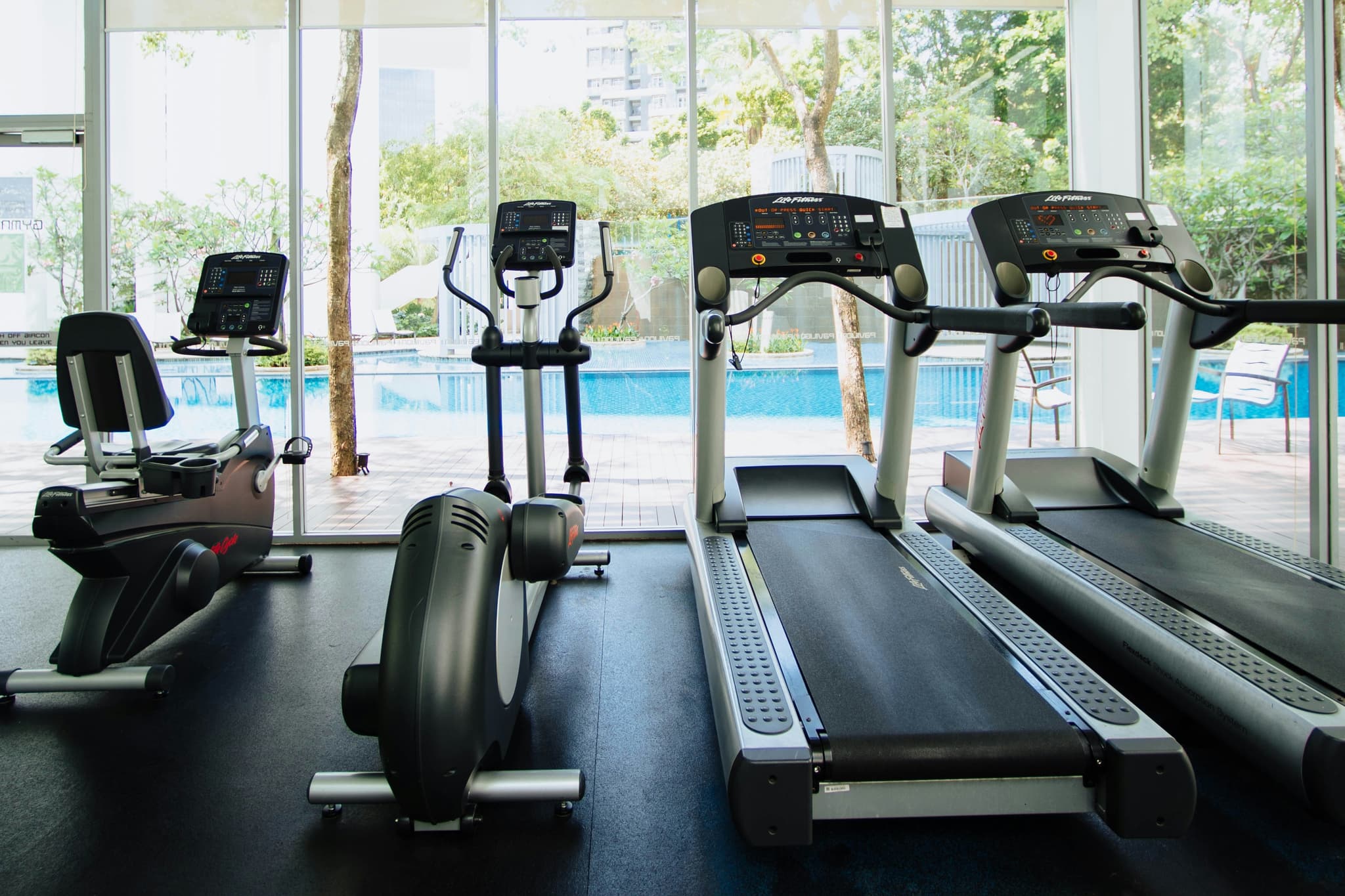
A full hotel gym with dumbbells up to 50 pounds, a couple of machines, and maybe a cable stack gives you more than enough to run a legitimate session. You won't recreate your home gym exactly, but you can hit the same movement patterns and progressive overload targets with different tools.
Substituting Barbell Movements With Dumbbells and Machines
Barbell back squat becomes goblet squat or dumbbell front squat, held at the chest. Barbell bench press becomes dumbbell bench press, which demands more stabilization because each arm works independently, without a barbell linking both arms for balance. Don't be surprised if you fatigue faster at the same relative load.
Deadlifts convert to dumbbell RDLs or, if the gym has a trap bar, use that. Rows work fine as single-arm dumbbell rows or chest-supported rows on a bench. Overhead press swaps to dumbbell shoulder press without much loss in carryover.
Match the movement pattern first. Worry about the exact load second.
Keeping Your Progression Logic Intact With Lighter Loads
If your hotel gym tops out at 50-pound dumbbells and you normally squat 225, you can't load-match. These travel workout tips work: push sets to 12-15 reps, slow your eccentric to 3-4 seconds, and add a 1-second pause at the bottom of squats or the top of rows.
Tempo and rep manipulation create enough mechanical tension to hold your strength base for a week or two. Track your reps and tempo the same way you'd track weight at home, so you're not just guessing at effort.
Once you're back to your normal setup, you'll drop right back into your loading progression.
Adapting Your Workout Routine While Traveling: Minimal or No-Equipment Hotel Gym
This is the gym you'll actually get. Two dumbbell pairs topping out at 30 pounds, a cable stack if you're lucky, maybe a bench with no back pad. Most people see this setup and mentally check out, defaulting to 45 minutes on a treadmill because "there's nothing to work with." Wrong move. You've got enough to run a real session if you stop thinking about load and start thinking about tension.
Rebuilding Push/Pull/Legs Around One or Two Tools
Drop the split logic that assumes a full rack. With one dumbbell pair and a cable, run push/pull/legs using whatever tool covers the most joints per exercise. Push day becomes dumbbell floor press, cable or band overhead press, and dips off a chair. Pull day is cable rows, single-arm dumbbell rows, and face pulls. Legs get goblet squats, Romanian deadlifts, and step-ups using the bench.
Three lifts per session, done well, beats five lifts done sloppy because you're rushing to fit in volume that doesn't matter this week.
Using Tempo, Pauses, and Unilateral Work to Replace Missing Load
This is where exercise while traveling actually gets interesting. A 20-pound dumbbell doesn't feel like 20 pounds if you slow the eccentric to four seconds, add a two-second pause at the bottom, and work one limb at a time. Research on eccentric tempo backs this up: slower lowering phases extend time under tension and can drive similar or greater muscle growth than faster reps at heavier loads, since the muscle already resists more force eccentrically than concentrically. Unilateral work also forces your core and stabilizers to work harder than a bilateral lift with the same total load, since your body has to fight rotation and control an offset weight on its own.
Don't chase more reps to compensate for less weight. Chase more time under tension per rep instead. You'll load the muscle harder without needing more plates, and you'll leave that cramped gym having actually trained.
How to Maintain Your Workout Routine While Traveling With No Gym Access
No gym. No hotel fitness room. Nothing. Maybe you're in an Airbnb, maybe you're staying with family. You still train. You just rebuild the session around what your body can generate instead of what a rack provides.
Translating Your Program's Sets and RPE Onto Bands and Bodyweight
Your sets and reps stay put. If your program calls for 4 sets of 8 on a compound lift, keep that structure and change the resistance source. A heavy band anchored to a door frame can push you to an RPE 8 on rows and presses if you slow the tempo down, especially on the eccentric.
Bodyweight-only movements need a rep adjustment to hit the same intensity. Bulgarian split squats at 4x8 with dumbbells become 4x15-20 bodyweight to land in a similar fatigue zone. Rest periods don't change. If your program says 2 minutes between sets, take 2 minutes. Cutting rest to make up for lighter loading just turns your strength day into a conditioning day. That's not the swap you're going for.
What to Actually Skip vs. What to Force Through
Heavy hinge patterns like deadlifts and heavy squats don't translate well without external load. Skip them rather than faking intensity with reps you can't feel in the right muscles. Upper body pressing, rows, and single-leg work hold up fine on bodyweight or bands. Force through those even when the setup feels improvised.
Working Around Jet Lag, Time Zones, and Packed Itineraries
Your program's fine. Your equipment workaround is fine. The reason you're not training on this trip is that you never blocked out the 30 minutes to do it. Fix the schedule and the workout routine while traveling takes care of itself, before you even land.
Picking Your Workout Window Around Jet Lag
Stop trying to train at your "normal" time when you're six time zones off. Your body doesn't know what time it is at home, and forcing a 6 a.m. session when your system thinks it's 2 a.m. is how you get a garbage workout and talk yourself out of the next one.
Instead, pick your window based on when you'll actually be upright and functional. First two days in a new time zone, train in the afternoon once you've had a full meal and some daylight. Your nervous system adjusts faster than your motivation does, so give it a few days before you fight for your usual slot back.
Packed itinerary with meetings stacked wall to wall? Train first, before the day has a chance to eat your window. Waiting for a "good time" on a travel day is how zero workouts happen.
The 20-Minute Session: When Short and Intense Beats Skipped Entirely
You don't need an hour. Research shows that relatively low training volumes can maintain muscle and strength when intensity remains high and sessions happen consistently, according to Alyssa Gonzalez of FitnessAI. A focused 20-minute session, done, beats a skipped 60-minute one every single time.
If you're staring down a 20-minute window between a flight and a dinner meeting, run three exercises, three sets each, minimal rest. Squat pattern, push, pull. Push the load, keep the rest short, get out. That's how you stay fit while traveling on weeks the calendar won't cooperate.
Once the time is blocked, the only thing left is figuring out what you're actually working with once you get to the gym.
Getting Back to Your Workout Routine Without Losing Momentum
You're home, unpacked, and staring at your program wondering if you need to start over. You don't. What you need is one smart week, not a punishment session.
The instinct to "make up for lost time" is where people get hurt. Jumping back in at your old top sets after ten days off is how you strain a pec or tweak a lower back. Babying every lift for three weeks straight costs you more gains than the trip did.
Your First Week Back: Load and Volume Guidelines
Drop your loads by 10 to 15% on your main lifts for the first session of each pattern, then build back to your previous numbers over one to two weeks. Keep your set count close to normal. Volume preserves your work capacity better than intensity does, so cutting sets aggressively while loading up the bar defeats the purpose.
If you managed even minimal training while away, you'll likely be back to full loads within a week. If you took a true week or two off, give yourself two weeks to ramp back up fully.
Why Planned Breaks Don't Hurt Long-Term Progress
The research backs up the calm approach. Ogasawara and colleagues ran a study where one group trained for six weeks, took three weeks off, then repeated that cycle across six months, while a second group trained continuously over the same stretch.
By the end of the 24 training weeks, triceps growth, pectoralis major growth, and bench press one-rep max strength gains were similar between both the continuous and periodic groups, even though the periodic group alternated between training for 6 weeks and completely resting for 3 weeks for a full 24 weeks, racking up roughly 25% fewer total sessions than the continuous group.
A week or two off a normal schedule while traveling doesn't undo months of work. Your body absorbs it easily when you come back with a plan instead of panic.
FAQ: Your Real Questions About Maintaining a Workout Routine While Traveling
How do I keep a workout routine while traveling?
Pick your minimum viable session before you pack a bag. Three or four compound moves, done for 20 to 30 minutes on a consistent basis, will beat a perfect program you skip half the trip. Decide your non-negotiable now, not when you're standing in a hotel lobby at 6 a.m. deciding whether to bother.
What is a good workout routine for travel?
A good travel workout routine hits the same movement patterns as your normal one: a push, a pull, a hinge, a squat. Three sets of 8 to 12 reps per movement, using whatever load is available, keeps you close to your baseline strength. Swap exercises freely. Keep the pattern fixed.
How can I stay fit when I travel a lot?
Frequent travelers stay fit by treating training like brushing their teeth, not like an event that requires perfect conditions. Set a floor of two or three sessions a week no matter where you land, and stop negotiating with yourself about whether today counts. Missing one workout because a hotel gym is closed won't hurt you. Skipping training for three months straight will.
If you travel often enough, these questions stop being FAQ material. They turn into muscle memory.
Why App-Guided Coaching Makes This Whole Problem Disappear
You've now got a mental checklist for hotel gyms, bodyweight-only setups, jet lag scheduling, and the return trip. That's a lot to manage on your own, and most people won't do it every trip. They'll skip the substitutions and skip the workout instead.
Adaptive coaching solves this. Instead of standing in a hotel room trying to remember what cable exercise replaces a barbell row, the app does that math for you. Tell it you've got dumbbells up to 50 pounds and 35 minutes, and it rebuilds the session around those constraints on the spot.
SHRED works this way by design: tap the equipment you have, and the workout rebuilds in one tap. Its AI then suggests your next weight, tunes tempo, and times your rest, so progress doesn't stall just because you're on the road.
That's the difference between winging it in a hotel gym and staying on a workout routine while traveling that's built to travel with you. Check the app before your next trip. Let it handle the version of you that's tired, jet-lagged, and standing next to three dumbbells and a yoga mat.
The Bottom Line
Travel doesn't break your program. It just introduces a variable you need to manage, the same way you'd manage a busy work week or a minor injury. Audit what you've got, cut the split down, hit your compound lifts with whatever equipment shows up, and you're fine. That's the whole system.
Maintaining a workout routine while traveling doesn't require heroics or a perfect copy of your home setup. Hold the line with 2 to 4 solid sessions a week until you're back in your normal rotation. Anything more is a bonus. Anything less and you'll still be fine, as long as you don't turn one skipped trip into a permanent excuse.
If you'd rather not rebuild your program from scratch every time you check a bag, SHRED handles the adaptive programming for you, adjusting each session based on whatever gym you walk into.