
How to Do Resistance Training Outdoors (With Progressive Overload)
Most outdoor training guides hand you a circuit and call it a program. This one gives you a complete system — progressive overload, structured phases, and real results from any patch of grass.
How to Do Resistance Training Outdoors (With Progressive Overload)
Most guides to resistance training outdoors hand you a circuit and call it a program. This one doesn't. The reason so many people drop outdoor training after a few weeks isn't that the environment fails them. It's that no one gave them a system.
Mechanical tension is the primary driver of muscle hypertrophy through resistance training. That's true whether you're generating it under a barbell or on a patch of grass with a set of rings and your own bodyweight. The setting doesn't change the biology.
What changes is the structure, and most outdoor training resources skip that part entirely. No progression model. No phases. Nothing trackable. Just a list of exercises and a timer. This guide gives you the complete system for resistance training outdoors: how to map your gym lifts to outdoor movements, how to apply progressive overload without machines, and how to build a structured 4-to-6-week plan.
Research shows that exercising outdoors is associated with greater feelings of revitalization and positive engagement, and participants report higher enjoyment and a stronger intent to repeat the activity. That converts directly into consistency, which is the variable most programs fail to account for.
Is Resistance Training Outdoors as Effective as the Gym?
Resistance training outdoors is just as effective as the gym, provided you apply progressive overload consistently.
Mechanical tension is the primary stimulus behind muscle hypertrophy. Skeletal muscle mass is regulated by mechanically induced changes in protein synthesis, and mTOR signaling is necessary for the hypertrophy that occurs in response to increased mechanical loading. Bodyweight and loaded resistance both generate that tension. The source of the load doesn't change the biology.
Strength training builds muscle, tendon, and ligament strength, increases bone density, raises metabolism, improves the lactate threshold, and supports both joint and cardiac function. None of those adaptations require a roof over your head or a power rack in the corner.
Progressive overload is a principle of resistance training program design that relies on increasing demand to facilitate further adaptation. You can get there by increasing the weights you're using, increasing the number of reps you complete, or decreasing your rest time between sets. The setting is irrelevant. The overload principle is not.
When you're doing outdoor weight training or resistance exercises outside, the same rules apply. Summer strength workouts demand the same consistency and progression as indoor sessions. How to train outside effectively comes down to one thing: making each session harder than the last.
How to Do Resistance Training Outdoors: 5 Steps to Set Up Your Session
Step 1: Choose a Training Environment That Matches Your Movement Patterns
A flat surface handles pressing and hinging. A pull-up bar or sturdy horizontal beam opens up vertical pulling. Sloped terrain adds challenge to lunges and carries. Pick your spot based on the movements you're programming, not just convenience.
Step 2: Select Equipment Based on the Lifts You're Replacing
Map your gym session to its outdoor equivalent. Barbell rows become banded rows or TRX rows. Leg press becomes weighted split squats. Bring only what fills the gaps your bodyweight can't cover. Resistance bands, a weighted vest, and adjustable dumbbells handle most outdoor weight training needs.
Step 3: Establish Your Baseline: Reps, Load, and Time
Before you can progress, you need a starting point. Log your first session completely: reps per set, load used, rest periods, and total time under tension. That data is your benchmark, and everything after it is measured against it.
Step 4: Set Your Progressive Overload Target Before You Start
Progressive overload works by gradually increasing stress on the musculoskeletal and nervous systems across successive sessions, either through added resistance or additional reps. Decide which variable you're targeting before you train, not during it. Walking in with a specific target keeps the session structured.
Step 5: Log Every Session So the Plan Can Actually Progress
Research shows that outdoor exercisers report greater enjoyment and a stronger intent to repeat the activity compared to indoor exercisers, and exercising in natural environments is associated with decreases in tension, anger, and depression alongside increased energy. That compliance advantage only compounds if your logs give you something concrete to build on. No log means no progression, just repeated effort with no direction.
The setup takes ten minutes. The payoff compounds over months, but only if the data is there to guide it.
Why Most Outdoor Workouts Don't Actually Build Muscle
Most people who train outside work hard. They sweat, they push, they feel it the next day. But they don't actually get stronger, and the reason is almost always the same: no progression.
A park circuit of push-ups, jumping jacks, and a jog around the field is activity. It's not a training program. Your muscles adapt to a stimulus quickly, and if that stimulus doesn't change, growth stops. This is exactly why someone can do the same bodyweight routine for six months and look identical at the end of it.
The missing variable is progressive overload: systematically increasing the stress placed on your muscles and nervous system over time. The American College of Sports Medicine regards progressive overload as "necessary … to stimulate further adaptation toward specific training goals." In practice, that means repeating the same exercises and increasing training volume over time, whether by adding weight, reps, or sets. Without it, you're maintaining fitness at best.
The environment, at least, is working for you. Research shows that physical activity in natural outdoor environments significantly improves psychological outcomes, including reduced anxiety, anger, and fatigue compared to urban environments. The programming is what fails people.
Progressive overload doesn't require barbells or a cable stack. It requires a plan and the discipline to track what you did last session so you can do more in the next one. When you apply progressive overload to resistance training outdoors, you remove the excuse that you need a gym. The sections below show you exactly how to apply that outdoors.
How to Map Your Gym Lifts to Resistance Training Outdoors
The simplest way to keep your program intact outside is to stop thinking in muscle groups and start thinking in movement patterns. Every lift you do in the gym is either a push, a pull, a hinge, a squat, or a carry. Match the pattern, and you preserve the training stimulus. This approach to outdoor weight training works because the stimulus comes from the movement, not the machine.
Push Patterns: Bench Press and Shoulder Press Outdoors
Gym Lift | Outdoor Equivalent | Equipment Needed |
Flat bench press | Push-up (feet elevated on bench or curb) | No equipment |
Incline bench press | Standard push-up or banded push-up | Resistance band |
Overhead press | Pike push-up or banded overhead press | Resistance band or no equipment |
Elevating your feet on a bench shifts the angle to mimic incline pressing. Add a resistance band looped across your upper back to increase load without adding plates.
Pull Patterns: Lat Pulldown, Row, and Chin-Up Equivalents
Gym Lift | Outdoor Equivalent | Equipment Needed |
Lat pulldown | Chin-up or inverted row under a low bar | Pull-up bar or low horizontal bar |
Seated cable row | Banded row or ring row | Resistance band or gymnastic rings |
Face pull | Banded face pull (anchor to a post or tree) | Resistance band |
A low horizontal bar gives you the inverted row. Your body angle controls the difficulty: the more upright your torso, the easier the movement; the more horizontal your body, the harder it gets.
Squat and Hinge Patterns: Leg Press, RDL, and Deadlift Substitutions
Gym Lift | Outdoor Equivalent | Equipment Needed |
Leg press | Bulgarian split squat | Bench or step |
Romanian deadlift | Single-leg RDL (bodyweight or loaded) | Dumbbell or kettlebell |
Conventional deadlift | Trap bar or barbell deadlift | Portable barbell or trap bar |
A portable trap bar or a single kettlebell covers your hinge pattern without any rack. A single-leg RDL with a 35 lb kettlebell and a strict tempo gives you both levers.
Carry and Core Patterns: Cable Core Work Without the Cable
Gym Lift | Outdoor Equivalent | Equipment Needed |
Cable Pallof press | Banded Pallof press (anchored to post) | Resistance band |
Cable woodchop | Banded woodchop | Resistance band |
Farmer's carry | Loaded carry with dumbbells or kettlebells | Dumbbells or kettlebells |
Once you have this translation layer, your existing gym program becomes the template. You're not starting over; you're running the same patterns on a different surface.
What Equipment Do You Need for Resistance Training Outdoors?
The answer depends on what movement patterns you need to train, not on how much gear you can carry to the park. Think in tiers.
Tier 1: Bodyweight and Environment — Zero Kit Required
Zero equipment doesn't mean zero options. Your bodyweight provides enough resistance to train every major pattern if you manipulate the variables correctly. Slope, surface, and leverage all change the difficulty of a movement. For progressive overload, you can drive adaptation by increasing reps or by progressing to harder movement variations across sessions, such as moving from a push-up to an archer push-up to a single-arm variation. The archer push-up's asymmetrical loading forces one arm to handle most of the load while the extended arm supports less weight, progressively increasing unilateral demand and building single-arm pressing strength.
Tier 2: Portable Load — What to Bring and Why
Once bodyweight variations stop producing progress, you need external load. A sandbag, a pair of adjustable dumbbells, or a weighted vest each solve a different problem. A vest lets you load carries and bodyweight movements without changing your grip. A sandbag handles hinge and carry patterns well. Adjustable dumbbells cover pressing and single-leg work. Add weight when the target rep range gets too easy.
Tier 3: Park Infrastructure — What to Look For in a Training Location
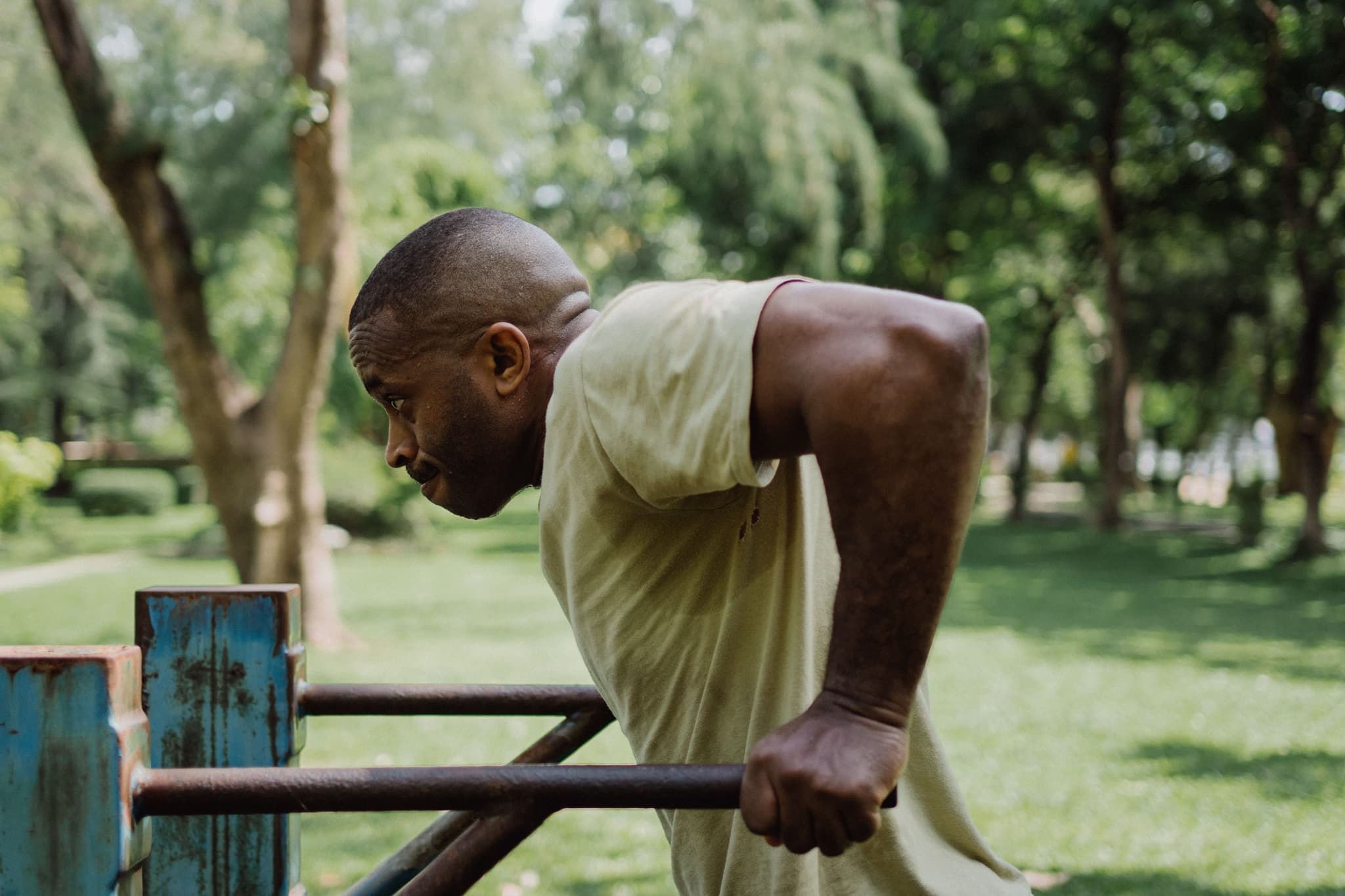
You can do resistance exercises outside in a park, but the quality of your session depends on what's there. A pull-up bar opens vertical pulling. Dip bars cover horizontal pushing and triceps work. A sturdy bench handles step-ups, incline pressing, and Bulgarian split squats. Scout the location before you program the session, not after. Pair any of these with a weighted vest and you have a legitimate progressive overload mechanism for upper-body pulling and pushing work.
Your equipment tier should follow your movement gaps, fill what's missing from Tier 1, and build from there.
How to Apply Progressive Overload in Resistance Training Outdoors
The gym makes progression feel obvious. Add a plate, move the pin, increase the number. Outside, you don't have those anchors, so you need to think in mechanisms instead of equipment. There are five ways to drive consistent adaptation using whatever resistance you have available.
Method 1: Load Progression — Add Weight or Resistance
The principle is simple: increase the resistance over time. Pack a heavier backpack for weighted step-ups. Move from a light resistance band to a heavier one for pull-aparts. Carry a loaded sandbag instead of nothing. The external load doesn't need to be precise, but it does need to increase across weeks.
Track it: Log the weight or band color used each session and bump it when you hit the top of your target rep range cleanly.
Method 2: Rep and Set Progression — Do More With What You Have
When you can't add load, add volume. If you did 3 sets of 8 pull-ups last week, hit 3 sets of 10 this week. Once you reach your rep ceiling across all sets, add a fourth set before loading further.
Track it: Record total reps per exercise each session. Progress when your numbers plateau for two consecutive sessions.
Method 3: Density Progression — Compress the Work Window
Same exercises, same reps, less time. Set a 20-minute window and complete a fixed amount of total work. Each session, try to finish that same workload faster. This increases training density without changing a single rep or adding external load.
Track it: Clock your total session time and note it at the top of your log.
Method 4: Mechanical Drop Sets — Extend the Set, Don't End It
When you hit failure on a hard variation, shift to an easier one and keep going. Max out on archer push-ups, then drop straight into standard push-ups without resting. You extend the set's productive volume without stopping the stimulus.
Track it: Log the variation chain and total reps completed across both levels.
Method 5: Tempo Manipulation — Slow the Eccentric, Increase Tension
A 3-second lowering phase on a bodyweight squat creates more mechanical stress than a fast rep with the same load. Muscular hypertrophy is driven by mechanical tension, which activates mTOR signaling pathways that increase muscle protein synthesis. That process responds to time under tension, not just load. Slowing the eccentric exploits this directly.
Track it: Write the tempo as a number (e.g., 3-1-1) next to the exercise. Increase it before you add load or reps.
Each of these methods satisfies the core requirement of progressive overload: a systematic increase in training stimulus over time. Pick the one that fits what you have that day.
Building a 4–6 Week Outdoor Resistance Training Plan
Six weeks is enough time to produce real adaptation if the program has structure. The framework below organizes the work into three phases, each built around a specific overload mechanism so your sessions compound instead of just accumulate.
Phase 1 (Weeks 1–2): Establish Your Outdoor Baseline
Before you progress anything, you need to know where you're starting. Spend the first two weeks running consistent sessions across all four movement patterns and recording your numbers. How many reps per set at bodyweight? What band tension? How long does the carry take to break down?
This phase is calibration. You're setting the performance benchmarks that every future session will be measured against. Establishing your baseline is the foundation of any effective resistance training outdoors program.
Phase 2 (Weeks 3–4): Drive Progressive Overload
In weeks 3–4, pick one overload variable per session and apply it consistently. If you added reps last time, hold the rep count and increase load this time.
Research published in Environmental Science & Technology found that exercising in natural environments was associated with greater feelings of revitalization and positive engagement, and decreases in tension, confusion, anger, and depression compared with exercising indoors. That psychological recovery advantage gives you more capacity to push the physical variables.
Phase 3 (Weeks 5–6): Push Intensity and Lock In Adaptation
Weeks 5–6 compress the demand. Introduce mechanical drop sets at the tail end of your primary movement, apply tempo prescriptions (3–4 second eccentrics), and track density targets: total reps completed within a fixed time window. A 2022 meta-analysis covering 19 studies with 1,662 participants found that green exercise may lower negative affect, including anxiety, tension, anger, depression, and fatigue. That edge matters when intensity climbs and sessions get hard.
If you're running this as a 6-week summer strength block, this is the phase where the adaptation you've been accumulating actually becomes visible.
Sample Weekly Session Architecture
Day | Session Focus | Overload Priority |
Monday | Hinge + Carry | Load or rep progression (Ph. 1–2), tempo (Ph. 3) |
Wednesday | Push + Squat | Rep progression (Ph. 1–2), density target (Ph. 3) |
Friday | Pull + Carry | Load progression (Ph. 1–2), mechanical drop set (Ph. 3) |
Three days, full pattern coverage across the week, one overload mechanism per session. Simple on paper, demanding in practice.
SHRED tracks your numbers across all three phases and tells you when you've hit the threshold to progress. You're not estimating whether last week was good enough. The data makes the call.
Track Every Session in the SHRED App — So the Program Actually Progresses
Outdoor resistance training already has an edge most people overlook. Research shows that people who exercise outdoors report greater enjoyment and satisfaction with the activity, along with a stronger intent to repeat it, compared to those training indoors. That intent matters, but it only converts into actual adaptation if you're logging what happened and building on it.
Progressive overload means adding stress to your musculoskeletal and nervous system over time, either by increasing resistance or accumulating more reps across successive sessions. You cannot do that consistently from memory.
Inside SHRED, you log each outdoor session by movement pattern, not just exercise name. That means recording load, rep count, tempo targets, and which phase of your plan you're in. Over six weeks, those entries become your benchmark data. You can see whether your push volume went up, whether your hinge loads progressed, and whether your phase-two targets are within range.
That visibility is what separates a training block from a collection of good workouts.
Download the SHRED app and start logging your next outdoor weight training session before you leave the house.
Frequently Asked Questions About Resistance Training Outdoors
Can you build muscle with outdoor resistance training?
Yes. Muscle growth is driven by mechanical tension: mTOR signaling is necessary for the increase in protein synthesis and hypertrophy that occurs in response to increased mechanical loading. That process works the same way regardless of whether the resistance comes from a barbell or your bodyweight. Apply progressive overload by gradually increasing resistance or reps across sessions, and adaptation follows.
Can I do resistance training in a park?
A park covers more than most people expect. Pull-up bars, benches, open grass, and uneven terrain handle most major movement patterns without any additional gear. Bring a resistance band or a loaded backpack if you need more challenge.
How do I stay consistent with outdoor training across seasons?
Adjust the logistics, not the program. Heat means earlier sessions and shorter rest periods. Cold requires a longer warm-up and appropriate layering. Waiting for perfect conditions guarantees gaps in your training.
Is outdoor resistance training suitable for beginners?
It's a solid starting point. Bodyweight movements are generally easier to learn with good form than barbell lifts under load. Start with foundational patterns, prioritize clean reps over volume, and add progression once you can hit your target sets without breaking down.
The Bottom Line
The gym doesn't build muscle. Progressive overload does. Resistance training outdoors works for the same reason any program works: apply consistent mechanical tension and drive that tension forward over time, and your body adapts. The park, the trail, the backyard, none of those variables determine your results. The program does.
What separates an outdoor training program from an outdoor workout habit is structure and data. Without logged sessions and tracked progression, you're just repeating effort. With them, you're running a program.
Start Phase 1 this week. Keep it simple, keep the reps honest, and log every set in SHRED. The app will show you exactly when to progress, so you're not guessing, you're responding to numbers. That's how outdoor weight training stops being a seasonal novelty and becomes a serious long-term programming environment you can build real results around.
Now go get the first session done.