
Resistance Band Travel Workouts: Why They Work and the Key Exercises to Know
Resistance band exercises for travel give you a full training stimulus, no gym required. Here's exactly how to train on the road.
Travel doesn't kill your training. Resistance bands do more than just fill a gap when you're away from the gym. They're one of the few tools that actually make sense on the road, and the research backs that up.
A 2019 meta-analysis published in SAGE Open Medicine found that elastic resistance training produces strength gains comparable to conventional resistance training across both upper and lower limbs. The equipment was never the limiting factor.
This article covers why resistance bands are the right call for travel, what flying and long drives actually do to your body, and the key exercises you need to know along with the form cues that make them work.
Why Resistance Bands Are Built for Travel
Most gym equipment doesn't travel. A barbell doesn't fit in a carry-on. A cable stack doesn't set up in a hotel room. Resistance bands do both, and they do it without sacrificing the training stimulus that matters.
Here's what makes them the right tool specifically for travel, not just a convenient substitute.
They pack to nothing. A full set of loop bands weighs under a pound and fits in a toiletry bag. You have no excuse not to bring them, which means you have no excuse not to train.
They work in any space. Most of the key movements require nothing more than a 4x4-foot footprint and something to stand on. No anchor point, no rack, no floor mat required.
Band type doesn't matter. These exercises work with any band you own: loop bands, mini bands, or tube bands with handles. For moves that typically use handles, loop-band users anchor the band underfoot and grip the top. To scale resistance without swapping bands, adjust your foot position. More band underfoot shortens it and spikes the tension. Less contact drops it. One band covers more range than most people realize.
They match what travel does to your body. This is the part most people miss. Resistance bands aren't just convenient. They're well-suited to the specific physical state you're in after hours of sitting in a plane or car. More on that below.
What Flying and Long Drives Actually Do to Your Body
Before you pick up the band, you need to understand what travel actually does to your physiology. The three mechanisms below explain why specific movements matter more after a long trip, not just which ones to do.
Your Hip Flexors After a 4-Hour Flight
Sitting locks your hip flexors in a shortened position for hours at a time. People whose jobs require prolonged sitting are more likely to experience adaptive changes that shorten the psoas and iliacus, and once that shortening occurs, the spine hyper-lordoses and the pelvis tilts anteriorly, placing stress on the erector spinae and surrounding spinal muscles. The practical result: your glutes stop firing properly, your lower back takes on load it shouldn't, and any squat or lunge pattern you attempt in your hotel room will be compensated from the start. Prioritizing hip extension movements early addresses this before it becomes a loading problem.
What Sitting Does to Your Thoracic Spine
A UK university observational study published in PMC found reduced thoracic mobility in individuals who spend more than seven hours per day sitting and fewer than 150 minutes per week being physically active. The thoracic spine stiffens into flexion when you're slumped in a seat for hours, whether a plane seat or a car, and that stiffness doesn't resolve on its own once you stand up. Sedentary behavior has long been associated with neck and low back pain, and the thoracic spine contributes around 33% of functional neck movement, meaning stiffness there limits your shoulder range of motion too. Any pulling or pressing movement you do through a restricted thoracic spine will be compromised, which is why extension and rotation work should appear in any session regardless of duration.
Jet Lag, Exercise Timing, and Your Circadian Rhythm
Timing your workout isn't a minor detail when you've crossed time zones. Research published in The Journal of Physiology found large phase advances from exercise at 7:00 a.m. and from 1:00 p.m. to 4:00 p.m., with advances being the desired adjustment for eastward air travel. Morning movement helps advance your clock faster after heading east. A short session with enough intensity to drive a cortisol response, without creating the kind of systemic fatigue that makes sleep worse on night one, is the right call when you're still adjusting.
The Key Resistance Band Exercises for Travel (With Form Cues)
These are the movements that cover the most ground with one band and limited space. Each one is chosen because it works multiple muscle groups, requires no anchor point, and addresses the physical effects of travel described above.
Banded Squat
Stand on the band with feet shoulder-width apart and hold the handles at shoulder height. Squat until your thighs are parallel to the floor, keeping your chest up and knees tracking over your toes. Drive through your heels to stand.
Form cue: Don't let the band pull your torso forward. Keep your elbows up and your upper arms parallel to the floor throughout the movement. If your chest collapses on the way down, the band tension is too high for your current position.
Bent-Over Row
Stand on the band with feet hip-width apart, hinge at the hips to roughly 45 degrees, and pull both handles to your lower ribs with your elbows tracking close to your sides. Lower with control.
Form cue: The hinge angle is the most common failure point here. If your torso is too upright, you're doing a partial movement and your lats aren't loaded properly. Get your chest closer to parallel with the floor and keep your spine neutral throughout.
Overhead Press
Stand on the band and hold the handles at shoulder height with palms facing forward. Press straight overhead to full extension, then lower with control.
Form cue: Don't let your lower back arch to finish the press. If you're hyperextending at the top, your core isn't braced and your shoulder range of motion is likely limited from sitting. Brace your abs before you press and keep your ribcage down.
Romanian Deadlift
Stand on the band with soft knees and drag the handles down your shins as you push your hips back. You should feel a hard pull through your hamstrings before you reverse. Drive through your hips to stand, not your lower back.
Form cue: The band should stay in contact with your legs the entire way down. If it's swinging away from your body, you're bending at the waist instead of hinging at the hip. Think about pushing the floor away from you as you stand, not pulling the band up.
Glute Bridge
Lie on your back with the band looped across your hips and the ends pinned under your feet. Drive through your heels to lift your hips, hold one second at peak extension, then lower with control.
Form cue: Squeeze your glutes hard at the top, not your lower back. If you feel this in your lumbar spine instead of your glutes, your feet are too far from your body. Move them closer and reset. This movement directly addresses the glute inhibition that comes from hours of sitting.
Lateral Band Walk
Place the band around your ankles and step side to side with a slight bend in your knees and your hips pushed back slightly. Keep tension in the band throughout. Don't let your feet come together between steps.
Form cue: The tendency is to stand upright and shuffle. That shifts the work away from the glute medius, which is the whole point of this movement. Stay low, stay hinged, and keep the steps deliberate.
Bicep Curl
Stand on the band and curl both handles simultaneously, keeping your elbows pinned at your sides. Lower with control.
Form cue: Don't let your elbows drift forward at the top of the rep. That's your shoulder flexors taking over. Keep the elbows fixed and focus on the forearm rotating toward your shoulder, not the elbow swinging forward.
Band Pull-Apart
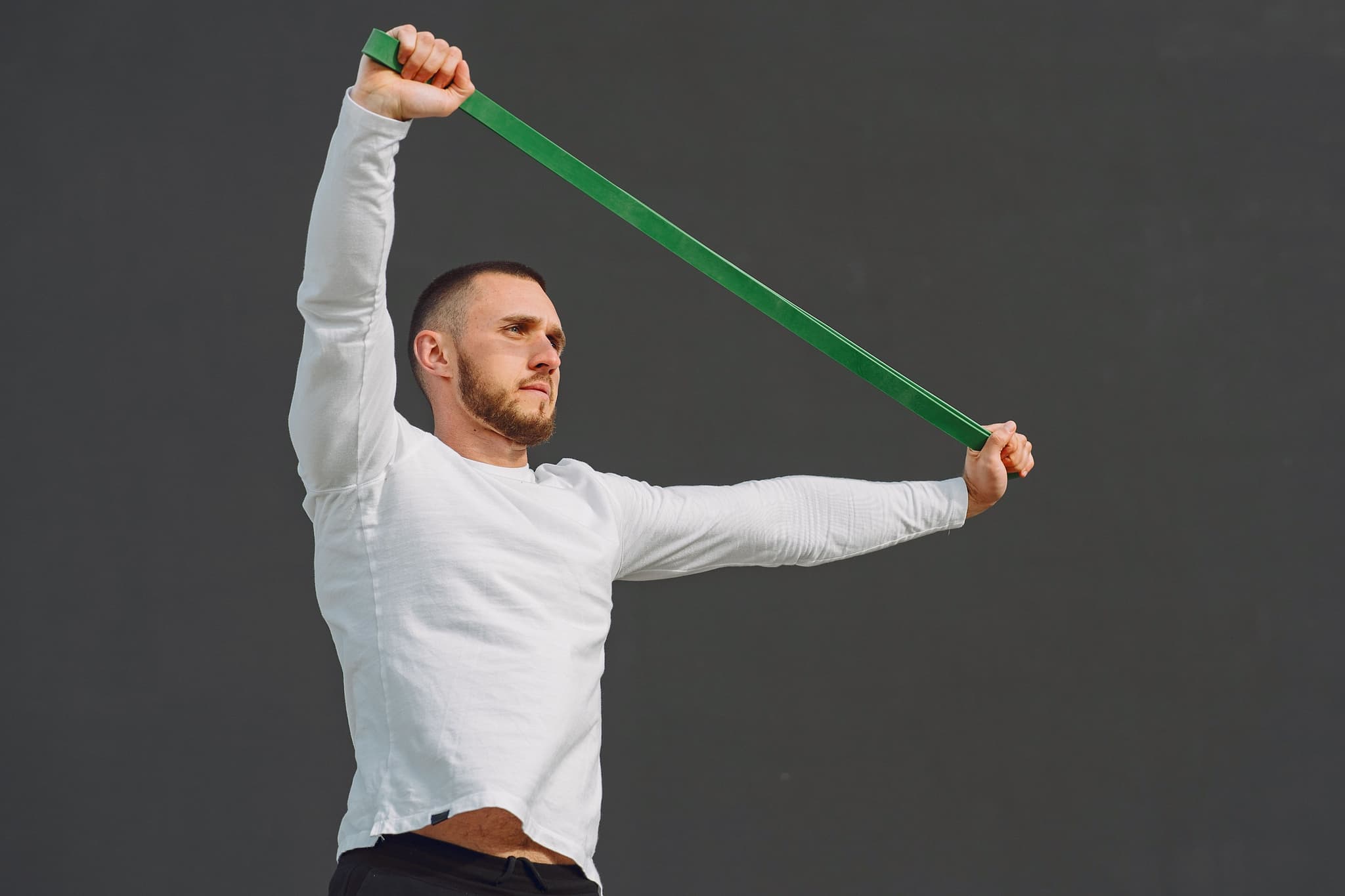
Hold the band in front of you at chest height with straight arms and hands shoulder-width apart. Pull the band apart by driving your hands out to your sides until the band touches your chest. Return with control.
Form cue: Keep your arms straight throughout. Bending your elbows turns this into a row and removes the stimulus from your rear deltoids and mid-back, which is exactly where you need work after hours of sitting hunched in a seat.
Standing Face Pull
Anchor the band under one foot and pull both handles toward your forehead with your elbows flared wide and high. This is one of the best movements you can do after a long flight for restoring shoulder and thoracic function.
Form cue: Elbows should finish higher than your hands at the top of the rep. If your elbows are dropping, you're turning this into a row. Drive the elbows up and back, and think about pulling your shoulder blades together and down simultaneously.
Banded Good Morning
Stand on the band with it looped across your upper back. Hinge at the hips with a soft bend in your knees until your torso is roughly parallel to the floor, then drive through your hips to stand.
Form cue: This is a hinge, not a squat. Your knees should barely move. If your hips are dropping and your knees are bending significantly, you've lost the hip hinge pattern. Keep the shins vertical and push your hips back, not down.
Frequently Asked Questions
Can You Build Muscle With Resistance Bands While Traveling?
Yes, and the research backs it up. A 2019 study by Lopes et al. in SAGE Open Medicine found that resistance bands produce muscle gains comparable to conventional resistance equipment. The deciding factor is working close to muscular failure on each set, not the equipment itself. If your current setup feels too easy, shorten your grip, double the band, or slow your tempo to increase effective resistance.
Are Resistance Bands Allowed on Airplanes?
Resistance bands are allowed in both carry-on and checked luggage. The TSA does not list them as prohibited items, though a security officer retains discretion to inspect anything that looks unusual.
How Long Should a Resistance Band Travel Workout Be?
Ten minutes is enough to maintain strength on a short trip. If you're away for more than a few days and want actual progress, twenty to thirty minutes is the right call. Pick based on your schedule and available space, and the adaptation will follow.
The Bottom Line
Resistance bands work for travel because they're portable, versatile, and well-matched to what your body actually needs after hours of sitting. The hip flexor shortening, the thoracic stiffness, the glute inhibition — the movements above address all of it directly.
Pack the band. Run through the form cues once before you go. When you get to the hotel, you already know what to do.