
How to Do Step-Ups: Fix Mistakes, Maximize Muscle Growth
Quads burning but glutes silent? Learn how to do step-ups the right way with EMG-backed form cues that fix the mistakes killing your gains.
Your quads burn, but your glutes stay quiet. That's your sign something's off. Knowing how to do step-ups correctly and actually performing them with proper step-up form are two different things, and most people never learn the difference.
This article walks through step-ups using EMG data on which muscles actually fire, not just guesswork. You'll see why your back leg might do more of the work than your front leg. You'll also see how box height changes which muscles take over, and what separates a real step-up from a lunge in disguise. We'll break down the exact form fixes that turn a mediocre step-up into a genuine glute-builder, and cover the variations worth adding once your form is clean. Then we'll settle the step-ups-versus-squats debate with actual numbers instead of opinions.
Fix these issues, and your step-ups will finally hit the muscles they're built to work.
What Muscles Do Step-Ups Work?
Step-ups primarily activate your quads, glutes, and hamstrings, with research showing the vastus lateralis and vastus medialis (outer and inner quad muscles) firing at the highest levels across step-up variations. A 2012 EMG study by Simenz and colleagues measured muscle activation in 15 women performing four step-up variations on an 18-inch box at 6-rep-max loads. The researchers tracked activation in the biceps femoris, gluteus maximus, gluteus medius, rectus femoris, semitendinosus, vastus lateralis, and vastus medialis.
That's the surface answer. The real story is in the smaller muscles that keep you from wobbling off the box.
Why Glute Medius Activation Matters for Step-Up Form
A 2020 PLOS ONE study tracked EMG activity in the gluteus medius, gluteus maximus, hamstrings, and quads during lateral step-ups, forward lunges, and monopodal squats in 20 participants. Vastus lateralis and vastus medialis showed the highest EMG activity, followed by gluteus medius and gluteus maximus. The quads lead, but glute medius still does real work on every rep. That matters because glute medius weakness shows up as knee cave and hip drop, the exact mistakes that ruin your proper step-up technique later.
Step-ups also work as a single-leg balance test. Skip that detail and you're leaving muscle growth on the table.
Hip, Knee, and Ankle: The Full Joint Picture
Step-ups load three joints at once. The loaded step-up exercise lets you train unilateral resistance while performing extension at the hip and knee, plus plantar flexion at the ankle. Your hip and knee drive you upward, and your ankle pushes off to complete the movement.
That joint-by-joint demand is exactly why sloppy technique costs you gains fast.
How to Do Step-Ups: Step-by-Step Form That Actually Works
Forget the version where you just hop on a box and hope for the best. Here's how to do step-ups with proper step-up technique that builds muscle instead of wrecking your knees.
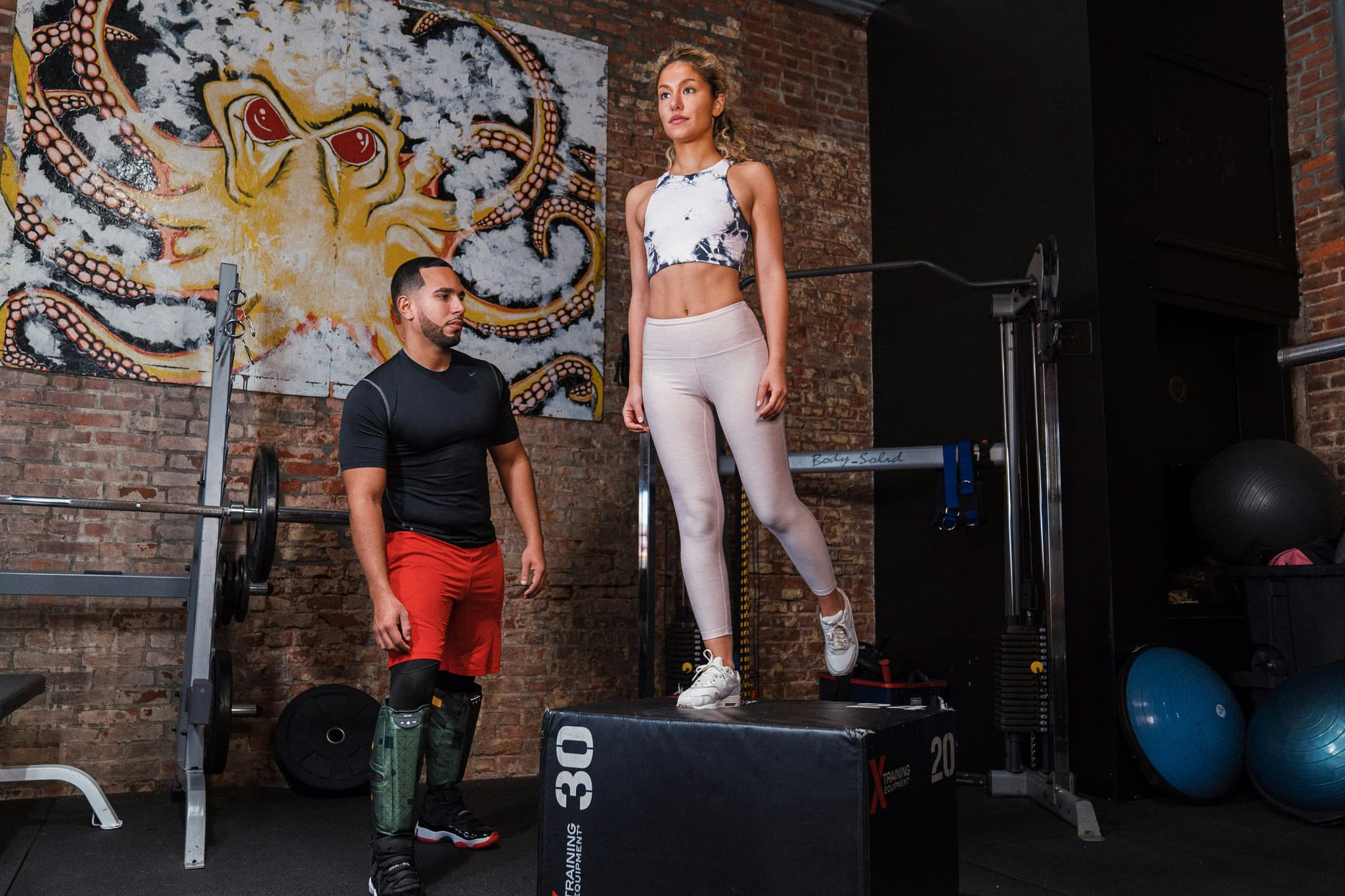
Stand tall in front of a box or bench. Set it at a height where your knee bends to about 90 degrees when your foot lands on top. Too high, and you'll lean on momentum instead of muscle.
Plant your whole foot on the box. Not just your toes. Your heel needs contact for stability and full glute engagement.
Drive through your planted heel. This is the cue that separates real step-ups from sloppy ones. Pushing through your toes shifts the work to your calves and quads, cutting your glutes out of the movement.
Press your hips forward as you rise. Don't just extend your knee. Think about finishing the rep with your hip, not your leg.
Control your body at the top. Stand fully upright on the box before you do anything else. Rushing this step is how people lose balance and slam their trailing foot down.
Lower with intention, not gravity. Reverse the motion slowly. Bend your standing knee and hip together, and let your trailing foot tap the ground softly.
Reset before the next rep. Step all the way off the box between reps if you're training strength. Staying on top the whole set turns this into a quasi-lunge, not a true step-up.
Run through this sequence slowly the first few sets. Speed exposes bad habits fast, and step-ups punish shortcuts more than most lower-body exercises.
The Back-Leg Mistake That's Killing Your Step-Up Form
Most people torch their step-up gains without knowing it. They let the back leg push off the ground on every rep.
Men's Health flagged this as the most common flaw in step-up exercise form. Treating the movement as a simple step onto a box misses the point. The exercise is meant to be unilateral, with nearly all the work driven by the front leg on the box.
Push off the back foot and you turn a single-leg exercise into a half-assed squat. Your working leg stops doing the job it's supposed to do.
How to Flex and Lift the Back Foot Mid-Rep
Here's the fix. As you drive up onto the box, flex your trailing foot and lift your toes off the ground before your lead leg locks out.
Trainer Eb, quoted in that same Men's Health piece, teaches this exact cue to kill momentum from the back leg. The back leg needs to disengage as much as possible, which happens by taking away your ability to drive off it and flexing the foot. Lifting the toes off the ground at the start and holding that position keeps the front leg and quad doing the work.
You should feel your standing leg burn earlier and harder. If you don't, you're still pushing off the floor.
Why the Working Leg Must Do All the Work
Proper step-up technique demands single-leg accountability. The second your back foot assists, you shift load away from the quad and glute you're trying to train.
Kill the push-off from the back leg. The rep will look almost the same, but the muscle you're training will finally carry the load it's supposed to carry.
Common Step-Up Mistakes
The back-leg push-off isn't the only thing wrecking your step-ups. These mistakes show up constantly, even in people who train hard and know their way around a gym. Run through this checklist to fix your step-up form.
1. Pushing Off the Back Foot
This one gets its own section above, but it still ranks as mistake number one on any checklist. Fix it first. Every other correction here works better once your back foot stops doing the job your front leg should handle.
2. Box Too High
A box that's too high forces your hip into more flexion than you need, and you end up hinging forward just to land your foot on the platform. Physical therapists recommend placing your front leg on the box with your knee at or just below a 90-degree angle.
Fix: Drop the box until your hip stays stacked over your knee at the top. If you're rounding your lower back to reach the platform, it's too high.
3. Losing Hip Control
Watch your knee cave inward as you press up. That's your hip losing stability, not your legs losing strength. It shows up when you're moving too fast or the load is too heavy for your control level.
Fix: Slow the concentric phase down. Cue your knee to track over your second toe on every rep.
4. Leaning Forward Instead of Driving Through the Heel
Leaning forward shifts work off your glutes and onto your lower back and hip flexors. That's a compensation pattern people mistake for a variation.
Fix: Keep your torso upright. Drive through your heel, not your toes, and feel your glute fire at the top.
5. Rushing the Eccentric (Step-Down) Phase
Most lifters treat the descent as dead time and rush it to get to the next rep. That skips the eccentric loading that builds muscle. Research shows eccentric-phase training increases muscle strength more effectively than concentric-only training because muscle fibers experience greater stress during lengthening.
Fix: Control the step-down for a full two to three seconds. Your working leg should feel it burn on the way down, not just the way up.
Check this list before your next set. One of these five is probably why your step-ups feel off.
How High Should a Step-Up Box Be?
Your box height should put your knee at or below a 90-degree angle when your foot lands on top. That usually means 12 to 18 inches, depending on your height and leg length. This is the foundation of proper step-up technique.
Go higher and your hip flexors and lower back start doing the work. Go lower and you cut your glutes out of the movement.
Test it before you load up. Step onto the box with bodyweight only and check that your knee doesn't cave past a right angle.
Step-Up Variations to Maximize Muscle Growth
Once your form is clean, plain step-ups stop being enough. Your legs adapt fast. You need variations that force new demands on the same movement pattern.
Step-up exercise form changes slightly with each variation below. The core mechanics stay the same, but load placement and foot direction shift which muscles do the work.
Loaded Step-Ups for Unilateral Strength
Hold dumbbells at your sides or rest a barbell across your back. Keep your torso upright through the whole rep. Added load punishes any back-leg push-off instantly, so it doubles as a form check.
Start light. Two 15-pound dumbbells expose sloppy balance faster than bodyweight ever will.
Lateral Step-Ups for Glute Medius Emphasis
Turn sideways to the box. Step up and over with your outside leg instead of straight ahead. This shifts the work toward your glute medius, the muscle that stabilizes your hip during single-leg stance.
Lateral step-ups require greater glute medius activation than forward step-ups, according to research published in Physical Therapy. If your hips cave or shift during walking or running, this variation targets that weak point directly.
Rotate between loaded and lateral versions week to week. Your joints get variety, your muscles get a new stimulus, and your form stays honest under different demands.
How Step-Ups Compare to Squats, Lunges, and Hip Thrusts
People ask this like there's one right answer. There isn't. Each exercise loads your muscles differently, and the EMG data backs that up.
Step-Ups vs. Squats for Glute Activation
A gluteal EMG study published on PubMed Central tested squats, step-ups, and step-downs in a group of healthy adults. Step-ups produced significantly higher glute medius activation than squats. For glute max, the muscle that builds a bigger backside, the two moves land in about the same range.
The squat in that study was done on both legs. Split the load across two legs and each one does less work. Load a step-up and one leg carries everything, plus the balance demand that comes with standing on a box.
Squats still win on total load capacity. You can put more weight on a bar than you can carry up a box on one leg. If pure strength is the goal, squat. If you want glute medius work and single-leg control, step-ups take the lead.
Step-Ups vs. Single-Leg Squats
A PLOS One EMG study compared lateral step-ups, forward lunges, and single-leg squats in 20 active adults performing 5 repetitions at 60% of their 5-rep maximum in each exercise.
Single-leg squats produced higher EMG activity than step-ups in glute, hamstring, and most quad muscles. Single-leg squats demand more balance and ankle stability since there's no box to push off. That extra instability likely explains why the muscles fire harder. Both exercises belong in a program. The step-up gives you a stable entry point; the single-leg squat asks more once you're ready for it.
Step-Ups vs. Hip Thrusts: Different Movements for Different Goals
Hip thrusts isolate the glutes with less quad and stabilizer involvement. Step-ups spread the work across quads, glutes, hamstrings, and the core, since you're managing balance the entire rep.
Use hip thrusts when you want maximum glute tension without other muscles jumping in. Use step-ups when you want a multi-muscle movement that trains strength and stability together.
Neither replaces the other. Pick based on the outcome you want, then check your box height. That's where most people quietly sabotage the whole exercise.
How to Do Step-Ups With Proper Programming: Sets, Reps, and Frequency
Knowing how to do step-ups technically is one thing. Programming them so they build muscle is another.
The superior portion of the gluteus maximus had significantly greater relative EMG activity than the inferior portion of the gluteus maximus during exercises that incorporated elements of hip abduction and/or external rotation, and forward step-ups produced greater activation of the superior portion of gluteus maximus in comparison to the inferior portion, according to a JOSPT study. Your setup determines how much of that muscle you actually recruit.
Recommended Sets and Reps by Goal
For hypertrophy, run 3 to 4 sets of 8 to 12 reps per leg, twice a week. For strength, drop to 4 to 5 sets of 4 to 6 reps with heavier dumbbells or a loaded barbell. For endurance or conditioning work, 2 to 3 sets of 15 to 20 reps gets the job done.
Can Step-Ups Replace Leg Day?
Not entirely. Keep step-ups in your rotation, but don't make them your only leg exercise. Proper step-up technique works the quads and glutes hard, but you'll miss activation in the hamstrings and inner thighs that other movements target.
Step-Up Form FAQs
What is the proper step-up technique? The proper step-up technique starts with placing your entire foot flat on the box, then driving through your heel to stand up fully on the box before stepping down. Keep your chest upright, your knee tracking over your toes, and your core tight throughout the movement. This form protects your knees and maximizes work on your quads, glutes, and hamstrings.
What muscles do step-ups work? Step-ups hit your quads, glutes, and hamstrings on the working leg. Your calves and core kick in for balance too. It's a full lower-body exercise disguised as a simple movement.
Are step-ups bad for your knees? Not if your box height and tracking are correct. Problems show up when your knee caves inward or your box is too high. Fix those two things and your knees stay fine.
Should you step up with your whole foot or just your toes? Plant your whole foot on the box before you push. Toes-only landings shift load to your calf and reduce stability. You want your heel down for a solid base.
Can beginners do step-ups? Yes, start with a low box and bodyweight only. Master the balance and knee tracking before adding load. Step-ups reward patience more than most exercises.
Fix Your Step-Up Form in Real Time With SHRED
You can read every cue on this page and still push off with your back leg tomorrow. That's how motor patterns work: you revert under fatigue unless something catches you.
SHRED's coaching app watches your reps as you do them. It flags a back-leg push-off before it turns into a habit, and it catches wrong box height too.
Samuel's fix—flex the foot, lift the toes—only works if you know you're breaking form. Step-up exercises produce some of the highest levels of gluteus maximus activation of any common strength movement, but that data means nothing if your form never lets your glutes fire in the first place.
SHRED closes that gap between knowing and doing.
The Bottom Line
Every fix in this article funnels down to one thing: kill the back-leg push-off. That's the difference between a real single-leg exercise and a disguised squat.
One EMG study found step-ups produced higher glute activation than squats, while squats produced the lowest activation for both the gluteus maximus and gluteus medius. But that advantage only shows up when your working leg does the actual work. Add reps or load on top of a compensating back leg and you're just reinforcing the wrong pattern, harder.
Knowing proper step-up technique on paper doesn't mean your body executes it under fatigue. Form breaks down exactly when you stop watching for it, usually around rep six or seven. That's the gap SHRED closes. It watches your reps in real time, catches the back-leg push-off before it becomes habit, and corrects you on the spot instead of after months of wasted volume. Quality reps compound. Sloppy ones just add up. Get SHRED and make every rep count.