
How to Activate Glutes Before Workout: 5 Warm-Up Moves
"Just do some bridges" isn't a warm-up plan—it's a guess. Here's the exact 5-move, 8-minute glute activation protocol backed by research, plus a 60-second test to confirm it worked.
If your glutes aren't firing before you squat, your quads and lower back end up doing a job that isn't theirs. Most lifters know they need to activate their glutes before a workout, but "just do some bridges" isn't a warm-up plan. It's a guess.
This article gives you the actual protocol: five moves, done in a specific order, in under 8 minutes, no equipment needed. You'll learn why timing matters more than the exercises themselves, and why research on glute activation shows mixed results—studies found performance benefits only after specific rest windows (around 8 minutes after the warm-up), while others found no improvement. Rest interval and load are the variables that determine whether you actually get a benefit from the protocol. You'll get sets, reps, and rest periods for each move, plus a 60-second test to check if it worked before you touch a bar.
If your squats still feel like a quad workout after all that, there's a reason. We'll cover the four most common causes, including one habit almost every desk worker has that quietly shuts glutes down.
Why You Need to Activate Glutes Before a Workout (And When You Don't)
Glute activation isn't magic. It won't turn on muscles that were "off." Timing matters more than most lifters think.
A 2015 study in the Journal of Human Kinetics tested a low-load gluteal warm-up protocol and found it was capable of augmenting force production variables in a squat jump provided an 8 minute rest period was implemented between the gluteal warm-up protocol and subsequent jump performance. The effect showed up specifically at that 8-minute mark, not immediately.
That's the window you're working with. Too early or too late, and you lose the benefit.
Not every study agrees on the mechanism. A clinical trial protocol from the University of the State of Santa Catarina notes that although widely used in clinical and sports practice, it is unclear whether, in fact, performing gluteal activation exercises in warm-up is effective in increasing electromyographic activation (EMG), as well as the mechanisms that explain eventual gluteal activation improvement of neuromuscular function (ClinicalTrials.gov, PI Caroline Ruschel).
Coaches use glute priming anyway because the practical result—better force output before heavy squats or sprints—shows up even if the exact mechanism stays unsettled. Relentless Athletics coaches build it into warm-ups for this reason. It's cheap insurance against a flat first set.
Your warm-up needs structure. Random band walks won't cut it. You need specific moves, done in the right order and timed to land inside that performance window.
This protocol delivers how to activate glutes before workout in under 8 minutes, timed to have your hips firing when the bar loads up.
The 8-Minute Glute Activation Protocol at a Glance
Short on time? Here's the full routine. These glute activation exercises hit your glutes in under 8 minutes, no equipment required.
Do them in this order, right before your warm-up sets:
Glute Bridge
(2 x 15 reps, 20 seconds rest)
Clamshell
(2 x 12 reps per side, 15 seconds rest)
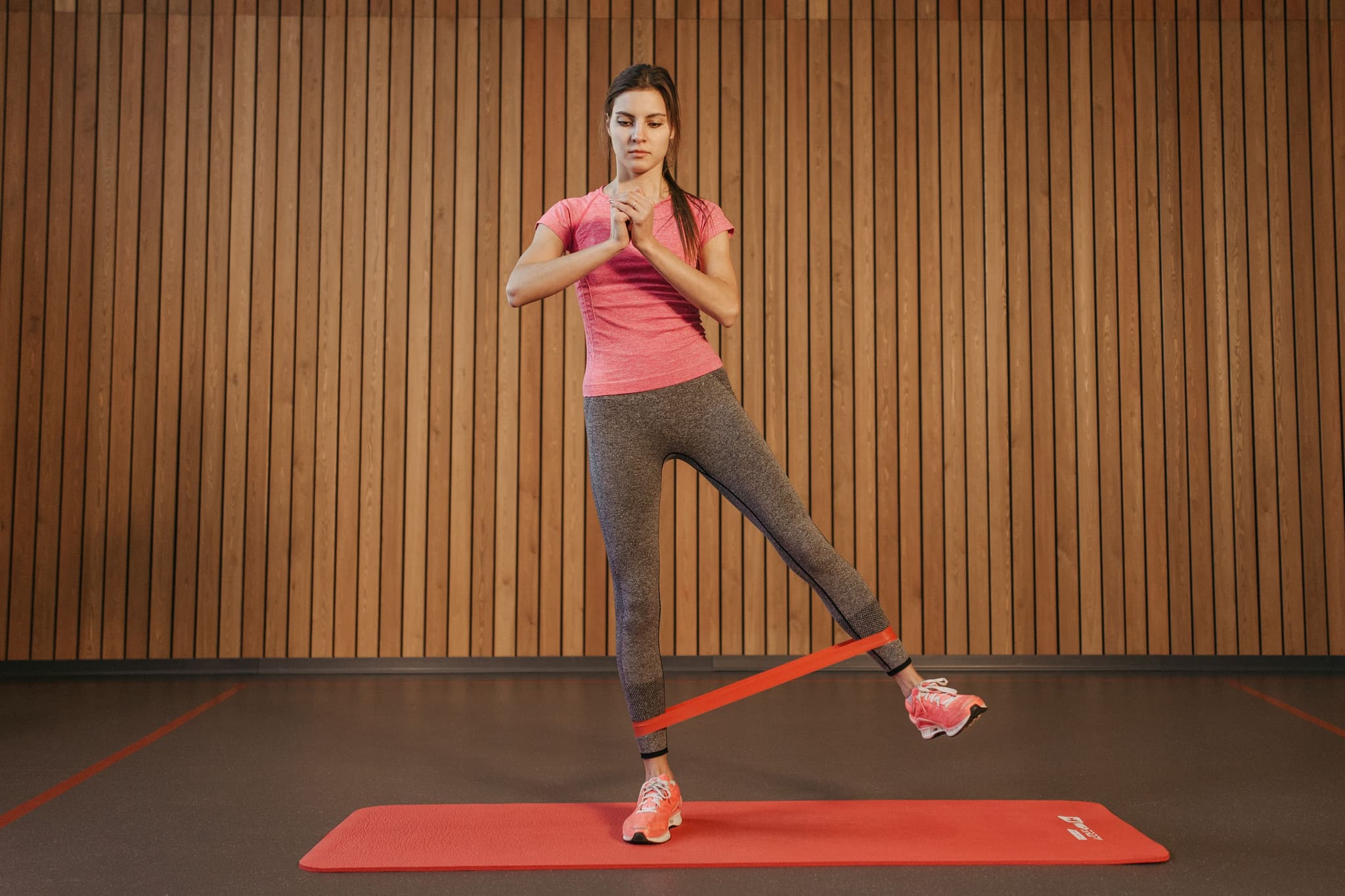
Banded Lateral Walk
(2 x 10 steps per direction, 20 seconds rest)
Bird Dog
(2 x 10 reps per side, 15 seconds rest)
Single-Leg Glute Bridge
(2 x 8 reps per side, 30 seconds rest)
Move through the list without checking your phone between sets. Keep rest short and intensity low. You're not training to failure here. You're waking up a muscle group that tends to go quiet after hours in a chair.
Total time lands around 7 to 8 minutes, including transitions. Do this right before squats, deadlifts, lunges, or any lower-body session. Skip it on upper-body or pure cardio days.
Here's a breakdown of why each move made the cut and how to do them correctly.
How to Activate Glutes Before a Workout: The 5-Move Warm-Up Sequence
This sequence follows a specific order. You start with isometric holds to prime the muscle, move into resisted patterns, then finish with dynamic movement that mimics what you're about to do under a barbell. Each move below lists sets, reps, rest, and equipment options, so you can scale up or down depending on what's in your gym bag.
Move 1: Half-Kneeling Glute Squeeze (Isometric Prime)
2 x 10-sec hold each side, 20-sec rest
Kneel on one knee, plant the other foot flat in front of you. Squeeze the glute of your back leg as hard as you can for 10 seconds. Keep your hips square. Don't let your lower back arch to compensate.
This move has data behind it. The half-kneeling glute squeeze elicited higher peak gluteus maximus activity than the split squat with a moderate effect (d = 0.68), in a study of twenty-four participants from various athletic backgrounds published in the European Journal of Applied Physiology. The effect didn't quite clear the bar for statistical significance (p = 0.064), so treat it as a solid prime rather than a proven winner.
Equipment tier: Bodyweight only. No band needed here.
Move 2: Resisted Knee Split
2 x 8 reps each side, 20-sec rest
Loop a mini-band around your knees, lie on your back with knees bent. Drive one knee outward against the band, hold for a beat, then return with control. Keep your feet planted and pelvis still. This glute activation exercise is one of the most effective moves in a pre-workout glute warm-up.
The same study found this move drove gluteus maximus activity significantly higher than the split squat, with a large effect size. The RKS (p = 0.011, d = 0.96) elicited higher peak gluteus maximus activity than the SS with a large effect. Of the four exercises tested for glute max, this is the one with the clearest statistical edge.
Equipment tier: Mini-band required. Loop-band works too if it sits above the knee.
Move 3: Glute Bridge / Banded Hip Thrust
2 x 12 reps, 30-sec rest
Lie on your back, knees bent, feet flat. Drive your hips up until your body forms a straight line from shoulders to knees, squeeze at the top, lower slowly. Add a loop band around your thighs for more resistance, or elevate your shoulders on a bench for a full hip thrust variation.
In that same 24-person EMG study, the highest peak glute max activity averaged over all participants was found for the hip thrust at 143% MVIC, with no significant difference to the resisted knee split (128% MVIC) and half-kneeling glute squeeze (125% MVIC). All three earn a place in your warm-up.
Equipment tier: Bodyweight works. Loop-band or barbell adds load for advanced lifters.
Move 4: Resisted Prone Hip Abduction
2 x 10 reps each side, 20-sec rest
Lie face down, band looped around your ankles. Keeping your leg straight, lift one leg out to the side, hold briefly, lower with control. This targets the gluteus medius, the muscle that stabilizes your hip during squats and single-leg work. Adding this to your leg day warm-up ensures both glute muscles are primed before heavy loading.
The same research team found resisted prone hip abduction beats other glute medius moves by a wide margin. The resisted prone hip abduction elicited the highest peak EMG activity at 149% MVIC, with a significant difference and large effect compared to resisted side-stepping (93% MVIC) and a moderate effect compared to the side-plank with leg abduction (118% MVIC). Both of those moves get programmed constantly for the same goal, but this one wins the comparison.
Equipment tier: Ankle loop-band required. A mini-band around the ankles works in a pinch.
Move 5: Lateral Band Walk (Dynamic Integration)
2 x 10 steps each direction
Place a loop band around your ankles or just above your knees. Drop into a quarter squat, step laterally, keep tension on the band the entire time. Don't let your feet come together between steps. This move closes out the warm-up by shifting from isolated activation to movement that resembles your training. Your glutes are firing. Now they need to work while your hips and knees move together.
Equipment tier: Loop-band works best. Mini-band is a fine substitute if that's all you have.
Run all five moves back to back with minimal rest between exercises. By the time you finish, your glutes should feel warm, slightly fatigued, and ready to fire under load. Head straight into your first warm-up set while that activation is still fresh.
How Do You Know If Your Glutes Are Activated?
Run this test right after your warm-up, before you touch a bar.
Step 1: Lie on your back and set up a single-leg glute bridge. Plant one foot, extend the other leg straight.
Step 2: Push through your heel and lift your hips until your body forms a straight line from shoulder to knee. Hold for 20 seconds.
Step 3: Pay attention to where you feel the burn. Your glute should be working. Your hamstring or lower back should not be doing the heavy lifting.
If you can't hold the position without your hips sagging or your lower back cramping, your glutes aren't firing yet. Go back through the sequence and add another round of bridges before you load anything heavy.
Pass the test, and you're clear to move into your warm-up sets. This glute activation check confirms the muscle is online before you ask it to stabilize a loaded squat or hip hinge.
If you feel the burn in the right spot on both sides, load the bar and get to work.
Why Aren't My Glutes Activating During Squats?
Four things usually cause this. Fix the right one and squats stop feeling like a quad workout.
Your bar path shifts weight forward. If your knees drift past your toes early and your torso stays upright, your quads take over. Your glutes barely get a chance.
You're not hinging enough at the hip. A proper squat needs your hips to travel back before they travel down. Skip that hinge and you turn the movement into a knee-dominant leg press.
Your posterior chain is weak. Weak glutes and hamstrings mean your body finds the path of least resistance. That path runs straight through your quads.
You're skipping glute activation before your workout. Cold glutes don't fire on command. Research shows that a pre-workout glute warm-up can improve force production in the early phase of a muscle contraction, with faster time to peak force among the gains researchers measured.
None of these are permanent. Bar path and hip hinge are technique fixes you can work on during your warm-up sets. Weak posterior chain muscles respond to consistent loading over weeks.
Walk into squats with zero glute activation, and you're already behind before the bar loads. That's what the 5-move warm-up sequence above is built to fix.
FAQ: Glute Activation Before Leg Day
What is glute activation and why does it matter before a workout?
Glute activation wakes up your gluteal muscles so they fire properly during squats, deadlifts, and lunges. When you sit for hours, your glutes go quiet and your hip flexors tighten—a condition called gluteal amnesia or dead butt syndrome. A few minutes of targeted glute activation exercises before your workout forces your glutes to engage again, so they do the work instead of letting your quads and lower back take over.
What is dead butt syndrome and how do you fix it?
Dead butt syndrome (gluteal amnesia) happens when your glutes stop firing properly, usually from too much sitting. Your hip flexors tighten, your glutes go quiet, and other muscles pick up the slack during squats and deadlifts. Fix it with regular glute activation and less time parked in a chair.
How long should you do glute priming before a workout?
Eight minutes works best. A 2015 study by Comyns, Kenny, and Scales in the Journal of Human Kinetics tested countermovement and squat jump performance after a low-load gluteal warm-up, checking results at 30 seconds, then again at 2, 4, 6, and 8 minutes post-warm-up. Squat jump force production showed its clearest gains at that 8-minute mark. Rush the warm-up or wait too long after it, and the benefit fades.
What is the best exercise to activate glutes?
The hip thrust wins on the data. An EMG study analyzed 24 trained participants and found the highest peak glute max activity averaged over all participants for the hip thrust, at 143% MVIC, with no significant difference from the resisted knee split (128% MVIC) and half-kneeling glute squeeze (125% MVIC). If you only have time for one move before squats or deadlifts, make it the hip thrust.
Can you activate glutes without a resistance band?
Yes. Bodyweight moves like glute bridges, clamshells, and single-leg hip thrusts work fine without any equipment. Bands add extra tension, but they're not required to wake up your glutes before a lift.
Bookmark these answers. They cover the questions that come up most once you start taking glute activation seriously.
The Bottom Line
Random bridges for 20 minutes won't do what a specific sequence does in 8. Order and intent beat volume every time. Isometric holds prime the muscle, resisted patterns teach it to fire under load, and dynamic movement carries that activation straight into your first squat or deadlift. Skip the order, and you're just tired, not activated.
Learning how to activate glutes before a workout the right way changes what leg day actually trains. Get the sequence wrong, and leg day quietly turns into a quad workout.
If you'd rather not track sets, reps, and order in your head every session, SHRED builds this exact warm-up into your workout automatically, one guided flow from first bridge to last rep. You just show up and move.