
Cable Machine Glute Exercises: Sets, Reps & Progression
Only have 20 minutes on the stack? Here's the exact cable machine glute exercises lineup, sets, reps, and progression plan a coach would hand you.
Cable machine glute exercises are among the most effective tools for building strength and muscle in your posterior chain. You've got 20 minutes on the stack. That's enough time for three exercises, done right, if you know which pin to load and which stance to take.
This guide gives you exactly that. You'll get the setup for kickbacks, pull-throughs, and abduction work, down to the pulley height and foot position. You'll get set and rep ranges that build muscle, not just burn time. You'll also get a weekly plan that tells you how often to hit each station without overlapping recovery.
Skip the lecture on why cables work. Here's the station order, the numbers, and the progression rules a coach would hand you before walking off to check on someone else. By the end, you'll have a complete cable machine glute routine ready to run today.
The 3 Best Cable Machine Glute Exercises
The best cable machine glute exercises target your glutes from three angles: hip extension, hip hinge, and lateral abduction. Set up in this order for a complete session.
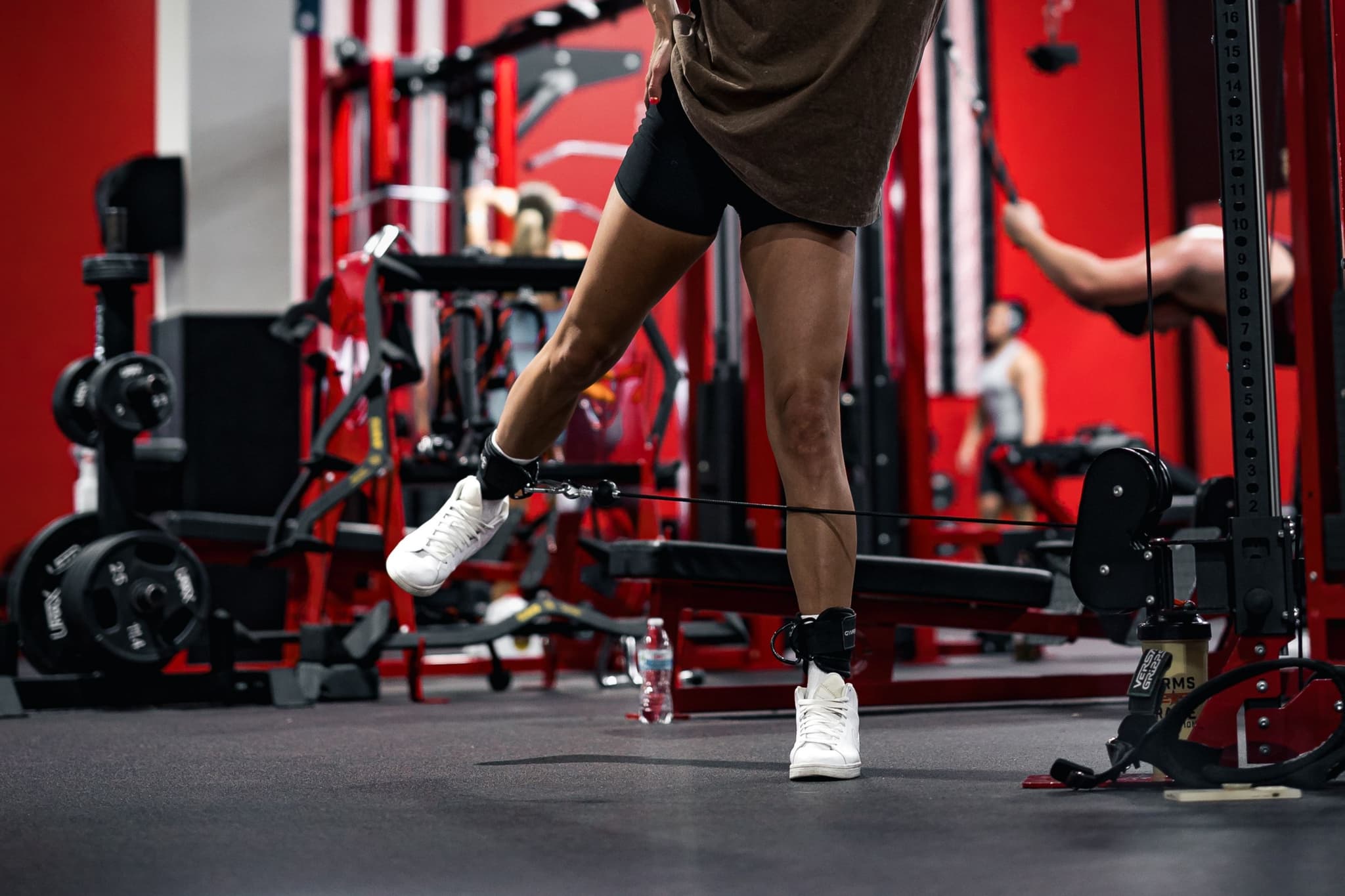
Cable Glute Kickbacks. Attach an ankle cuff to the low pulley. Face the machine, hold the frame for balance, and kick your leg straight back. Keep your knee soft, not locked. Work 12 to 15 reps per leg.
Cable Pull-Throughs. Set the pulley at the lowest position and attach a rope handle. Face away from the machine, hinge at your hips with a flat back, then drive your hips forward to stand tall. Aim for 10 to 12 reps.
Cable Abduction. Attach the ankle cuff to a low pulley and stand sideways to the machine. Keep your torso still and sweep your leg out to the side. Do 15 reps per leg.
Run all three back to back. Kickbacks isolate hip extension, pull-throughs train the hinge pattern, and abductions hit the side of the glute the other two miss.
Why Cable Machine Glute Exercises Load the Muscle Differently Than Bodyweight
Your glutes respond to how resistance is applied, not just how much weight you move. Swapping a bodyweight kickback for a cable machine glute exercise changes the movement more than most people expect.
Start with the compound lift comparison. In a 2015 study published in the Journal of Applied Biomechanics, the barbell hip thrust elicited significantly greater mean (69.5% vs 29.4%) upper gluteus maximus EMG activity than the back squat. That gap exists because hip thrusts keep tension on the glutes through hip extension, the same motion cable machine glute exercises let you isolate on command.
How constant cable tension compares to a bodyweight resistance curve
Bodyweight or ankle-weight kickbacks follow an uneven resistance curve. Resistance peaks near the top of the movement, then drops off fast as your leg returns. Your glute barely works during the first half of each rep.
A cable stack doesn't let up. The pulley pulls back the entire time, so your glute stays under load from the start of hip extension through the finish. You feel it working in the first few inches of the rep, not just at lockout.
Cables apply tension where bodyweight movements leave gaps. Once you understand that curve, you can set up each exercise below—cable glute kickbacks, cable pullthroughs, and glute abduction work—to use it, adjusting pulley height and stance to keep the glute loaded through the full range instead of just the peak.
Cable Glute Kickback: Setup, Form, and Sets/Reps
The cable glute kickback is the closest thing to isolation you'll get for the glutes. Get the setup right and it does the work for you.
Step-by-step setup and execution
Attach an ankle cuff to the low pulley.
Loop it around your ankle, snug but not cutting off circulation.
Face the machine and grab the frame with both hands.
Hinge forward slightly at the hips, maybe 20 to 30 degrees.
Kick your working leg straight back, squeezing your glute at the top.
Control the return. Don't let the cable yank your leg forward.
Keep your standing knee soft. Locking it out shifts load into your lower back.
Sets and reps for cable glute kickbacks
Run 3 sets of 12 to 15 reps per leg. Slow the tempo down: two seconds out, one second squeeze, two seconds back.
This isn't a heavy-load exercise. Stay light and prioritize the squeeze at the top of the movement over stacking plates on the pulley.
Cable glute kickbacks earn their spot here because of the resistance curve, not the weight moved. With bodyweight or ankle-weight kickbacks, resistance peaks at the top of the movement and drops off on the way back down, unlike a cable, which stays consistent throughout. A cable delivers constant tension throughout the entire arc of the movement, pulling against you consistently from the moment you begin extending the hip to the peak contraction at the top.
Why one leg at a time matters
Training unilaterally exposes weak sides fast. If your left leg fatigues at rep 10 and your right cruises to 15, that's data.
Research in the Journal of Orthopaedic & Sports Physical Therapy has shown that gluteal muscle weakness is associated with lower extremity injury risk. A kickback station is a cheap way to screen for a side-to-side imbalance before it shows up on the field or in your squat.
Once you've logged your reps here, move to a hip-hinge pattern. That's where the pull-through comes in.
Cable Pull-Through: Setup, Form, and Sets/Reps
Cable pull-throughs are one of the best cable machine glute exercises because they train the hip hinge without loading your spine the way a barbell does. That makes them a solid choice for glute training if your lower back gets cranky under load.
Step-by-step setup and execution
Set the pulley to the lowest position and attach a rope handle.
Face away from the machine and straddle the cable. Walk forward until you feel tension in the rope, then stop.
Take a shoulder-width stance. Hinge at your hips and reach the rope back between your legs, keeping your knees soft instead of locked.
Drive your hips forward to stand up and squeeze your glutes hard at the top. Don't lean back or hyperextend your lower back to finish the rep.
Reverse the motion slowly and let the rope pull your hips back into the next hinge. Your hamstrings help out with hip extension and receive some of the eccentric loading during the downward phase, so don't rush this part.
Sets and reps for the pull-through
Run 3 sets of 10 to 15 reps. The movement is easy on the joints, so it holds up well at higher rep ranges.
Rest 60 to 90 seconds between sets. Focus on reaching full hip extension every rep instead of just moving the weight.
Is cable pull-through better than deadlift for glutes?
For pure glute tension, the cable pull-through wins. Deadlifts load your spine axially, straight down through the vertebrae. Cable pull-throughs minimize axial loading and instead maximize horizontal loading, placing consistent tension on the glutes throughout the entire range of motion.
You also keep tension on your glutes through the entire range of motion. The cable provides constant tension and peaks at the lockout, while a deadlift loses tension right when you lock out.
That makes the pull-through a solid option if you're managing a back issue or want more time under tension for your glutes. Pair it with cable glute kickbacks or glute abduction machine work to round out hip extension, hinge, and lateral movement in the same session.
Glute Abduction Machine: Setup, Form, and Sets/Reps
The glute abduction machine targets the side of your hip, an area cable glute kickbacks and cable pullthroughs barely touch. That's your glute medius, the muscle that keeps your pelvis stable when you walk, run, or stand on one leg. Do cable hip abductions target the glute medius? Yes—the machine isolates it effectively because the movement pattern matches the muscle's primary function: moving your leg away from your body against resistance.
Step-by-step setup and execution
Sit in the machine with your back flat against the pad. Line up your knees with the pivot point of the levers.
Push your knees outward against the pads, slow and controlled. Pause for a beat at the top. Let the weight come back in with control. Don't let it slam.
Keep your torso still through the whole rep. If you're rocking side to side, drop the weight. That swinging motion means your hip flexors and lower back are bailing you out instead of your glutes doing the work.
Sets and reps for abduction work
Run 3 sets of 15 to 20 reps. This is a smaller muscle working in a limited range of motion, so higher reps recruit it better than heavy, low-rep sets.
Rest 45 to 60 seconds between sets. You don't need long breaks here. Squeeze hard at the top of each rep and hold for a full second before releasing.
Standing cable abduction vs. seated machine abduction
Standing cable hip abduction can activate the glute medius well. The standing cable version adds a balance challenge the seated machine doesn't. Attach an ankle cuff to a low pulley, stand sideways to the stack, and sweep your leg out to the side without leaning your torso away from the movement. That lean is the most common cheat, and it shifts work off your glutes.
If you have access to both, alternate them week to week. The seated machine isolates better for beginners. The standing cable version demands more control, which makes it a solid progression once your form is locked in.
Cable Machine Glute Exercises: Weekly Sets, Reps, and Placement
Running all three cable machine glute exercises in one plan works best when you treat them as specialists, not interchangeable moves. Kickbacks bias hip extension. Pull-throughs load full hip extension at lockout. Abduction hits the glute medius from the side.
The gluteus maximus has two functionally distinct regions. A study in the Journal of Orthopaedic and Sports Physical Therapy compared EMG activity in the upper and lower portions of the muscle and found the superior portion had significantly greater relative EMG activity than the inferior portion during common hip exercises that combine abduction or external rotation with extension. That's your cue to pair abduction work with kickbacks rather than skip one for the other.
Sample weekly split using all three cable exercises
Train glutes twice a week for solid recovery and growth.
Day 1 (after squats): Cable pull-throughs, then glute abduction. Day 2 (after RDLs or hip thrusts): Cable kickbacks, then glute abduction.
Slot cable work after your main compound lift. Your glutes are already warm, and you won't burn out your hip stabilizers before a heavy set.
Cable Machine Glute Exercises: Sets, Reps, and Weekly Structure
Exercise | Sets | Reps | Weekly Frequency | Placement in Workout |
Cable Pull-Through | 3 | 12-20 | 2x | After squats or deadlifts |
Cable Glute Kickback | 3-4 | 10-15 | 2x | After compound lifts |
Glute Abduction Machine | 3 | 15-20 | 2x | Last exercise, finisher |
For pure strength focus, drop reps toward the low end and add load. For hypertrophy, stay in the middle of each range and chase a slight burn by the last set. For activation before squats, use light weight for 15-20 reps just to wake the glutes up.
The cable provides constant tension and peaks at the lockout, making it one of the best glute exercises, which is exactly why the 12-20 rep range works so well for pull-throughs. You're loading the glutes hardest at the exact point they need the most protection: full hip extension.
Bodyweight kickbacks lose tension on the way back to the start. Cable kickbacks don't. The cable keeps resistance on the glute through the entire rep, both directions, which is why higher reps here build real muscle instead of just burning time.
Once you've got the weekly structure down, the next step is knowing how to break a plateau when these lifts stop feeling hard.
Progression Rules: When to Add Weight, Reps, or Sets
Progressive overload sounds simple until you're standing at the machine wondering if today's the day to bump the pin. Use rep thresholds, not gut feeling, to make that call.
Progression criteria for cable machine glute exercises
Once you hit 20 clean reps per side on cable glute kickbacks, add 5 to 10 pounds. Clean means full range, controlled tempo, no swinging the hip to generate momentum.
Same rule applies to the glute abduction machine. Hit 20 reps with your knees tracking smoothly and the movement staying in your hip, not your lower back, and it's time to load up.
If you drop below 12 reps after adding weight, back off 5 pounds. That's your deload cue. No shame in it. It just means the jump was too big.
Progression criteria for cable pullthroughs
Cable pullthroughs work differently because the hinge pattern limits how much load you can add before form breaks down. Stick to reps in the 12 to 15 range and only add weight once you complete all sets at the top of that range for two straight sessions.
If your lower back rounds before your hips finish extending, that's your signal to stop adding weight. Add reps instead, working up to 15 before you touch the pin again.
Track your numbers every session. A notebook or phone app works fine. Once you know your rep ceiling at each station, you'll know exactly when to add weight instead of guessing.
Cable Exercises for Glutes vs. Squats, RDLs, and Deadlifts
Cable machine glute exercises isolate. Squats and RDLs load the whole system. You need both, but they're not doing the same job.
The barbell hip thrust elicited significantly greater mean (69.5% vs 29.4%) upper gluteus maximus EMG activity than the back squat, according to a 2015 study by Contreras and colleagues published in the Journal of Applied Biomechanics. Hip extension movements with your torso upright crank glute activation harder than knee-dominant squat patterns do.
Cable pullthroughs and kickbacks work on that same principle. They isolate hip extension without the spinal loading a barbell brings.
Quick comparison: Cable isolation vs. compound lifts
Back squat
: Loads quads, glutes, and spine together. Lower glute max activation per the EMG data above.
Hip thrust/pullthrough pattern
: Higher glute max activation, minimal spinal load.
Cable kickback
: Isolates one glute at a time. No spinal load, no balance demand.
RDL
: Trains the hinge under heavy load. Builds strength cable work can't match.
Glute abduction machine
: Targets glute medius, a muscle squats and RDLs barely touch.
Don't drop your squats and RDLs for cable work. Use cables to fill the gaps those lifts leave behind, especially if your gym doesn't have a hip thrust setup.
FAQ: Cable Machine Glute Exercises
Do cable kickbacks actually work your glutes?
Yes. Cable kickbacks fix a problem bodyweight kickbacks can't. With bodyweight or ankle-weight kickbacks, resistance peaks at the top of the movement and drops off fast on the way back, leaving your glute barely loaded through the early range. A cable keeps tension on the muscle through the whole rep, not just the lockout.
What is the best cable machine exercise for glutes?
No single move wins outright. Cable pull-throughs load the glutes through hip extension with less stress on the spine than a deadlift. Kickbacks isolate one side at a time for symmetry work. Pick based on what you're missing, not what's trendy.
How many reps should I do for cable glute kickbacks?
Run 12 to 20 reps per leg. That range keeps steady tension on an isolation move without turning the set into spinal work. Go lighter and higher rep if you feel the burn in your lower back instead of your glute.
Is cable pull-through better than deadlift for glutes?
For pure glute tension, yes. The cable pullthroughs use hip extension to contract the glutes and bring the torso upright. Because cables maintain constant tension through the full range of motion, you get an intense muscle contraction without the spinal loading of a heavy deadlift. Deadlifts still win for total-body strength and loading capacity. Don't drop them for pull-throughs.
Do cable hip abductions target the glute medius?
Directly. A study in the Journal of Orthopaedic and Sports Physical Therapy found that gluteus medius activation was highest during side-lying hip abduction, while the single-limb squat and single-limb deadlift exercises led to the greatest activation of the gluteus maximus. That's the muscle squats and deadlifts mostly skip. Cable abduction machine work trains the same movement pattern, which makes it a solid tool for building the glute medius directly.
How often should I train glutes with cable exercises?
Two to three sessions a week works for most lifters. Space them out with at least one rest day between sessions so the muscle has time to recover before you load it again.
The Bottom Line
This section gives you a system, not three exercise descriptions. Kickbacks, pull-throughs, and abduction work each hit the glutes from a different angle. Stacking them in the right order and dose turns cable machine glute exercises into a real training block instead of a random finisher. The setup matters, but placement and progression are what make it pay off week after week.
Pick your slot right now. Add a pull-through to leg day after your compound lifts, or stack kickbacks and abduction as a finisher on a shorter session. Commit to the same rule: hit your clean rep target before you add a single pound to the pin. Load it into next week's plan, run it as written, and let the reps tell you when you're ready to progress.
Related Articles
Dumbbell Arm Exercises for Beginners: Why Free Weights Beat Cables
Cables feel safer, but they hide the mistakes that matter most. See why dumbbell arm exercises beginners should master first build real strength, better balance, and honest form fast.
Step-Ups for Hamstrings: Box Height, Stance & Form Guide
Are step-ups actually a hamstring exercise, or just quads in disguise? Here's how box height, stance, and hip hinge decide the answer.
7 Progressive Overload Mistakes Beginners Make (and Fixes)
Stalled lifts? You might be making one of these 7 progressive overload mistakes beginners make without realizing it. Get the symptoms, causes, and exact fixes before it costs you months.