
Best Isometric Exercises to Add to Your Strength Program
Planks and wall sits aren't the whole story. Here are the best isometric exercises that actually build strength, plus how to load and time each hold for real results.
Search "best isometric exercises" and you'll get two contradictory answers. Fitness sites treat isometric holds like a shortcut to bigger muscles. Mayo Clinic notes that isometric exercises help maintain strength, and they can also build strength, but not effectively. Cleveland Clinic takes a similar stance: one of its physicians says "if you can tolerate eccentric or concentric movements, they are definitely more effective for building strength," though "isometrics are usually the first form of exercise introduced for someone rehabbing an injury." Neither side is wrong. They're describing two different tools and calling them the same thing.
The type of hold you choose, and how you load it, decides whether you get a modest maintenance effect or genuine strength and muscle gains. A plank pressed against an immovable rack pin does something different to your nervous system than a loaded wall sit held for 30 seconds. This section breaks down that distinction: what separates overcoming holds from yielding ones, how long to hold each type, how much load to add, and where isometric workout routines fit if you're new to training or working around an injury.
What Are Isometric Exercises?
Isometric exercises involve generating muscular force against resistance without changing the muscle's length or the joint's angle. Instead of lifting and lowering a weight, you hold a fixed position, like a wall sit or plank, keeping tension constant for a set period of time. These are among the best isometric exercises for building strength at specific angles.
That static tension separates isometrics from the concentric and eccentric phases you're used to in a normal lift. There's no shortening, no lengthening. Just sustained contraction under load.
Isometric exercises target major muscle groups while keeping joints in stable, low-risk positions. That makes them useful for rehabbing an injury, breaking through a strength plateau, or building the kind of tendon and connective tissue resilience that heavy dynamic lifting alone doesn't always provide.
Coaches often program these holds at specific joint angles, say 90 degrees at the knee for a wall sit, because research provides solid evidence for joint-angle specific strength gains after isometric resistance training. Train the lockout position of your squat, and you'll get stronger mainly at that angle. Full-range strength improvements are best achieved when isometrics are paired with dynamic work.
That specificity is why isometric work deserves a real spot in your program, not just a warm-up afterthought.
Do Isometric Exercises Build Muscle, or Just Strength?
Yes—isometric exercises can build muscle, though the setup matters more than most people realize. Mayo Clinic and Cleveland Clinic typically frame isometrics as tools for strength and stability rather than muscle growth, a caution that reflects how most trainers teach the exercise: short holds, moderate effort, tacked onto a warm-up or a rehab session. But that advice skips what happens when you change the joint angle, load, and time under tension.
A systematic review in the Scandinavian Journal of Medicine & Science in Sports found that isometric training at longer muscle lengths produced greater muscular hypertrophy when compared to equal volumes of shorter muscle length training. In plain terms, a deep, stretched position (think a low squat hold instead of a near-lockout one) can build tissue even when it feels less powerful in the moment.
Load and duration matter just as much as joint angle. A near-maximal hold of 5 to 10 seconds, done for multiple sets, sends a different signal to your muscle fibers than a 60-second hold at 50% effort. The first builds strength and size. The second mostly builds endurance and positional tolerance.
The science isn't settled. A 2025 pilot randomized controlled trial protocol notes that despite increasing interest, the comparative effectiveness of isometric training versus dynamic training across various outcomes—strength, hypertrophy, endurance, and recovery—remains inadequately explored.
Pick your joint angle and load on purpose. A generic 30-second plank hold won't do the same job as a loaded, long-length isometric squat, so don't expect it to. The best isometric exercises for strength and muscle gain require intentional positioning and sufficient load.
Isometric vs. Isotonic Exercise: What's the Difference?
Isotonic training is what most people picture when they think "workout": a barbell squat, a dumbbell curl, a push-up. The muscle shortens and lengthens through a range of motion, and the joint angle changes from start to finish. Isometric exercises skip that movement phase entirely. That's why they work best as an addition to your program, not a replacement for it.
Coaches split isometric work into two categories:
Overcoming isometrics: you push or pull against something that won't move, like rack pins on a squat rack, aiming to hit peak force at a specific joint angle and hold it for 3 to 5 seconds. Westside Barbell will typically execute 1 rep per set, performing 3-5 total sets, depending on the athlete and their level of strength and fitness.
Yielding isometrics: you hold a joint position under a load that could move if you lose the fight, such as a bottom-position squat hold. When executing yielding isometric exercises, Westside can perform 3-6 total sets for time.
Christian Thibaudeau of Thibarmy notes that overcoming isometrics are best suited for short, very intense efforts. Yielding isometrics work the opposite way: less taxing on the nervous system, with more carryover to eccentric strength.
Keep that distinction in mind when you decide which holds belong in your program.
Overcoming vs. Yielding Isometrics: The Distinction Most Guides Skip
Most articles treat isometrics as one category: pick a position, hold it, done. That's incomplete. Two distinct modes exist, and mixing them up will get you mediocre results from what should be one of the most effective isometric holds in your toolkit.
The difference comes down to what's on the other side of the hold. Are you pushing against something that can't move, or holding your ground against something that can? That single variable changes the neurological demand, the adaptation you get, and how you should program the hold.
Overcoming Isometrics: Pushing Against the Immovable
Overcoming isometrics involve pushing or pulling against an immovable object, such as rack pins. The objective is to reach peak force output at a specific joint angle, then maintain it for 3-5 seconds. Westside Barbell has used this method for decades, typically executing 1 rep per set for 3-5 total sets, depending on the athlete's strength level.
Because there's no chance of movement, your nervous system recruits at close to maximal intensity. Each set functions more like a max effort attempt than an endurance task.
Christian Thibaudeau (Thibarmy) notes that overcoming isometrics transfer more to concentric strength and are more neurologically demanding and have a greater impact on strength than size.
Yielding Isometrics: Holding Position Under Load
Yielding isometrics flip the script. Here you're holding a joint position against a load that could move if you lose the fight—a loaded bottom-position squat hold or a heavy farmer's carry pause, for example. Westside describes this style as maintaining optimal positioning while resisting the external forces trying to move you out of it.
Yielding isometric exercises can be performed for 3-6 total sets for time, not for a single peak-force rep. Thibaudeau's contrast with overcoming work suggests yielding holds ask less of the nervous system, since overcoming isometrics are the ones flagged as more neurologically demanding.
Mode | Force Output | Primary Adaptation | Neural Demand |
Overcoming | Peak, brief (3-5 sec) | Concentric strength | High |
Yielding | Submaximal, sustained | Eccentric strength | Moderate |
Knowing which mode you're training changes how you should pick exercises. That's exactly where we're headed next.
The Best Isometric Exercises for Strength
Rack pins turn any bar into an immovable object. That's what overcoming isometrics need: a fixed point to push or pull against with everything you've got, so your nervous system learns to produce maximum force at the joint angle that usually gives you trouble.
The goal is to reach peak force output at a specific joint angle, then hold it for 3 to 5 seconds, typically for 1 rep per set across 3 to 5 total sets. Treat each hold as its own max effort. Here are four of the best isometric exercises for building strength at your sticking points.
Pin Squat Press (Rack Pins, Sticking Point)
Set the pins just above your weakest squat angle, usually a few inches below parallel. Load the bar on the pins, get under it in your normal squat stance, and drive up into the bar as hard as possible without it moving.
Keep your knee angle at that exact sticking point, not higher or lower. Brace your core, inhale before the push, and exhale in short bursts as you hold. Five seconds of true max effort beats fifteen seconds of half-effort.
Isometric Pin Pull (Deadlift Position)
Set pins at your deadlift sticking point, often just below the knee or right at the floor. Set up like a normal pull, grip the bar tight, and pull up into the pins with full tension through your hamstrings and back.
Keep your spine neutral and your hips locked at that angle for the entire hold. Take a big breath before you pull, hold it during the effort, then release slowly.
Isometric Pin Press (Bench or Overhead)
For bench work, set pins at the point where your press usually stalls, commonly a few inches off your chest. Press straight up into the pins with full force, keeping your elbows tucked at the same angle as your working sets.
For overhead presses, set the pins just above your head and drive up hard. Breathe out steadily as you push instead of holding your breath the whole five seconds.
Isometric Row Against Pins/Strap
Loop a strap around a fixed pin or anchor at the height that matches your row's midpoint. Pull back hard, squeezing your shoulder blades together and holding your elbow angle steady at 90 degrees.
Keep your torso still. No lean-back, no momentum. Exhale through the pull and reset your grip between reps.
Pick one or two of these per session and rotate the joint angle every few weeks as your sticking point shifts.
The Best Isometric Exercises for Building Muscle (Yielding Holds)
Yielding isometrics ask a different question than overcoming holds. Instead of pushing against something fixed, you hold a joint angle under a load that will move the moment you lose the fight. Add a vest, a dumbbell, or a barbell to any of these holds, and you've changed the exercise entirely—that added load is what turns a familiar bodyweight hold into a real hypertrophy stimulus.
Research on muscle length backs part of this approach, though the picture isn't as clean as it's sometimes made out to be. Nakao and colleagues, publishing in the Journal of Strength and Conditioning Research in 2023, had 28 subjects complete an 8-week hamstring isometric training program at either 30 degrees knee flexion (a long muscle length) or 90 degrees knee flexion (a short muscle length). The result wasn't a clear win for long lengths: both groups displayed similar, but small, increases in hamstring cross-sectional area across all three regions, with no significant differences between groups. Other work tells a different story. A systematic review found that isometric training at longer muscle lengths produced greater muscular hypertrophy compared to equal volumes of shorter muscle length training, and a study on knee extension found that whole-muscle and regional quadriceps cross-sectional area gains favored the group training at long muscle lengths. Length probably matters, but the size of that advantage depends on the muscle and the study.
Loaded Wall Sit at 90 Degrees (Weighted)
Set your back flat against a wall, knees at 90 degrees, and hold a dumbbell across your thighs or strap on a weighted vest. Thirty seconds unloaded is a warm-up. Thirty seconds with 20 to 40 pounds added is a quad-building set. Breathe steadily through the nose and keep your shins vertical.
Rear-Foot-Elevated Split Squat Hold
Elevate your back foot on a bench, drop into the bottom of a split squat, and hold at the point where your front thigh is near parallel to the floor. Hold a dumbbell in the goblet position or one in each hand. This trains the quad and glute at a long muscle length, the joint position several studies link to strong hypertrophy potential.
Copenhagen Plank (Adductor Hold)
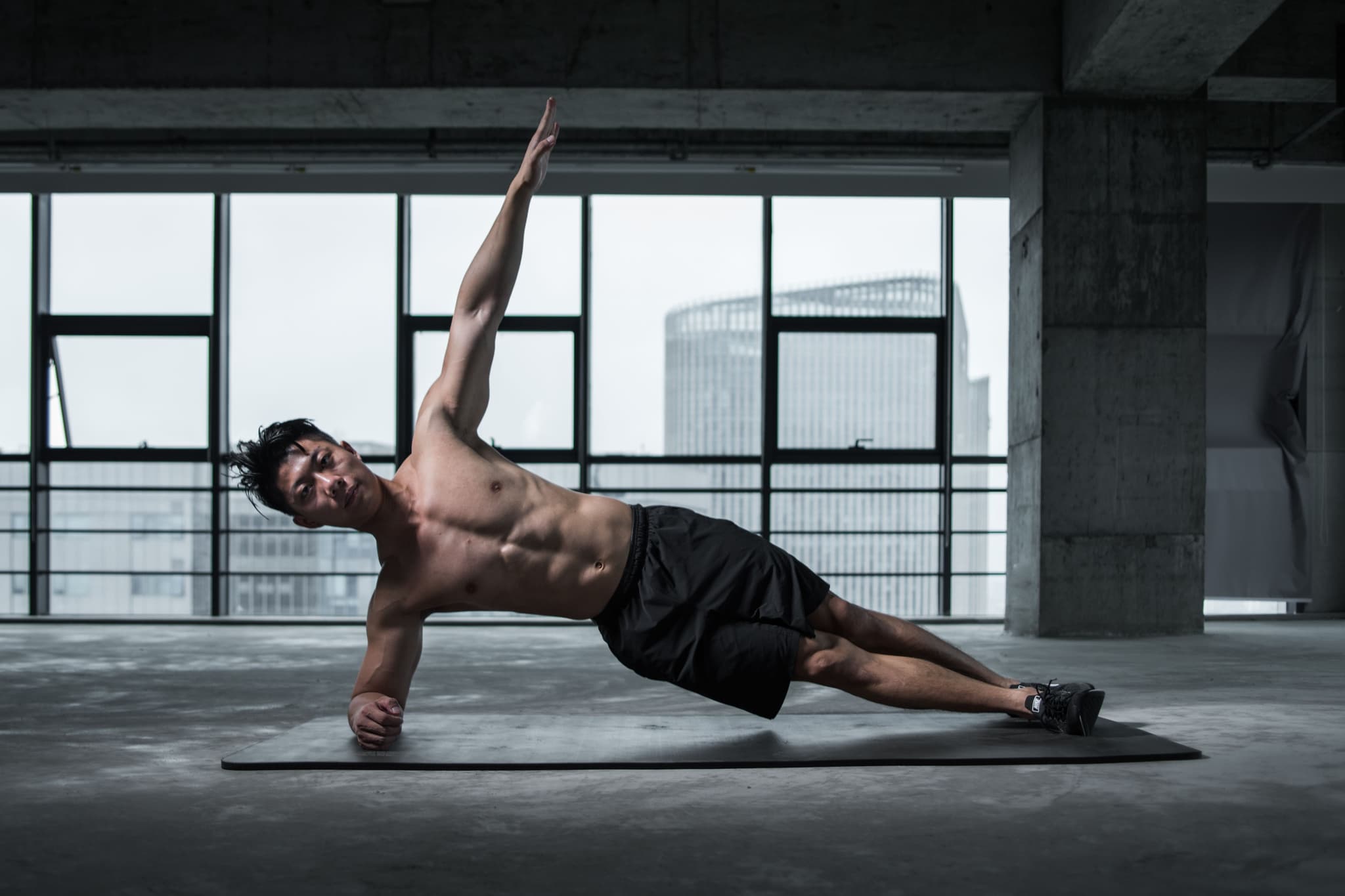
Prop your top foot on a bench, support your upper body on your forearm, and hold your hips level with your body in a straight line. This isolates the adductors under constant tension, a muscle group most lifters never train directly. Start with 15-second holds and build from there.
Weighted Front Lever Tuck Hold
Hang from a bar, pull your knees toward your chest, and lean back until your torso and thighs are roughly parallel to the floor. Add a weighted vest once bodyweight holds pass 20 seconds. Yielding isometrics typically provide about 50% greater pulling force than overcoming isometrics, which explains why this hold builds serious lat and core strength.
Programming determines whether these effective isometric holds actually add muscle or just burn 30 seconds of your session. The next section breaks down sets, load, and recovery.
How to Program Isometric Holds: Duration, Load, and Frequency
How long should you hold an isometric exercise? For strength work, 3 to 5 seconds per rep. For hypertrophy work, anywhere from 10 to 45 seconds per set, depending on the load and your training age. The right duration depends on the type of hold you're doing and what you want out of it. These timing windows are core to any effective isometric workout.
Overcoming Isometric Protocol for Strength
Set your rack pins at the joint angle you want to strengthen, load the bar to a weight you can't move, and push or pull with full intent. Overcoming isometrics involve pushing or pulling against an immovable object, such as rack pins, with the objective of reaching peak force output at a specific joint angle and holding it for 3 to 5 seconds.
Keep the volume low. Run 3 to 5 total sets of 1 rep per set, resting 1 to 3 minutes between sets depending on your level of strength and fitness. Focus on teaching your nervous system to fire hard at the joint angle that usually limits your lift, not on grinding through fatigue. This approach to isometric exercises for strength builds raw power without unnecessary metabolic stress.
Yielding Isometric Protocol for Hypertrophy
Yielding holds get trained for time, not for a fixed rep count. Westside Barbell programs 3 to 6 total sets for time, with each set lasting as long as you can hold good position under load before form breaks down.
Start conservative. A 20 to 30 second hold at a moderate load works well if you're new to isometric training. Breathe steadily instead of holding your breath. Bracing hard for 30 seconds or more without exhaling will spike your blood pressure and force you to cut the set short for the wrong reasons.
Progressing Over Time: Load, Angle, and Duration
You have three levers to pull: load, joint angle, and duration. Increase one at a time, not all three in the same week.
For overcoming holds, progress by adding weight to the pins while keeping the 3 to 5 second window fixed. For yielding holds, add time before you add load. A longer hold at your current weight builds the same tissue tolerance without risking a failed rep.
Don't ignore long muscle length positions when picking your angles. A 2023 hamstring study in the Journal of Strength and Conditioning Research found that low-intensity isometric training at long muscle lengths can induce hypertrophy and strengthening even when active torque production is lower than at short muscle lengths, though training at short muscle lengths may be more effective for building strength at that shorter length. That's a solid argument for training isometrics across a full range of joint angles, not just the one where you feel strongest.
Once you've settled on your angles and loads, the next question is how these holds fit alongside the squats, presses, and pulls you're already doing.
Are Isometric Exercises Good for Beginners or Injury Recovery?
Yes. Isometric exercises let you load a joint without the impact of a full range-of-motion lift, which makes them a solid entry point if you're new to resistance training or working around an injury.
The same overcoming and yielding logic applies here, just at lighter loads. Take an overcoming hold against a rack pin and scale it down to a gentle push, still aiming for peak tension at a specific angle, but without the near-maximal effort a competitive lifter would use. A yielding hold under a light resistance band or your own bodyweight teaches your joints to stabilize under load before you add real weight to the mix. Physical therapists use both versions to rebuild strength around cranky joints. You get tension without the shear stress of moving through a full rep, which matters if a joint can't handle that motion yet. Once that foundation holds steady, you can start layering in heavier concentric and eccentric work.
Isometric Exercise FAQ
Can isometric exercises help lower blood pressure?
Yes. Research on isometric handgrip and wall squat training shows real reductions in blood pressure. In one trial, mean systolic blood pressure dropped by 11.2 mmHg in the handgrip group and 12.9 mmHg in the squat group after 12 weeks of training, compared to a 0.4 mmHg change in controls. This article focuses on isometrics as a strength and muscle-building tool, so talk to your doctor if blood pressure management is your main goal.
What is the difference between isometric and isotonic exercise?
Isotonic exercise involves a muscle changing length while producing force. Think squats, bench presses, or bicep curls, where the joint moves through a range of motion. Isometric exercise keeps the joint angle fixed while the muscle contracts, whether you're pushing against something immovable or holding a loaded position still. Most training programs use a mix of both.
Do isometric exercises build muscle or just strength?
Both, depending on how you use them. Yielding isometrics, where you hold a joint angle against a load that can move, create enough mechanical tension and time under tension to drive hypertrophy on their own. Overcoming isometrics, where you push against a fixed object, mainly train your nervous system to produce more force and won't add much size by themselves. The best isometric exercises for strength and muscle gain match the hold type to your actual goal.
The Bottom Line
Isometric exercises deserve a spot in your program, but the payoff depends on how you load them. An overcoming hold against a fixed pin trains your nervous system to produce maximum force at a sticking point. A yielding hold under a load that can move builds the muscle to control that force over time. Confuse the two, or program them without a clear purpose, and you'll get flat results and blame the method instead of the setup.
You don't need to rebuild your entire routine this week. Pick one overcoming exercise, like a rack pull against pins, and one yielding exercise, like a paused goblet squat. Add them to a session you're already running. Pay attention to joint angle, hold time, and breathing as you go, and give it a few weeks before you judge the results. The best isometric exercises work because they match your goal—maximum force production or stability control—not because they're trendy or easy to program.